

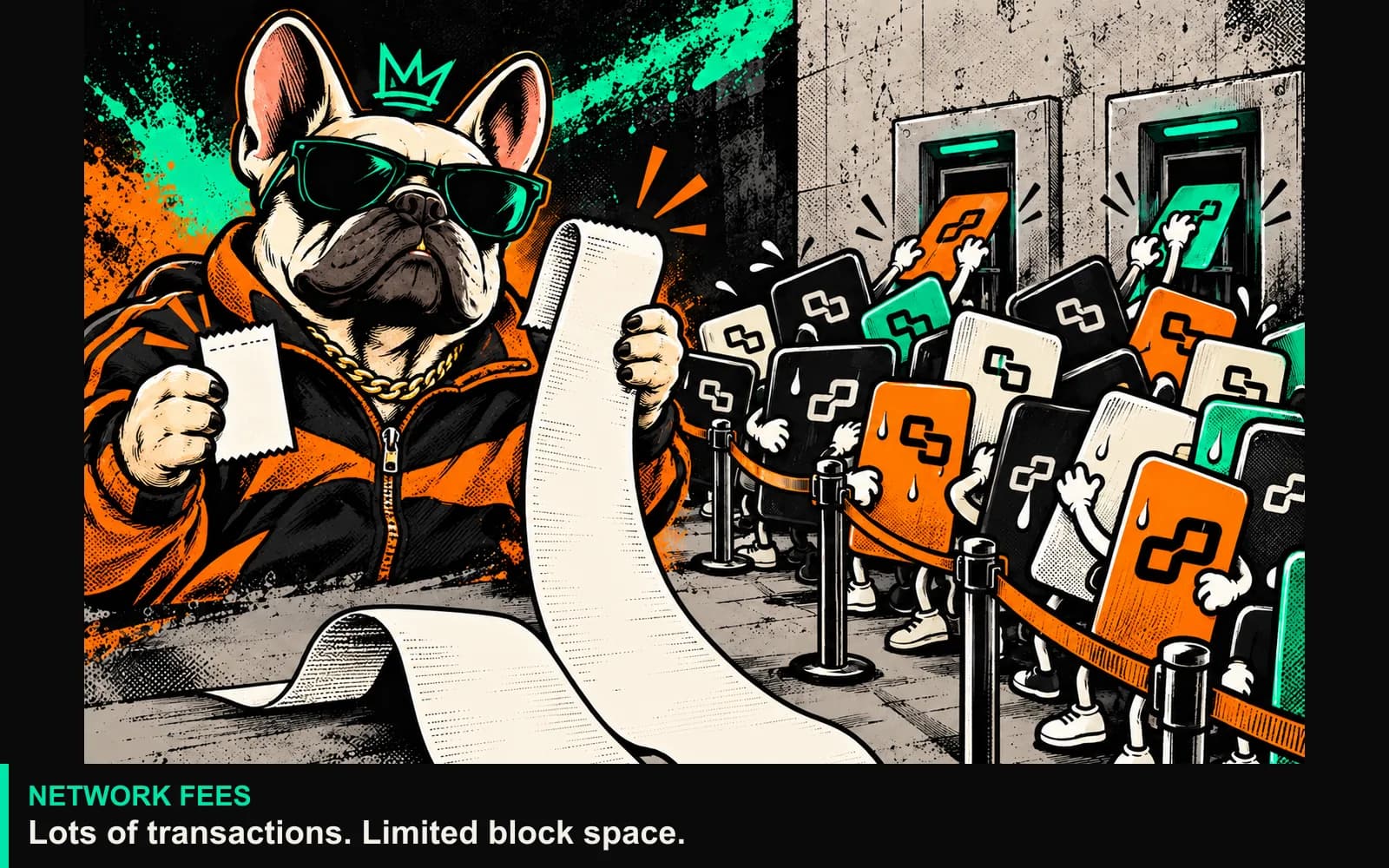
Think of a queue with limited workstations
A blockchain cannot process unlimited work in each block. Transactions compete for capacity. Fees help allocate that capacity and compensate participants according to the network’s rules.
On Ethereum, gas measures computational work. A transaction’s cost depends on gas used and the price per unit. The protocol’s base fee changes with demand and is burned; a priority fee can reward a validator for inclusion. A token transfer and a complex contract interaction can consume very different amounts of gas.
On Bitcoin, fees are commonly discussed in relation to transaction data weight. A transaction spending many inputs can be larger than one spending a single input, even if the value sent is lower.
Why a $10 transfer can cost more than a $1,000 transfer
Networks usually do not calculate fees as a percentage of the value. They charge for data, computation, or constrained capacity. A complex action with a small dollar value can therefore cost more than a simple high-value transfer.
A worked example
Assume an illustrative Ethereum action uses 50,000 gas. If the total per-unit price were 20 gwei, the fee would be 1,000,000 gwei, or 0.001 ETH. Converting that to a fiat amount requires a current ETH price, which this static example intentionally does not provide.
Before you approve
- Confirm which network will receive the transaction.
- Separate the network fee from any app or exchange fee.
- Check whether the wallet estimate can change before inclusion.
- Avoid repeatedly resubmitting without understanding nonce or replacement behavior.
Why can a failed transaction still cost money?
A network can spend computation checking and executing a transaction before the action fails. On Ethereum, that consumed gas is not automatically refunded merely because the intended state change did not finish. An app error shown before broadcast is different: if no transaction reaches the network, there may be no network fee.
Replacing a pending Ethereum transaction usually means broadcasting another transaction from the same account with the same nonce and a more competitive fee. Sending an unrelated transaction does not reliably cancel the first one. Wallet interfaces can simplify this flow, but the underlying ordering rule still matters.
Base layers and Layer 2 fees
A Layer 2 can show more than one cost component: execution on the Layer 2 plus the cost of publishing or settling data through a base layer. The interface may combine those numbers. Moving assets through a bridge is a separate action and can introduce additional fees, waiting periods, and contract risk.
Sources
- Ethereum.org: Gas and fees — accessed 13 September 2026.
- Bitcoin Developer Guide: Transaction fees and change — accessed 13 September 2026.
See something wrong? Brokzi logs material changes. Prepare a correction note.