

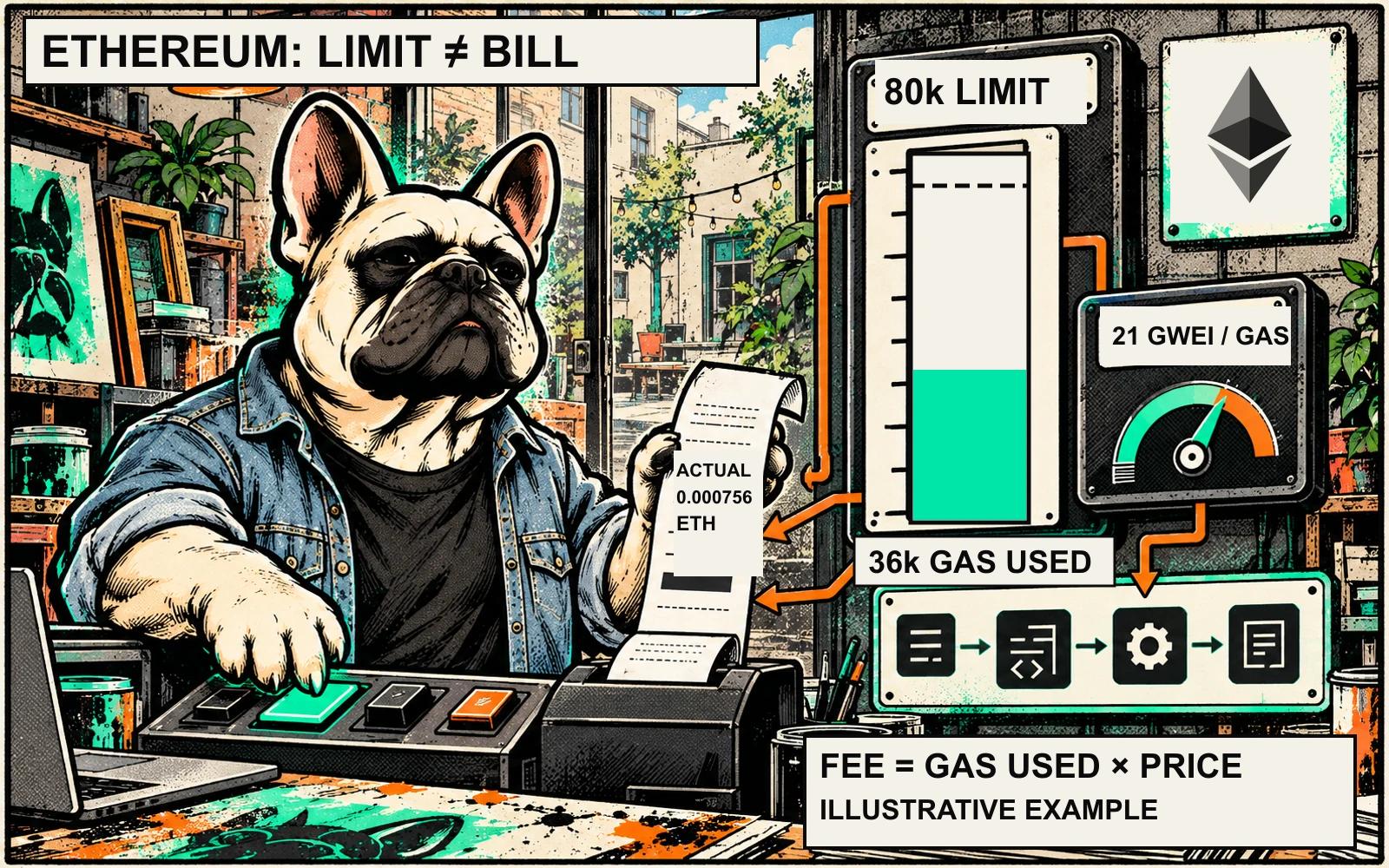
A wallet shows a maximum fee. The explorer later shows a smaller charge. Then there is a gas limit, which sounds like another price. None of those labels is especially helpful when you are trying to work out what left your account.
This is a read-the-receipt explainer for Ethereum gas limit vs gas price, with one fictional calculation carried all the way through. It covers ordinary EIP-1559 execution transactions on Ethereum mainnet, not a complete invoice for every Layer 2, blob transaction, bundled smart-account operation or exchange withdrawal. No wallet was connected and no transaction was sent.
Four fields, two different units
Gas measures work; it is not an amount of ETH. The unit price turns that work into a fee. Ethereum's gas documentation separates the work allowance from its price.
| Field | Unit | Read it as |
|---|---|---|
| Transaction gas limit | Gas units | The transaction's gas allowance, not a speed setting |
| Gas used | Gas units | The transaction's accounted gas usage in its receipt |
| Maximum fee per gas | ETH per gas, often displayed in gwei | The EIP-1559 unit-price cap |
| Effective gas price | ETH per gas, often displayed in gwei | The unit price actually charged |
The maximum priority fee per gas is a separate cap on the tip component. It is not a second gas allowance. Nor is the transaction gas limit the same field as the block gas limit, which constrains the block as a whole.
Our gas fee definition is the short reference. The task here is to turn those fields into a reconciled charge.
Work through a maximum fee and an actual fee
These figures are invented teaching inputs, not live gas prices, a fee recommendation or an estimate for a particular contract. One gwei is one-billionth of an ETH.
Suppose a transaction has:
- a gas limit of 80,000 gas;
- a maximum fee of 40 gwei per gas;
- a maximum priority fee of 3 gwei per gas.
Its execution-fee ceiling is:
80,000 × 40 = 3,200,000 gwei = 0.0032 ETH.
That is a ceiling for this fee component, not the amount of ETH being transferred. It does not predict the transaction's eventual gas usage.
Now suppose the transaction is included in a block with an 18-gwei base fee, and its receipt reports 36,000 gas used. The 40-gwei cap leaves room for the full 3-gwei tip. Its effective gas price is therefore 21 gwei per gas.
36,000 × 21 = 756,000 gwei = 0.000756 ETH.
The actual execution fee in this example is 0.000756 ETH, not 0.0032 ETH. The difference is 0.002444 ETH. That difference is unused fee headroom, not cashback earned from the network or a separate transfer you need to claim.
The example assumes the stated receipt values. A different execution path, block or transaction can produce different values; changing a ceiling does not prove the outcome would stay the same.
Why the maximum tip is not always the paid tip
EIP-1559 gives the base fee first call on the unit-price cap. For a transaction meeting the relevant validity conditions, the effective priority fee is the smaller of the maximum priority fee and the space remaining between the maximum fee and the block's base fee.
Change just the hypothetical maximum fee to 19 gwei, leaving the base fee at 18 and the maximum priority fee at 3. Only 1 gwei fits as the effective tip. The resulting effective price is 19 gwei, not 21. If gas used were still 36,000, the execution fee would be 684,000 gwei, or 0.000684 ETH.
A maximum fee of 17 gwei cannot cover that 18-gwei base fee, so it cannot meet that block's base-fee requirement. A bigger gas limit would not fix that price mismatch. Meeting the fee condition is not, by itself, a guarantee of inclusion.
Read the receipt, not a block-wide total
Ethereum's JSON-RPC receipt documentation names gasUsed for the individual transaction and effectiveGasPrice for its paid unit price. It also exposes cumulativeGasUsed, a cumulative figure within the block. Do not multiply that cumulative value by your transaction's price and call it your fee.
For this execution-fee calculation, the useful pair is:
individual transaction gas used × effective price per gas
Keep units consistent. A raw price in wei is not a price in gwei; converting the number without converting the unit can inflate the result dramatically. The same documentation describes hex-encoded quantities, so an RPC value is not necessarily a human-readable decimal amount.
Pending transactions do not yet have an included-transaction receipt. A wallet estimate is not a substitute for one. If the issue is a stuck transaction, use the pending Ethereum transaction guide rather than resending to make the numbers change. This article does not run an RPC call or test a wallet interface.
Unused allowance and a failed execution are different
Leaving gas allowance unused is not the same thing as refunding all the gas spent on an unsuccessful action. Work can still be charged when execution fails.
There are also different failure paths. EIP-140 defines REVERT, which can roll back execution changes without automatically consuming all the remaining gas. An out-of-gas exception is different. A failed subcall can also be handled by its caller; one error deep inside a contract is not automatically the status of the whole transaction.
Do not infer a full-limit charge from the word "failed", or a zero charge from the absence of the expected token transfer. Read the actual receipt and the relevant failure details. Rejection before inclusion is a different situation again.
Why a hand-counted work estimate can mislead
The receipt's gas usage is an accounting result, not simply a stopwatch counting visible actions. For example, EIP-7623 specifies a calldata-dependent floor in transaction gas accounting. A simple count of EVM execution steps does not necessarily reproduce that result.
This is why the worked example starts from a stated receipt value instead of pretending to simulate a contract. It also explains why "I changed only the gas limit" is not a reliable experiment: execution can depend on available gas and state. A higher allowance is not a promise of identical work, success or faster inclusion.
A quick fee-reading checklist
- Confirm the network and full transaction hash.
- Separate the transaction gas limit from gas used and from the block limit.
- Read the individual receipt, if inclusion is shown.
- Multiply gas used by the effective price using matching units.
- Keep transferred ETH, execution fees and any additional service or network-specific charges separate.
For the broader question of why different networks charge differently, see crypto network fees explained. You do not need to connect a wallet, sign a request or provide a recovery phrase to read public transaction data.
Brokzi's Take
The Ethereum gas limit is an allowance; the maximum fee per gas is a price ceiling. Neither is the final bill. Start with the receipt's usage and effective price, then check what that calculation does and does not include. Giving a task a bigger ceiling does not buy it a faster lane.
Sources
Primary documentation checked on 15 October 2026, Asia/Tbilisi. Calculations are fictional and independently recomputed, not observed transaction results.
- Ethereum.org: Gas and fees — gas units, limits and execution-fee context.
- EIP-1559 — unit-price caps, effective priority fee, base-fee validity and fee accounting.
- Ethereum.org: JSON-RPC API — individual and cumulative receipt fields, effective price and encoded units.
- EIP-140: REVERT — rollback and remaining-gas boundaries.
- EIP-7623: Increase calldata cost — calldata-dependent transaction accounting floor; not a live gas-price source.
See something wrong? Brokzi logs material changes. Prepare a correction note.