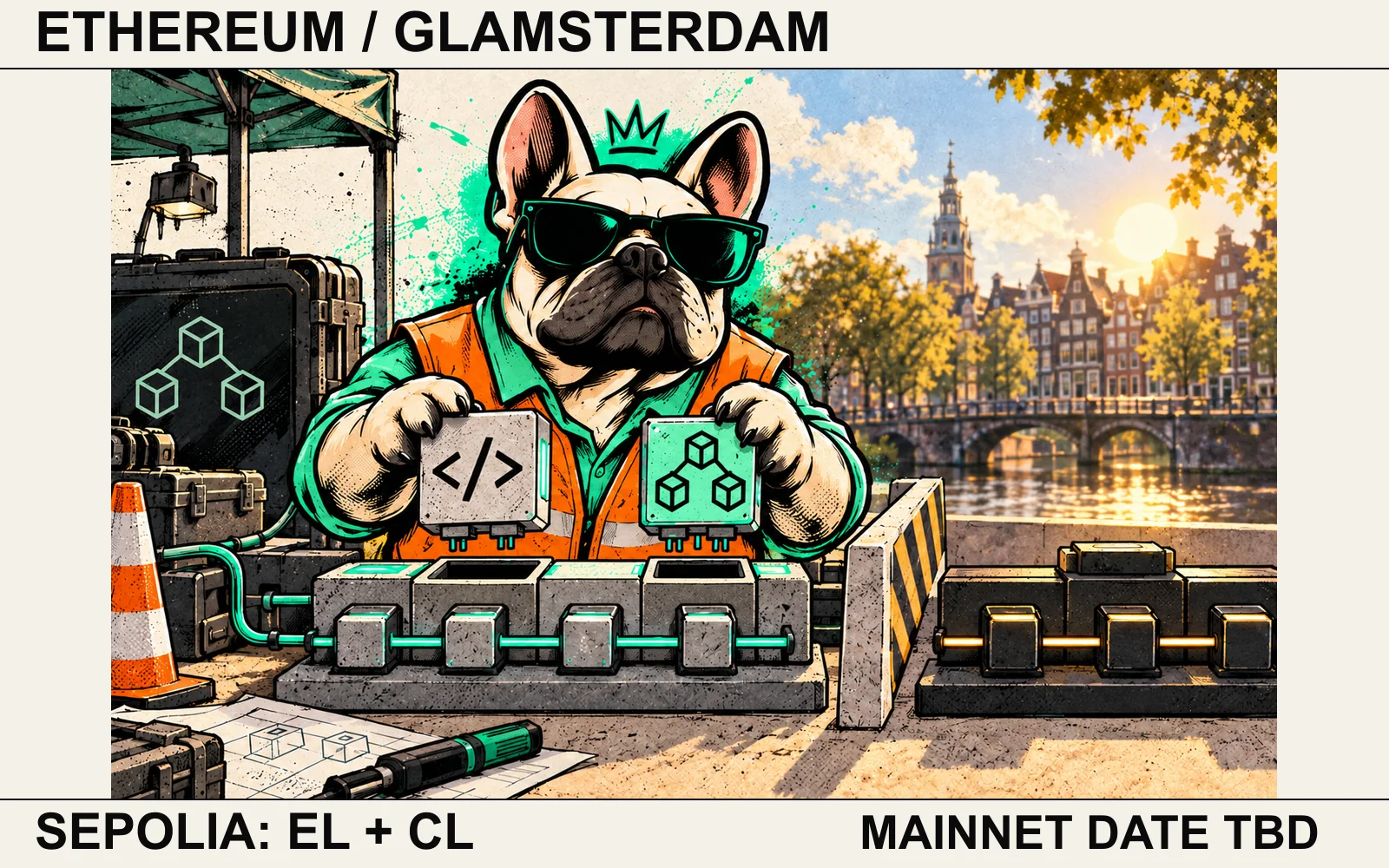
What happened
In its September 28 Glamsterdam announcement, the Ethereum Foundation schedules the Sepolia upgrade for October 6 at 13:53:36 UTC. It does not schedule an Ethereum Mainnet upgrade.
The distinction matters if you hold ETH rather than run a testnet node: the Foundation says Mainnet users and ETH holders do not need to do anything for this Sepolia announcement.
What is confirmed
The EIP-7773 activation table names Sepolia's planned epoch and timestamp, while Hoodi and Mainnet remain undecided. The merged schedule change records the same values.
| Network | Published schedule | What this establishes |
|---|---|---|
| Sepolia | October 6, 2026, 13:53:36 UTC | A scheduled testnet activation, not confirmation of its result |
| Hoodi | Undecided | No activation date in the checked schedule |
| Mainnet | Undecided | No Mainnet activation date in this announcement |
Sepolia's coordinates are epoch 353,024, slot 11,296,768 and Unix timestamp 1791294816. The time is 17:53:36 in Asia/Tbilisi, a timezone conversion rather than a second activation. The announcement's visible date is September 28; the September 17 text in its URL is not the publication date used here.
What changes are being tested
Glamsterdam combines Amsterdam on the execution layer with Gloas on the consensus layer. The Foundation identifies proposer-builder separation and block-level access lists as its headline changes. These concern block production and validation, rather than a new wallet token or a transfer of your funds.
The scheduled package also changes gas accounting. Developers need to test contracts and gas estimation, especially code that assumes a fixed gas allowance. It is not a promise that every transaction will become cheaper. Our network-fee explainer separates the work a transaction uses from the price attached to it.
Why it matters
Sepolia node operators need releases that support this scheduled fork on both the execution and consensus layers. Validator operators must also update the beacon node and validator client and review new duties. Use the official announcement's release links and the relevant full release notes; this report does not recommend a version from a table alone.
For application developers, the useful next step is testing the new rules on Sepolia after activation. For Mainnet wallet users, this testnet schedule creates no wallet-migration or move-funds instruction. See how Ethereum's network and programs fit together if those layers tend to blur together.
What remains unknown
The sources checked provide the planned Sepolia time, not an independently verified account of a completed activation. A schedule entry does not confirm successful activation. This report has not observed the chain's fork state or measured its performance.
Hoodi and Mainnet timing remains undecided in those sources. A successful testnet exercise would still not supply a Mainnet date, a universal fee reduction or an ETH price forecast.
Brokzi's Take
Read the network name before the upgrade headline. Sepolia preparation is a concrete job for operators and developers; a Mainnet wallet holder has a different question. Keep the rehearsal and the live network separate until their own announcements and results establish what changed. Follow Ethereum coverage for that context, rather than treating a calendar entry as a finished rollout.
Sources
- Ethereum Foundation: Glamsterdam Testnet Announcement, visibly published September 28, 2026; checked October 6, 2026. Schedule and operator/user distinctions, not post-activation evidence.
- EIP-7773: Hardfork Meta - Glamsterdam, current Review-status meta specification and activation table, checked October 6, 2026.
- Ethereum EIPs PR #12355: Set Sepolia activation time, merged September 17, 2026; schedule and epoch/slot/timestamp arithmetic checked October 6, 2026. A merged configuration change is not observation of the running chain.
See something wrong? Brokzi logs material changes. Prepare a correction note.