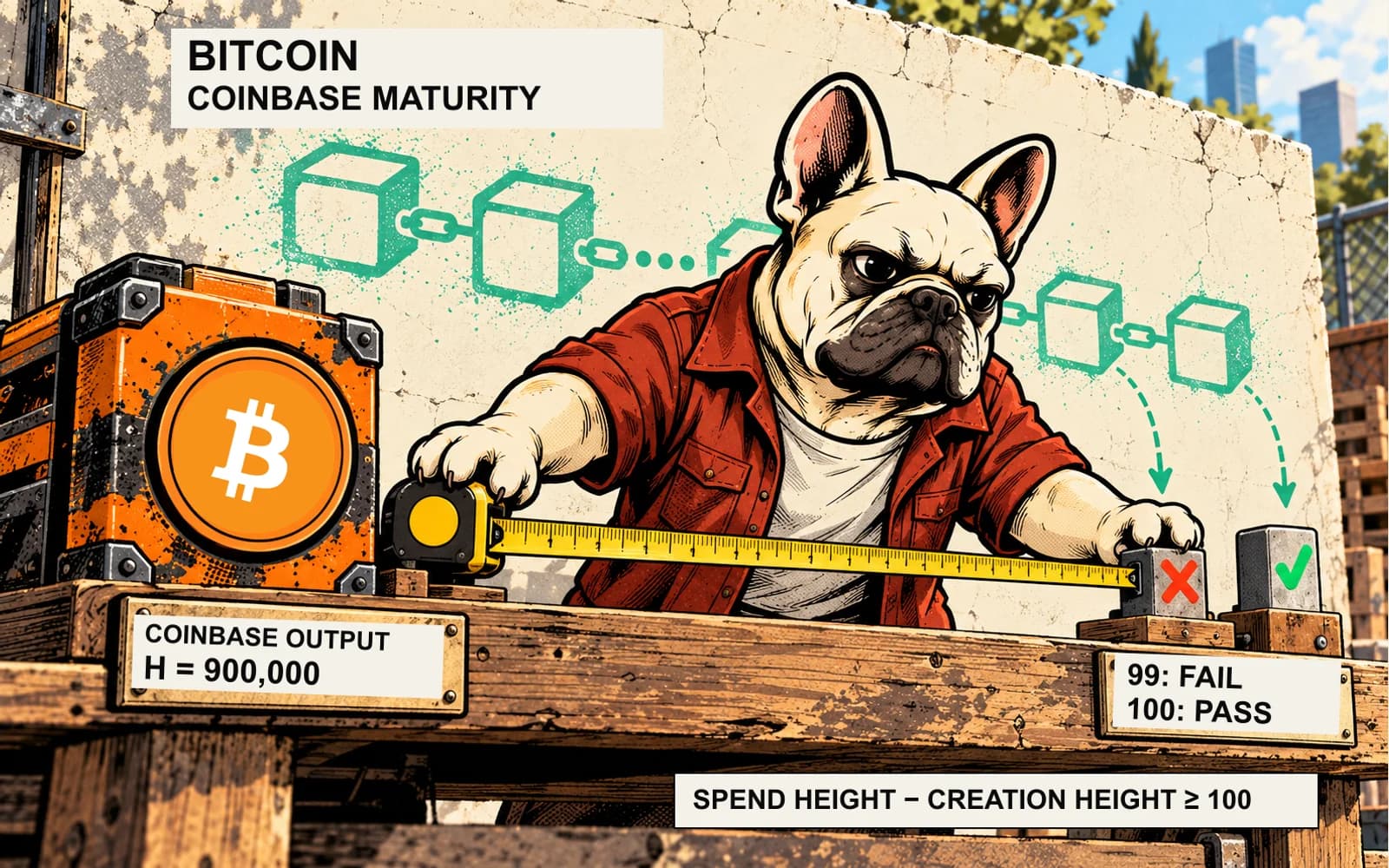
An explorer's confirmation counter and a wallet's available balance can describe different checks. Bitcoin coinbase maturity adds a rule that applies specifically to outputs created by a block's coinbase transaction: a proposed spending block must be at least 100 heights later than the block that created the output.
That is a block-height condition. It is not a 100-minute timer, a universal exchange deposit threshold or a promise that a miner will include a payment as soon as it becomes eligible.
This explainer follows current Bitcoin Core v32.1 source checked November 1, 2026. It separates the consensus comparison, a next-block mempool check and Core's own wallet reporting. The heights below are invented; no node, reward, wallet or transaction was tested.
Lowercase coinbase means a transaction, not the exchange
The Bitcoin Developer Guide describes the first transaction in a block as its coinbase, also called a generation transaction. It can collect the block subsidy and transaction fees. Its outputs have the special maturity condition.
The word refers to that Bitcoin transaction type. It does not mean that a payment came from, or went to, Coinbase the company. An ordinary exchange withdrawal does not become a coinbase transaction merely because the service has that name.
For the underlying output model, see Bitcoin UTXOs, inputs and outputs. Maturity is one additional condition on certain outputs, not a replacement for identifying which output a transaction spends.
The rule compares the spending block with the creation block
Core v32.1 defines COINBASE_MATURITY as 100. Its consensus input check rejects an input spending a coinbase output when:
spend height
  - creation height < 100
Equality therefore passes this maturity comparison. A gap of 99 fails; a gap of 100 passes. This does not establish that the whole transaction is valid. Its inputs must still be available, its spending conditions satisfied and the other applicable rules met.
Suppose an imaginary coinbase output was created at height 900,000 and remains unspent on the active chain. Assume the example's other spending conditions are satisfied.
| Candidate spending-block height | Height difference | Maturity check |
|---|---|---|
| 900,099 | 900,099 − 900,000 = 99 | Fails |
| 900,100 | 900,100 − 900,000 = 100 | Passes |
| 900,101 | 900,101 − 900,000 = 101 | Passes |
The earliest candidate height that passes this particular test is 900,100. These are alternative candidate checks, not payments we broadcast or blocks we observed. The table does not promise that a spend is actually included at that height.
The containing block already counts as one confirmation
For a transaction still included in the active chain, the usual depth calculation includes its containing block:
confirmations =
  tip - containing height + 1
Core's wallet depth calculation uses that relationship. With the same fictional containing height 900,000, a tip of 900,099 gives 100 confirmations: 900,099 − 900,000 + 1 = 100.
That counter refers to the existing chain tip. The maturity comparison refers to the block in which the output would be spent. They need not be the same height. Mixing them is how a compact phrase such as "wait 100 blocks" turns into an off-by-one argument.
Brokzi's confirmation explainer covers the broader inclusion, reorganisation and account-credit questions. This article addresses the extra coinbase-output condition.
A next-block check can pass before that block exists
Core v32.1's mempool admission code passes the active chain height plus one to the consensus input check. It evaluates transactions for a possible next block.
At a tip of 900,098 in our example, that candidate is 900,099, so the maturity difference is 99 and the check fails. At a tip of 900,099, the candidate is 900,100; the difference reaches 100 and this check passes.
This is eligibility testing, not an extra confirmation credited in advance. Other admission checks and policy still apply. A local mempool is not a reservation of future block space, and passing one rule does not make the proposed next block exist.
Why Core's wallet can still say immature at 100 confirmations
The wallet reports its own maturity state using a separate calculation. In the pinned wallet.cpp, GetTxBlocksToMaturity returns the larger of zero and:
101 - current confirmation depth
IsTxImmatureCoinBase remains true while that result is positive. Core's wallet RPC reporting consequently describes coinbase entries with 100 or fewer confirmations as immature, and those with more than 100 as generate when included in the active chain.
Assume the wallet has processed the same active tip as the node, without a lagging or reorganised view:
| Active tip in the example | Coinbase confirmations | Core wallet blocks to maturity |
|---|---|---|
| 900,098 | 99 | 101 − 99 = 2 |
| 900,099 | 100 | 101 − 100 = 1 |
| 900,100 | 101 | 101 − 101 = 0 |
At tip 900,099, the next-block consensus check can pass for candidate 900,100 while this wallet calculation still returns 1. The two source checks are using different contexts. A wallet's current category and eligibility for a proposed next block are not interchangeable evidence.
These labels are scoped to the checked Core implementation. They are not a promise about every wallet, explorer or exchange interface, or instructions to construct a transaction around a wallet restriction.
An ordinary payment does not inherit a fresh 100-block wait
The consensus condition checks whether the particular output being spent is coinbase. It is not a permanent label applied to every later output descended from a block reward.
If a valid ordinary transaction spends a mature coinbase output, that transaction's newly created outputs are ordinary outputs. They do not receive another coinbase-maturity requirement merely because of their ancestry. Their own script conditions, any applicable timelocks and other rules still matter.
Nor should an ordinary received payment be described as requiring 100 confirmations under this coinbase rule. That says nothing about a recipient's acceptance threshold or the risk of an unconfirmed payment. Our Bitcoin locktime guide explains separate height and time conditions that a transaction or script can impose.
Maturity is not account credit or irreversible settlement
An exchange's internal deposit credit is a service record. Its own confirmation requirement does not rewrite Bitcoin's consensus test, and a consensus-eligible output does not prove an exchange has credited a customer's account. Read the actual service's current asset, network and account instructions separately. No provider-specific threshold or crediting deadline is asserted here.
The chain view can also change. The Developer Guide explains that a reward from a block displaced by a competing branch can lose its basis in the active chain. The maturity restriction temporarily limits early spending of such rewards; it does not make reorganisations impossible after any particular count.
Because the rule uses block heights, elapsed wall-clock time alone cannot prove that the threshold was reached. A larger fee cannot make a failing height comparison pass, and a passing comparison does not guarantee selection or account availability.
Keep four observations separate: which output is coinbase, the proposed spending height, the observed confirmation depth and the wallet or service's own status. The 100-height consensus gap, Core's 101-confirmation wallet boundary and an exchange's crediting policy are different rules to read, not rival answers to one counter.
Sources
Primary source and documentation checked November 1, 2026. The official repository's latest stable release at preparation was v32.1; the article's implementation claims are pinned to that version. The Developer Guide supplies the coinbase and fork context; exact boundaries follow Core source.
All heights and output circumstances are hypothetical. No live chain height, coinbase output, node, wallet, RPC, mining, signature, broadcast or exchange account was tested. Passing maturity is not proof of full transaction validity, inclusion, account credit or risk-free settlement. This is protocol education, not mining or investment advice.
- Bitcoin Core v32.1: consensus maturity constant.
- Bitcoin Core v32.1: consensus input and coinbase-spend checks.
- Bitcoin Core v32.1: next-block mempool validation.
- Bitcoin Core v32.1: wallet confirmation depth and blocks to maturity.
- Bitcoin Core v32.1: wallet transaction categories.
- Bitcoin Developer Guide: coinbase transactions and chain forks.
See something wrong? Brokzi logs material changes. Prepare a correction note.