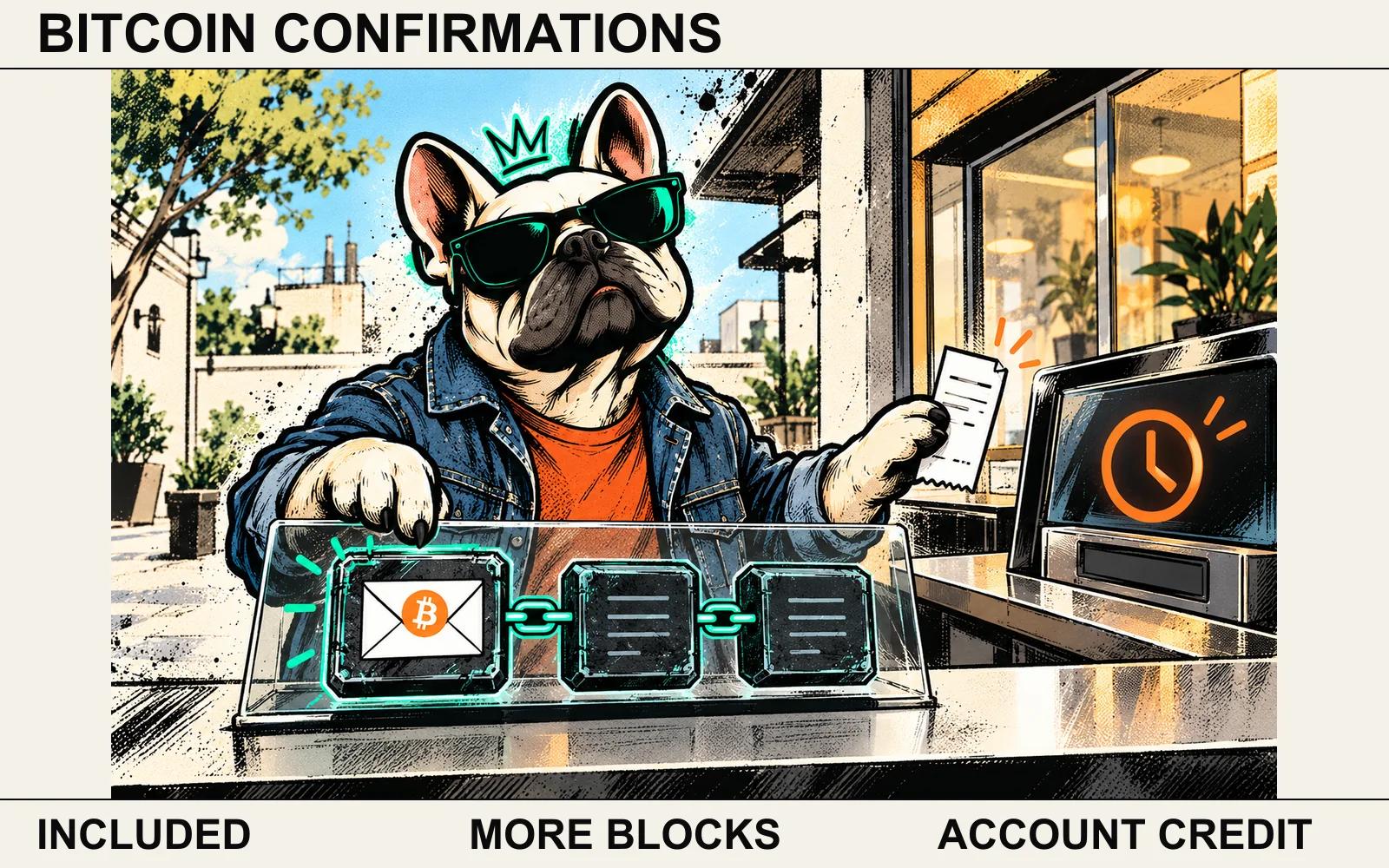
The explorer shows confirmations. The exchange balance still shows nothing. Those screens can be reporting different stages. A counter is not a delivery appointment.
A Bitcoin confirmation count describes a transaction's place in a node's active chain. Account credit is the receiving service's separate decision. Understanding the difference helps you investigate a pending deposit without sending a second payment to chase the first.
First inclusion counts as one confirmation
Broadcasting shares a transaction with the network. It does not establish that a miner has included it in a block or that the recipient's account has been credited. The Bitcoin payment-processing guide separates broadcasting from confirmed payment acceptance.
For a transaction included in the active chain's latest block, the count is one. A new block extending that chain makes it two, then another makes it three. The containing block counts too: six confirmations means that block plus five later blocks, not six extra blocks after it.
Here is a fictional height example, not a current transaction or deposit requirement. Our transaction first appears at height 100 and remains in the same active chain.
| Active tip height | Transaction's containing height | Confirmations |
|---|---|---|
| 100 | 100 | 1 |
| 101 | 100 | 2 |
| 102 | 100 | 3 |
| 105 | 100 | 6 |
For that included transaction, tip height − containing height + 1 gives the count. At tip 102, 102 − 100 + 1 = 3. This arithmetic requires the containing block to belong to that active chain; two unrelated blocks with matching height numbers do not establish inclusion.
The chain is valid work, not just the longest-looking line
Bitcoin nodes check consensus rules, rather than accepting every proposed block. When valid branches compete, accumulated proof of work determines the active chain. The block-chain developer guide explains valid forks and how nodes can change branches. More boxes in a diagram is not a substitute for validating their rules and work.
Bitcoin Core's 30.0 RPC reference describes its reported block height as the height of the most-work fully validated chain. That is a documented node view, not proof that an arbitrary explorer is synchronized or using the network you intended. This guide does not run a node or audit an explorer.
A reorganization can change the count
A chain reorganization replaces part of a node's active branch with another valid branch with more accumulated work. A transaction's old containing block may no longer be active. That is why a confirmation counter is chain state, not a permanent receipt stamped by a single operator.
The transaction might also appear on the new branch, at a different depth. If it does not, its previous confirmation count no longer describes an active-chain inclusion. Reinclusion is not guaranteed: transaction validity, conflicting spends and later block selection matter. A lower or disappearing count does not by itself identify an attack or prove the funds have been recovered.
For a concrete implementation boundary, Bitcoin Core's 30.0 getblock reference documents a block's confirmations as -1 when that block is not on the main chain. That is this RPC's block field, not a promise that every wallet or explorer displays a negative transaction count. Compare the block hash, active-chain status and observation time, not a screenshot's number alone.
Ten minutes is an average, not an appointment
Bitcoin.org's confirmation guidance explains that block discovery is probabilistic. Blocks arrive approximately every ten minutes on average; an individual interval can be shorter or much longer. The first inclusion also depends on which transactions miners select. Waiting ten minutes is not evidence of one confirmation.
Multiply an average interval by a count and you still do not get a guaranteed arrival time. A transaction can wait before its first inclusion, and later block intervals can vary. A higher fee does not create a scheduled block or override a receiving service's internal processing. The network-fee guide explains why limited block space affects transaction selection.
Six confirmations is not every recipient's rule
The historical Bitcoin developer guidance discusses six confirmations as a convention for high-value payment acceptance. It is not a Bitcoin protocol instruction that every exchange must credit every deposit at six, or a universal risk-free threshold. Its dated mining and software examples are not current measurements.
Additional work above a transaction increases the work needed to replace its history under Bitcoin's security assumptions. That is probabilistic settlement, not an absolute promise that any count makes reversal mathematically impossible. A recipient chooses its acceptance policy according to its risks and operations. Do not borrow a threshold from another asset, network or service.
Use the receiving service's current deposit instructions for your actual account, asset and network. Its confirmation requirement is an acceptance rule, not a network deadline or a promise that a product is available in your country. This article does not publish a universal exchange-count table.
Exchange credit is a separate ledger step
Suppose a fictional receiving service requires three confirmations for a particular onchain deposit. At tip 102 in our example, the chain count reaches three. That satisfies the example's count condition, not every possible condition for crediting an account. This is not a current Kraken or Coinbase requirement.
An explorer establishes no link by itself between the output address and your exchange account. Read the actual deposit details in the service you intended to use. Correct asset and network support, the intended destination, minimum deposit rules and any account-specific processing conditions need their own checks.
| What you observe | What it establishes | What still needs checking |
|---|---|---|
| Transaction ID exists | An identifier is available | Broadcast visibility and active-chain inclusion |
| Included with confirmations | Depth on the observed active chain | Correct output, receiving rules and internal credit |
| Account shows a credited balance | A service records a balance under its rules | Whether trading and withdrawal are both available |
| Account shows a hold | The service has a processing restriction | The service's stated reason and official support route |
Kraken's deposit-status guide distinguishes Pending/Processing, Credited, Successful and On hold. Where Credited applies, its documentation separates trading availability from withdrawal availability; it says not every asset uses that intermediate status. Do not apply those labels mechanically to every Bitcoin deposit or another exchange's interface.
Coinbase's pending crypto transaction guide concerns its primary balance. It tells users to check the sender's transaction hash, confirmation status and supported network when a deposit has not arrived, and warns that regional support can differ. It is not a bank-deposit, universal Bitcoin, or guaranteed recovery policy.
Investigate the stage, not the spinner
Keep the transaction ID, intended network, containing block and current confirmation observation together. Check the destination output against the service's own deposit instructions, rather than assuming the first address on an explorer is the intended recipient. A Bitcoin transaction can have multiple outputs; Bitcoin explained gives the underlying spend model.
If there is no active-chain inclusion, investigate with the sender's official tools. If the chain count meets the receiving service's documented requirement but credit is still missing, examine its deposit status and support instructions. Another payment does not repair the first transaction's account mapping or clear a hold. Never disclose a recovery phrase or private key to someone offering to “synchronize” a deposit.
Onchain Bitcoin, Lightning and wrapped Bitcoin on another chain are different routes. Use the route actually selected, not a familiar BTC ticker. No wallet connection, replacement transaction, support account login or transfer is required to read this guide. Start with wallets explained and the public-address definition if custody or destinations are unclear.
Sources
Primary documentation checked 11 October 2026. Heights and the three-confirmation recipient rule are fictional examples; no real transaction, account credit, confirmation-delay measurement or country-specific service availability was tested. Bitcoin Core references are explicitly version 30.0, not an assertion about every explorer's software. Historical guidance is used for the mechanism and convention, not current mining statistics. Provider examples are attributed, not endorsements or recovery guarantees.
- Bitcoin developer guide: Block chain — valid branches, proof of work and changing chain history.
- Bitcoin developer guide: Payment processing — inclusion and the historical acceptance convention.
- Bitcoin.org: You need to know — variable confirmation timing and confirmation depth.
- Bitcoin Core 30.0: getblock — block confirmation field and off-main-chain value.
- Bitcoin Core 30.0: getblockchaininfo — most-work fully validated chain and network context.
- Kraken: Deposit statuses — internal status and trading/withdrawal distinctions.
- Coinbase: Pending crypto transactions — primary-balance deposit investigation and network/region limits.
See something wrong? Brokzi logs material changes. Prepare a correction note.