

A Bitcoin wallet can restore the right keys and still miss a payment in its history. The app has to work out which addresses to check. Under BIP44, once the scan finds 20 consecutive receiving addresses with no transaction history, it stops looking along that address sequence. A payment at position 21 can be beyond the last address the scan checks.
What the Bitcoin address gap limit measures
A deterministic wallet can recreate the same sequence of addresses from the same wallet setup. Its gap limit gives it a finite place to stop looking for history. BIP44 applies this rule to the external chain, the branch used to receive payments. It specifies 20 unused addresses in a row. An address with past transactions still counts as used if its current balance is zero.
One address row, one stopping point
Imagine Mina’s wallet prepared a batch of receiving addresses. We number the positions from zero, as BIP44 does. These are positions in a sequence, so there are no real Bitcoin addresses in the example.
| Receiving position | What happened on-chain | What the restore finds |
|---|---|---|
| 0 | Received a payment, later spent in full. | The scan sees transaction history and keeps going. |
| 1–19 | No transactions. | The run of unused positions reaches 19. |
| 20 | No transactions. | The run reaches 20. The scan stops after checking this address. |
| 21 | Received a confirmed payment. | The scan never gets here. The payment remains in Bitcoin’s records. |
If position 20 had a qualifying transaction instead, the run would end at 19 unused addresses and the scan would go on to check 21. In the original example, the restore stopped one address early from Mina’s point of view. From the software’s point of view, it reached the end of its search window.
Does Electrum use the same rule?
Electrum’s FAQ explains the same broad idea and describes a default of 20 in Electrum 2.0. For this guide, we checked Electrum 4.8.4, listed on Electrum’s official site. In its deterministic wallet code, receiving addresses default to a gap of 20. Change addresses have their own default of 10. Both settings can come from the wallet database.
That version also extends its address window based on sufficiently confirmed history. Its address synchronizer defaults to three confirmations for that test. Assume Mina’s earlier transaction at position 0 is well confirmed. A fresh deterministic Electrum restore with the defaults and the same pattern on its receiving branch can stop short of position 21 as well. The shared default describes the receiving window. It does not identify the seed format or derivation path, and a wallet file that already contains more addresses can behave differently.
What can you check without moving funds?
Start with a full receiving address you saved earlier, or the recipient output from a known transaction. If the original wallet still opens, compare that public address in the original and restored wallets. Check that the restored wallet has finished syncing. A known transaction can confirm that an address received a payment, while a match inside the wallet helps establish that you are looking at the same address sequence.
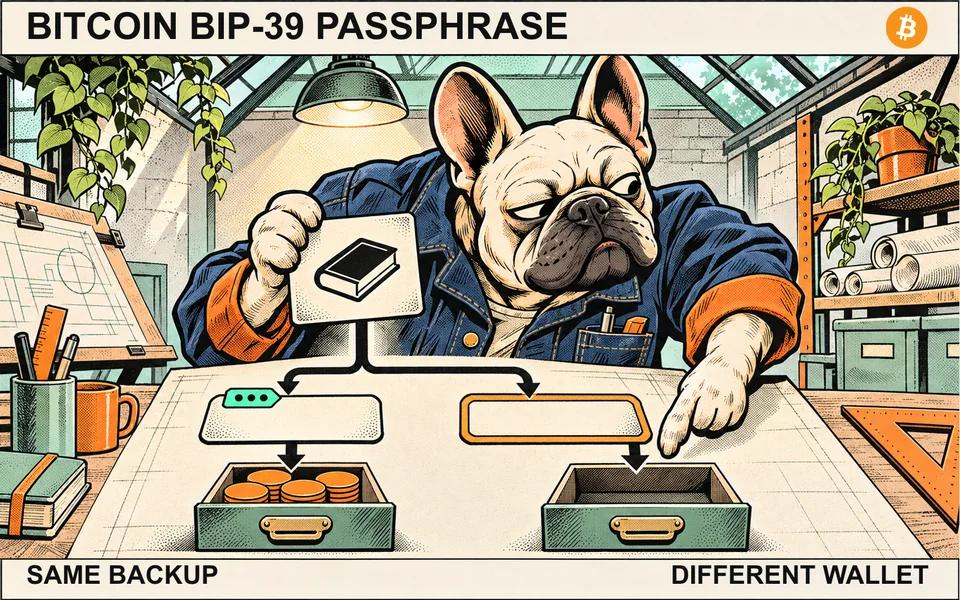
If the early addresses match but a later one is missing, check how your wallet handles address discovery and whether it supports looking farther along the same branch. If even the early addresses differ, review the original wallet type, account and backup settings first. For BIP39 wallets that used an optional passphrase, see why a different passphrase opens a different wallet.
Looking farther can reveal history for an address that the wallet already knows how to derive. Spending still requires the right signer. You can do the comparison with public information and keep recovery words, passphrases and private keys out of websites and support chats. See how wallets separate keys from transaction records.
Sources
- BIP44: account discovery and address gap limit — checked 15 November 2026.
- Electrum FAQ: gap limit and pre-generated addresses — checked 15 November 2026.
- Electrum: current download version — checked 15 November 2026.
- Electrum 4.8.4: deterministic wallet defaults and address synchronisation — checked 15 November 2026.
- Electrum 4.8.4: confirmation test used for extending the window — checked 15 November 2026.
See something wrong? Brokzi logs material changes. Prepare a correction note.