An ERC-4337 UserOperation is a request for a smart account to act. It is not an ordinary Ethereum transaction waiting under a different name. A bundler collects operations and submits a transaction that calls an EntryPoint contract. Account validation, execution and fee accounting happen through that route.
That distinction helps when an app shows an operation as accepted, sponsored or pending. Each label concerns a stage or condition. None establishes that the requested action has completed or that network gas disappeared.
This explainer follows the complete current ERC-4337 specification, checked November 3, 2026. It describes the standard's mechanism, not a deployed wallet, EntryPoint version or service we tested. No wallet, signature, RPC or transaction was used.
Follow the request and the transaction separately
The standard introduces a higher-level object instead of changing Ethereum's consensus transaction format. The wallet prepares operation data for its account. A bundler checks operations and can package them into a call to handleOps on a supported EntryPoint.
| Role | Job in this route | What the role does not establish |
|---|---|---|
| Smart account, the operation's sender | Checks authorization and performs the requested account action | Every smart account has the same policy or supported features |
| Bundler | Validates candidate operations and submits a bundle transaction | A received request is already included or executed |
| EntryPoint | Coordinates validation, execution and fee accounting | The intended application or account code is safe |
| Optional paymaster | Accepts specified gas-payment obligations | Every user, chain or action qualifies for free service |
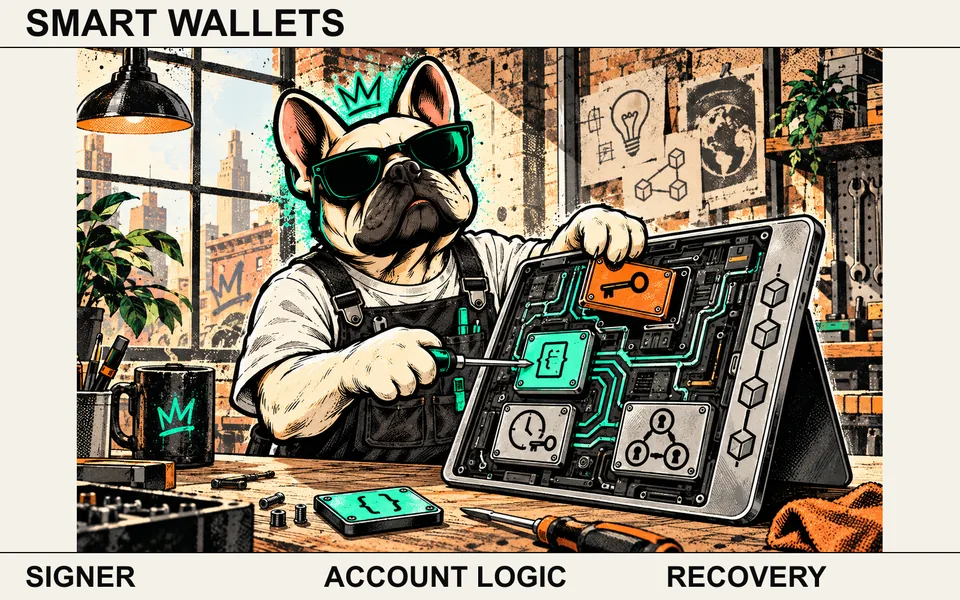
The smart-wallet overview covers recovery, modules and account control. Those account policies remain relevant here; a bundler does not replace them.
What travels in a UserOperation?
The specification's operation fields identify the sender, nonce, execution data, gas limits, fee caps, authorization evidence and any factory or paymaster data. The callData is passed to the account. Its interpretation depends on that account's execution logic; it is not necessarily a direct call to a destination the reader recognizes.
The published specification distinguishes the expanded operation representation from PackedUserOperation, which is passed onchain to EntryPoint, accounts and paymasters. In the packed form, some values share fixed-size fields: accountGasLimits combines verification and call gas limits, while gasFees combines the priority-fee and maximum-fee values. Factory information is represented through initCode; paymaster information through paymasterAndData.
This is why copying field names from one representation into another is not a complete transaction recipe. This article supplies no payload or signing code. Read the actual account, EntryPoint and interface version used by an application before interpreting its request.
Three fictional operations can travel in one bundle
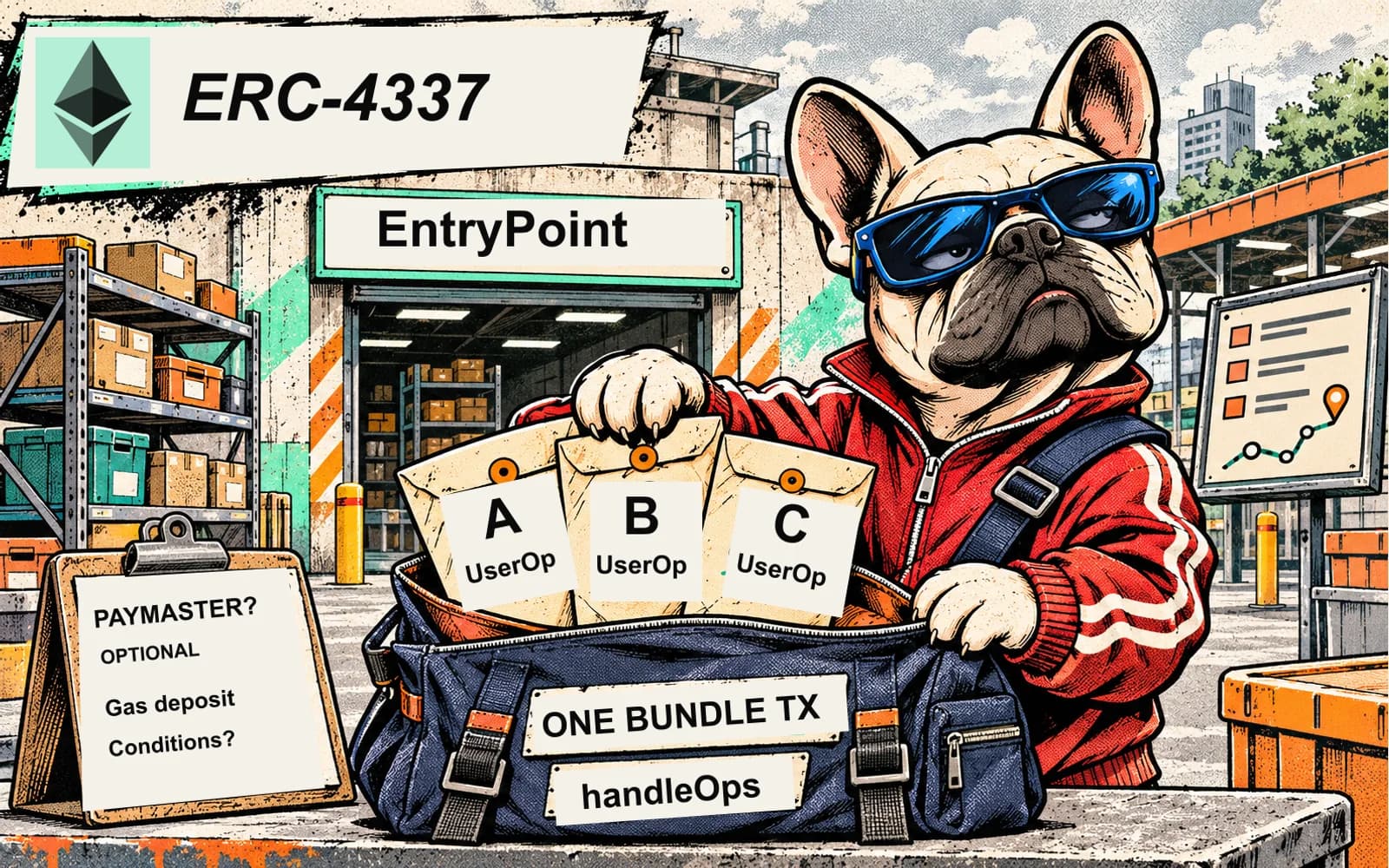
Imagine requests A, B and C from three different fictional sender accounts. Suppose each satisfies the applicable checks, and a bundler chooses to include all three in one handleOps transaction. The three requests remain distinct operations inside that transaction. They do not become three ordinary transactions sent directly by those accounts.
This is a routing illustration, not a prediction about bundle size, inclusion time or supported throughput. The standard places restrictions on combining operations; an arbitrary collection is not necessarily valid. In particular, its ordinary bundling rules restrict multiple operations from the same sender, with a stated exception for staked senders.
Keep the identifiers and stages apart too. An operation hash identifies the operation context. The enclosing transaction has its own transaction hash. The specification requires operation signatures to depend on the chain ID and EntryPoint address, so the account and network context belong in the record too. A bundler's initial acceptance is not evidence that its later bundle has reached a block. Do not substitute a saved operation identifier for a confirmed record of the requested action.
Validation and execution answer different questions
The EntryPoint flow separates verification from execution. It checks the account's authorization and required funding before the main execution call. The account's validateUserOp must accept a trusted EntryPoint caller and verify the operation's authorization under its own rules.
The current specification also describes offchain validation and bundle simulation by the bundler. Operation validation can depend on contract state. A request that passed an earlier check may no longer satisfy the relevant conditions when bundled or included. Simulation is a check in a particular context, not a reservation of future chain state.
Execution is the account carrying out the call data. Passing validation does not establish that every intended application action succeeds. The paymaster interface explicitly distinguishes a successful operation from a reverted operation while retaining gas-payment obligations. Read the operation's result rather than treating a sponsor or acceptance badge as an execution receipt.
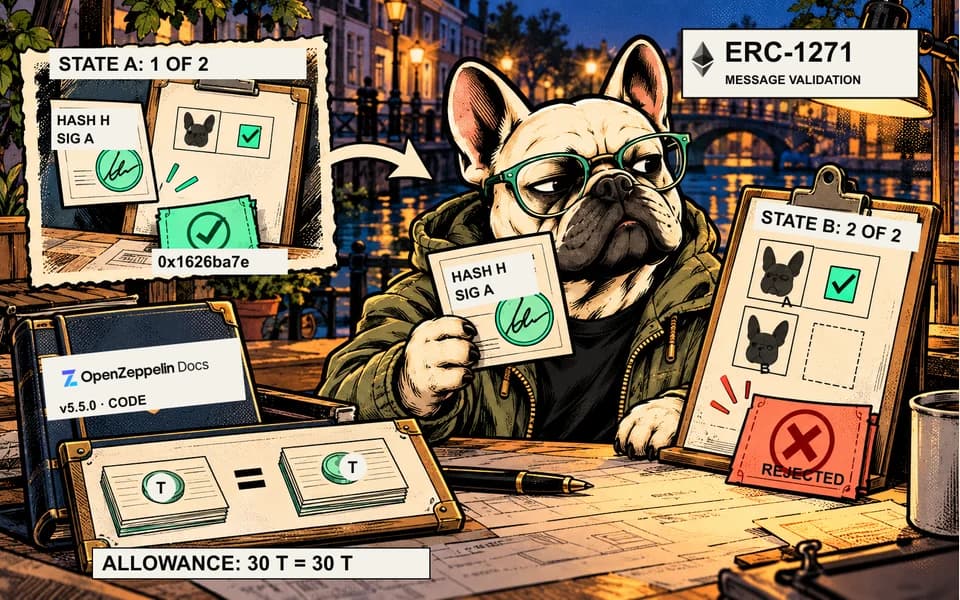
For a separate signature-validity interface, see ERC-1271. It answers a contract-signature question; it does not stand in for this entire operation-processing route.
Sponsored gas still has funding and conditions
A bundler submits the enclosing blockchain transaction, which still incurs network gas costs. EntryPoint accounts for operation costs and pays collected fees to the specified beneficiary. The funding for an operation can come from the sender's deposit or, on the paymaster route, from the paymaster's deposit with EntryPoint.
For a paymaster-backed operation, EntryPoint checks that the paymaster has sufficient deposited funds and asks it to validate its willingness to pay. The account's validation is still required. Sponsorship is not a way to bypass the account's authorization rules.
The specification distinguishes the gas-paying deposit from a locked stake used in the system's validation and reputation arrangements. These are not interchangeable balances. Nor does a paymaster's presence explain its commercial terms: a sponsor may subsidize a request or arrange payment in a token. The network cost is still funded, and the user may face separate terms or charges.
The standard's post-operation interface notes that a paymaster still pays gas when an operation reverts. That is a funding obligation, not a refund promise to a user. Which requests are eligible and how a service prices or withdraws sponsorship need provider-specific evidence. This article makes no availability or fee-quote claim. The network-fee explainer covers the underlying gas-cost distinction.
ERC-4337 is not a universal wallet feature list
The current specification includes support for EIP-7702 authorizations on networks where that mechanism is enabled. Such authorization data can accompany an operation and affects the relevant bundling and hashing rules. It is not evidence that every chain, account, bundler or wallet implements the same route.
The standard also describes signature and domain requirements, nonce handling, factories and optional aggregation. Those mechanisms do not certify a particular deployment. Recovery, spending limits and upgrades depend on actual account code. The EIP-712 explainer separates typed-data identity from the application's own action and replay rules.
When reading an operation status, identify the network, sender account, supported EntryPoint, bundler and any paymaster. Then distinguish receipt by the bundler, validation, inclusion of a bundle and the actual requested action. Keep the gas-funding explanation beside the execution result. An easier wallet experience should make those stages clearer.
Sources
The complete official ERC-4337 specification was captured and read November 2, 2026, then rechecked in full on November 3, 2026 with no source changes. This is an international protocol explanation, not an audit, fee offer or claim about current wallet support. A, B and C are invented requests from different fictional accounts; no real operation hash, transaction identifier, signature, gas estimate, wallet, RPC, contract or account was produced or tested. The illustration is a fictional mechanism diagram, not a transaction record.
- ERC-4337: Account Abstraction Using Alt Mempool — operation representations, EntryPoint/account validation, bundler checks, paymasters, deposits and stake, simulation, execution and EIP-7702 context.
See something wrong? Brokzi logs material changes. Prepare a correction note.