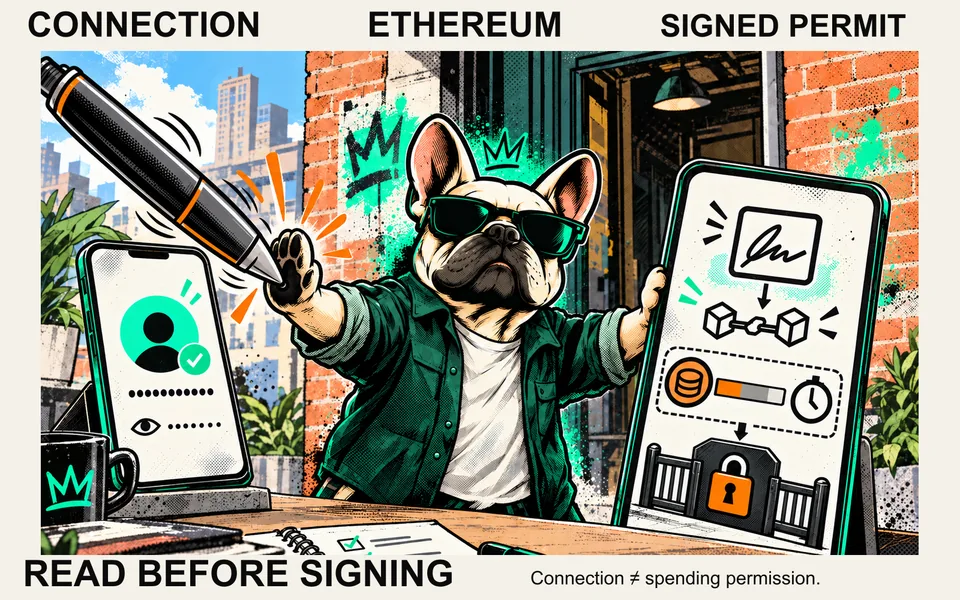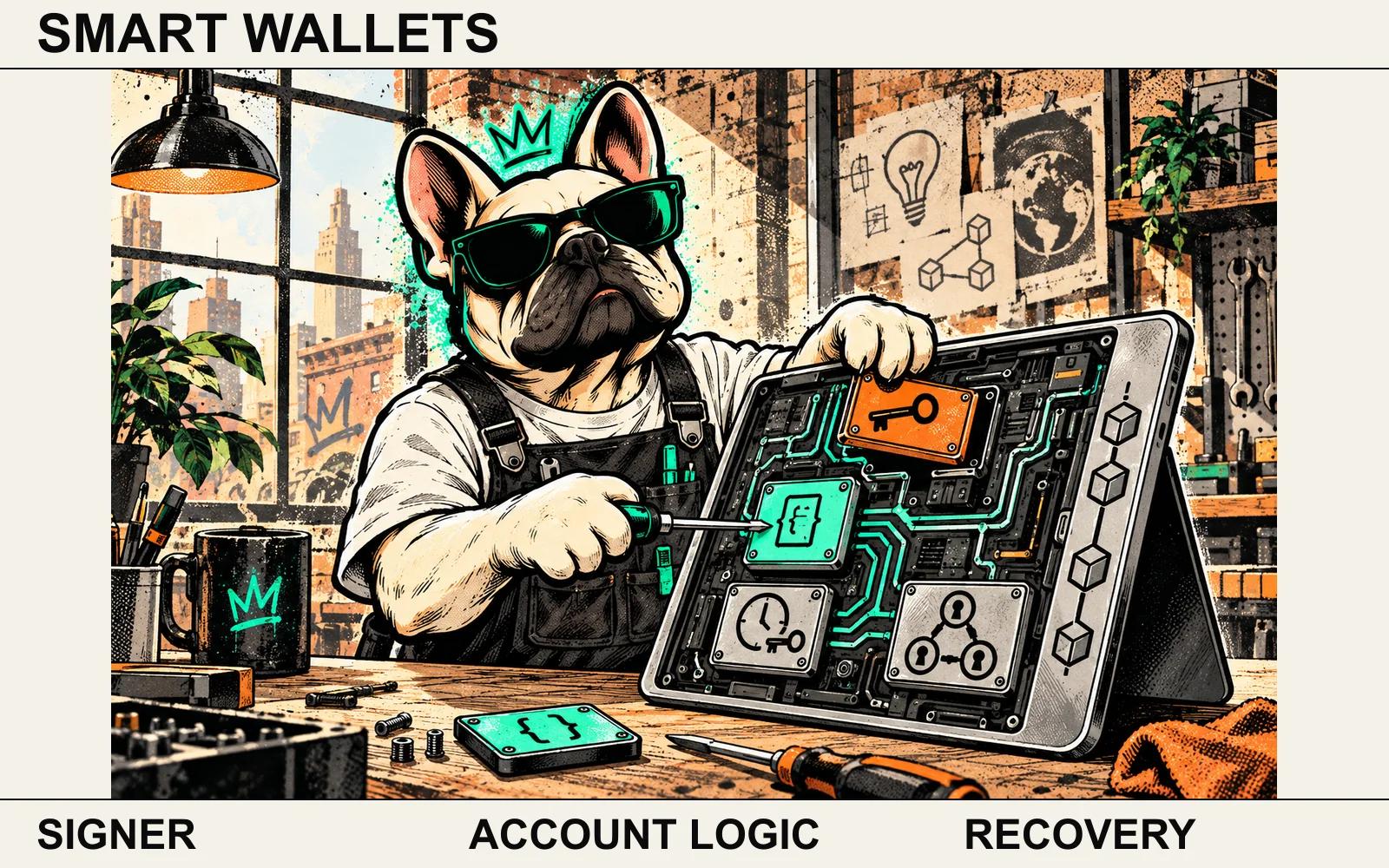
One tidy wallet screen beats a queue of popups. It still does not tell you who can spend, recover access or change the account's rules.
Smart contract wallets move some of those rules into code. This guide explains the Ethereum and compatible EVM mechanisms, not the features or security of a particular wallet. Start with what a crypto wallet manages if keys, accounts and apps still blur together.
What makes a wallet account programmable?
For an ordinary, undelegated externally owned account (EOA), a private key signs transactions under the network's normal rules. A smart account can instead check authorization through contract logic. That opens space for different signers, recovery arrangements and spending conditions, as Ethereum's account-abstraction overview explains.
The wallet app is the interface; the account is what the blockchain identifies. A nicer interface does not prove that the underlying account has custom recovery or spending limits. The smart-account documentation describes implementation choices, including accounts whose code is fixed and accounts whose logic can be upgraded.
Think of it as a key versus a rulebook that checks a key. The rulebook might demand another approval. It might also contain a bad rule. Programmable does not mean protective by default.
ERC-4337 and EIP-7702 are different routes
ERC-4337 defines a request called a UserOperation. A bundler packages operations into an onchain transaction. An EntryPoint contract coordinates account validation, execution and fee accounting; an optional paymaster can pay the gas.
EIP-7702 lets an existing EOA authorize delegation to code at another address. It is not simply a new wallet app or one token's approval. The delegation persists until changed or cleared by a valid authorization; failure of subsequent execution does not undo a delegation already processed.
| Route | What changes | What still needs checking |
|---|---|---|
| Undelegated EOA | Ordinary key-authorized account transactions | Key protection and each requested action |
| ERC-4337 smart account | Account code validates operations through an EntryPoint route | Actual account logic, infrastructure and fee terms |
| EIP-7702 delegated EOA | An existing account delegates to code | Delegate implementation, authorization scope and key protection |
These are not mutually exclusive product categories. ERC-4337 explicitly supports EIP-7702 authorizations on networks where that mechanism is enabled. A wallet can combine them. Ask which account and chain you actually use, rather than assuming the label on the download page answers that.
Recovery is a configured rule, not a reset button
An account can be designed to replace a lost signer through an alternative authorization path. It does not follow that every smart wallet offers this, or that a help desk can restore any account. The smart-account design guide treats authentication and recovery as implementation choices.
Consider a fictional account configured for recovery approval from 2 of 3 guardians. If one guardian is unavailable, the other two can satisfy that chosen approval threshold. If two are unavailable, the remaining one cannot. If two are compromised, that same threshold is a problem rather than a rescue.
This is an illustration of a rule, not a real wallet recommendation. The recovery procedure could also require delays or other conditions. Recovery authority can differ from ordinary spending authority. Find out who the guardians are, what they may change, and whether you can replace them before relying on the arrangement.
A passkey or email login describes part of the experience, not the complete custody model. Ask whether a provider can authorize spending or recovery, and whether you can still access the account without its interface. Do not assume an old seed phrase reconstructs a different account design.
Session permissions need enforceable limits
A session key can let an application perform a defined set of actions without repeatedly asking the main signer. The session-key documentation describes wallet-specific limits such as time bounds or permitted targets. ERC-4337 itself does not install those policies for every account.
Look for the actual permitted contracts and actions, any asset or amount limits, expiry and a way to end the session. A promise in the app's interface is not enough if the account's logic does not enforce it.
Keep the permission layers separate. Revoking a token allowance does not necessarily disable a session or clear EIP-7702 delegation. Our connection, signature and approval comparison covers these different scopes; an empty approval list is not a complete account-permission audit.
Sponsored gas still has a payer
A paymaster can sponsor an operation or support payment in a token rather than requiring the user to hold the chain's gas asset for that flow. Paymaster documentation describes the conditions a sponsor can enforce, including eligibility checks and spending policies.
The network cost has not vanished. Someone funds it, and a token-payment arrangement can charge the user under its own terms. A sponsor may not cover every chain, contract or operation, or remain available indefinitely.
The EntryPoint explainer separates gas funding and reimbursement from the requested action. A sponsored request is not a promise that execution succeeds. Read the fee quote and fallback behavior; do not treat "gasless" as "free forever." For the underlying cost, see network fees explained.
Who can change the rules?
Some accounts support added modules for validation or execution, and some permit implementation upgrades. Modular-account documentation explains those extension points. A useful recovery module is still code with authority.
Check who can install or remove a module, change an implementation, or alter signer and recovery settings. Separate your own administrative authority from a provider's authority. An audit may be relevant evidence for a named version; it does not prove that every later module or configuration is covered.
The application-layer guide distinguishes the wallet interface and SDK from account logic, bundlers and paymasters. Those dependencies matter when an app or hosted service is unavailable. Ask what alternative route exists; do not assume that an ordinary EOA transaction guide applies unchanged.
A read-first wallet checklist
- Identify the network, account address and actual account mechanism. Verify the documentation through an independently checked route.
- Read who can authorize spending, recover access and change account logic. Note any provider or guardian authority.
- Check session and module permissions, their limits, and the documented way to end them.
- Read the fee and sponsor terms. Find out what happens if sponsorship stops or a request fails.
- Check the documented access route if the app or service is unavailable. If it is unclear, do not assume funds are reachable through a familiar backup method.
For EIP-7702, the delegated implementation and the authorizing key remain important. The specification warns that delegated code has broad account access; this is not a setting to approve from an unsolicited rescue link.
This guide asks you to inspect documentation, not connect a wallet, disclose recovery material or run a transaction with real funds. Brokzi's take: useful automation should make the rules easier to inspect, not give them a hiding place.
Sources
Primary documentation checked 11 October 2026. Protocol capabilities are not a test of a deployed wallet, its custody arrangements, recovery service or security. Availability and implementation remain wallet- and chain-specific.
- Ethereum.org: Account abstraction — programmable authorization and potential user-facing features.
- ERC-4337 documentation: Smart accounts — account validation, authentication and implementation choices.
- ERC-4337: Account Abstraction Using Alt Mempool — operations, bundlers, EntryPoint, paymasters and EIP-7702 interoperability.
- EIP-7702: Set Code for EOAs — persistent delegation, authorization and security boundaries.
- ERC-4337 documentation: Session keys and delegation — wallet-specific permissions and limits.
- ERC-4337 documentation: Paymasters — optional sponsorship and payment policies.
- ERC-4337 documentation: Modular accounts — validation and execution modules and extensibility.
- ERC-4337 documentation: Application-layer wallets and SDKs — interface and infrastructure dependencies.
- ERC-4337 documentation: EntryPoint explainer — validation, execution and gas accounting.
See something wrong? Brokzi logs material changes. Prepare a correction note.