
What is the difference between a seed phrase and a private key?
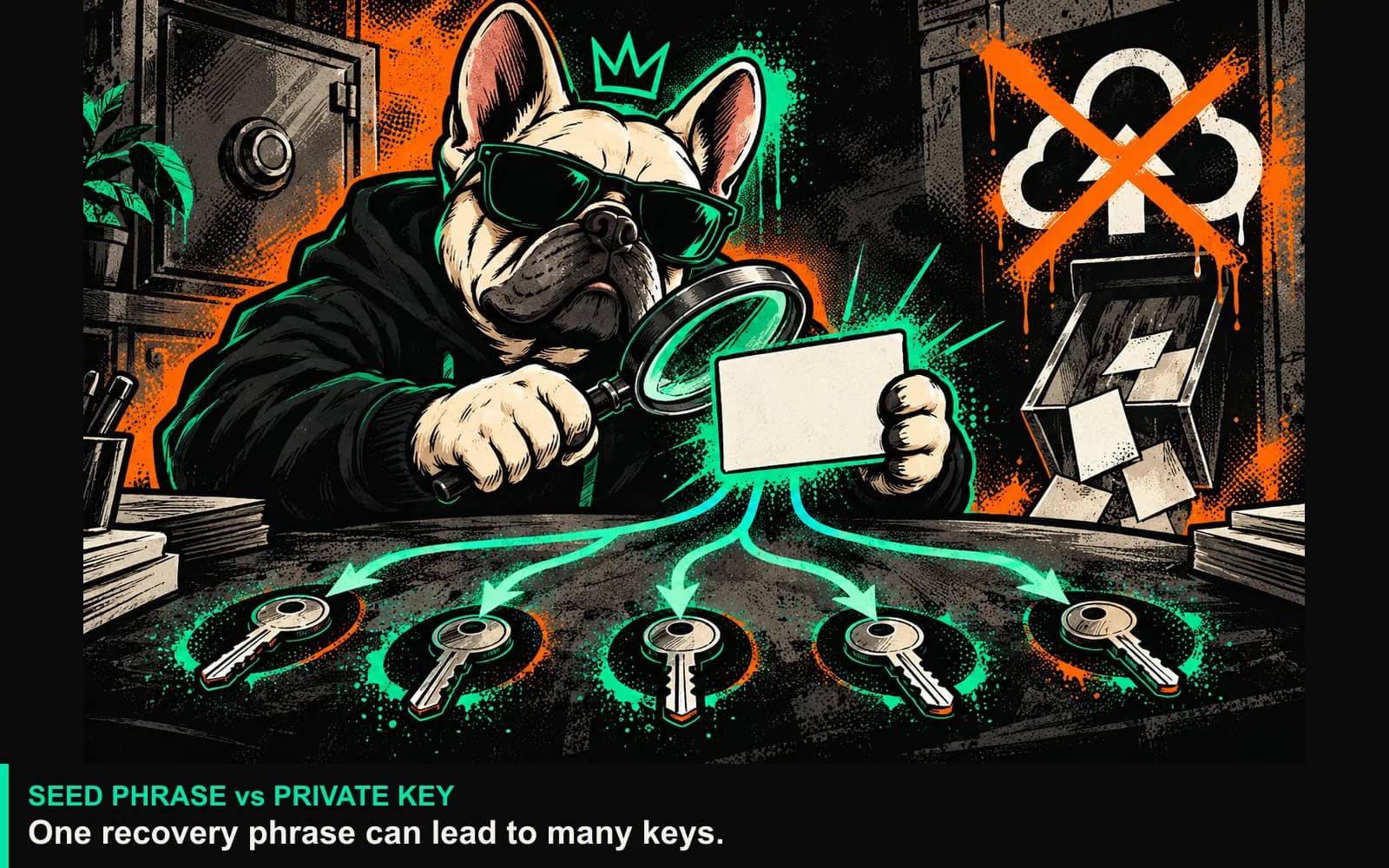
Think of a private key as one working key and a seed phrase as the recovery source from which a wallet can rebuild a whole keyring. The recovery source is usually more powerful, so exposing it can expose every account derived from it.
The phrase is not a password reset request sent to a company. In a self-custody wallet, there may be no company capable of cancelling or replacing it.
How the relationship works
BIP-39 describes one widely used way to turn entropy into a mnemonic sentence and then into a binary seed. Wallets can combine that seed with hierarchical deterministic derivation schemes to produce many keys.
Not every wallet or network uses BIP-39. A product may use a different recovery design, multiple devices, social recovery, or an account abstraction system. Read the wallet’s own documentation before assuming a phrase from one product will restore another.
A practical example
Suppose a wallet creates Account A and Account B from one recovery phrase. Each account can have its own private key and address. Exporting Account A’s private key may expose only that account. Exposing the recovery phrase may allow an attacker to derive both accounts and more.
That distinction is why “I only used one address” is not a safe response after a seed phrase leak.
Checks worth doing twice
Is a seed phrase the same as the wallet password?
No. A wallet's local password commonly protects access to the app or its stored keys. In a BIP-39 wallet, an optional passphrase is different again: it participates in deriving the seed. A different passphrase produces a different seed; the original words alone will not restore that same wallet. Check the product's recovery design rather than treating these three secrets as interchangeable.
Why might the same phrase show different accounts?
Recovery also depends on the wallet's derivation and account-discovery rules. An imported account may not have been derived from that phrase at all; MetaMask documents this separate recovery case. Start with the documentation for the wallet that created the account, and never paste recovery material into an online tool suggested by a stranger.
A short recovery checklist
- Keep the recovery phrase offline in a form you can read later.
- Do not photograph it, paste it into cloud notes, or send it to “support.”
- Verify any recovery exercise with the wallet’s official instructions and a controlled environment.
- If a secret has been exposed, treat it as compromised rather than trying to make it secret again.
The distinction to keep: a private key authorizes activity; recovery material helps rebuild access under a particular wallet design. For the wider custody picture, read what crypto wallets manage.
Update note
13 September 2026: clarified the difference between an app password, a BIP-39 passphrase and recovery words. The original publication date is unchanged.
Sources
-
MetaMask: Recovery phrase and imported accounts — imported private-key accounts are separate; checked 13 September 2026.
-
Bitcoin Improvement Proposal 39 — specification, passphrase derivation rechecked 13 September 2026.
-
Ethereum.org: Ethereum accounts — accessed 12 September 2026.
See something wrong? Brokzi logs material changes. Prepare a correction note.