
A contract uses a value during a transaction. Later, a reader looks for that value in permanent storage and finds nothing. Did the earlier step fail?
Ethereum transient storage can hold a value for use within one transaction without preserving it for the next. EIP-1153 defines TSTORE to write that temporary state and TLOAD to read it. The important boundaries are the transaction, the contract that owns the store and any call frame whose writes are reverted.
This is a reading guide for contract explanations and execution records. It follows the rules in EIP-1153, rather than testing a deployed contract or describing every EVM network's current rules.
What does transient storage keep, and for how long?
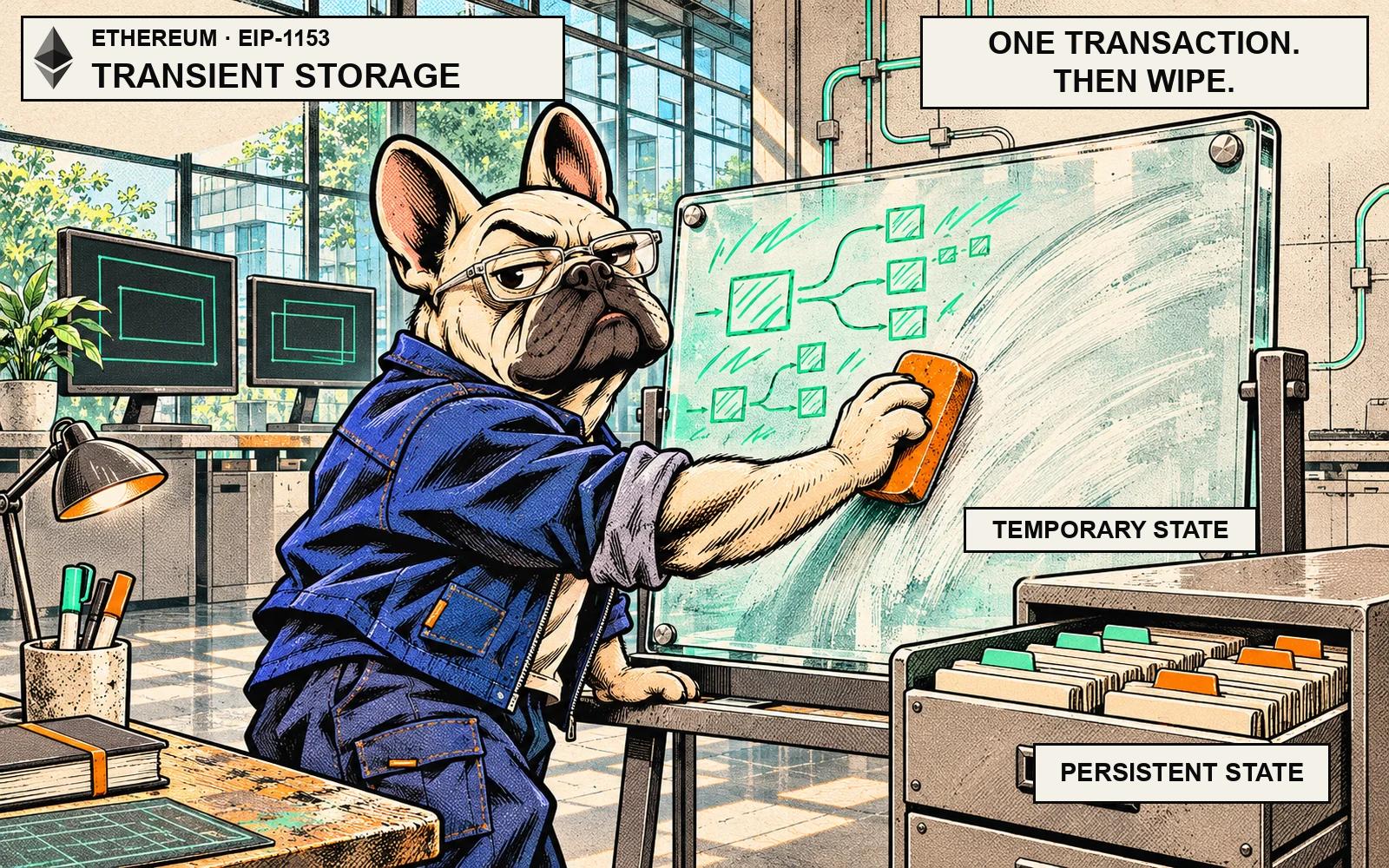
Transient storage is a contract-owned store of temporary values. Its values are discarded when the transaction ends. Before a slot has been set in that transaction, reading it returns zero.
That lifetime makes it different from both persistent storage and a call frame's memory. A call frame is one execution context within a transaction; calls can create further, nested frames. A transaction can therefore involve several frames associated with the same contract.
| State area | Relevant boundary | What a later frame can assume |
|---|---|---|
| Persistent storage | State that can survive the transaction, subject to its execution outcome | The relevant contract's committed values can remain for later transactions |
| Transient storage | The current transaction and the owning contract | Frames of that owner share the current transient store, subject to reverted writes |
| Memory | The individual call frame | A separate frame does not inherit the first frame's memory as a shared store |
The table compares lifetimes and access contexts. It does not say that a value written anywhere necessarily survives: a reverted execution can undo state changes.
EIP-1153 provides transient storage for communication between a contract's frames. Returning from a successful call is not the transaction-end cleanup boundary. A temporary value can still matter to another call in that same transaction.
Whose temporary value is it?
“Transaction-scoped” does not mean that every contract in the transaction gets one shared scratchpad. EIP-1153 keeps transient storage associated with an owning contract, much like persistent storage.
The call type determines the owner:
| Fictional call context | Whose transient store the executing code uses |
|---|---|
Contract A calls Contract B with CALL | B's |
A makes a STATICCALL to B | B's, with writes prohibited |
A executes B's code through DELEGATECALL | A's |
A uses CALLCODE | A's |
A and B are teaching labels, not deployed addresses. The same slot key in two different owners' stores does not make those stores the same place. Nor does calling another contract hand that contract direct access to the caller's transient store.
The delegate-call case is easy to misread: the location of the code and the owner of the state can differ. Our proxy and upgradeable-contract explainer explains that broader distinction. Here, the useful question is narrower: which contract context owns this temporary slot?
In this context, a separate or “private” store is an execution-access rule. It is not a promise that activity on a public blockchain is confidential.
A reverted call rolls back its writes, not every earlier value
The specification's revert rule covers transient writes made after entry into a reverting frame, including writes made by its inner calls. It does not say that any nested failure wipes all transient state established earlier in the transaction.
Consider a fictional transaction involving Contract A and a temporary slot called flag. The values below are invented teaching inputs; no contract or opcode was executed for this article.
| Step | What happens | A's transient flag |
|---|---|---|
| 1 | A writes 1 before entering a nested call | 1 |
| 2 | The nested execution, using A's state context, writes 2 to that slot | 2 |
| 3 | That nested frame reverts; the outer execution handles the failure and continues | Restored to 1 |
| 4 | A later frame using A's context reads the slot in the same transaction | Reads 1, assuming no intervening write or broader revert |
| 5 | The transaction ends | The transient values are discarded |
| 6 | A new transaction reads the slot before setting it | 0 |
The earlier 1 survives step 3 because it was written before entry into the reverted frame. The later 2 does not. If a broader frame also reverts, the rollback boundary moves outward with it.
Two different things happen in this example: rollback restores the earlier value within the transaction; transaction completion discards the transient store. Neither operation means that all of A's persistent storage is erased.
Static calls can read transient state but cannot write it
Under EIP-1153, TLOAD is permitted in a static context. TSTORE in a static context raises an exception instead of changing the value.
That distinction belongs alongside ownership. A static call to B uses B's transient store; it does not gain access to A's temporary values merely because A initiated the call. And permission to read a transient slot does not imply permission to update it.
This is a rule about execution context. It does not establish what a particular user interface displays or whether an arbitrary contract implements a public method that exposes the value.
What a missing value actually tells you
A blank or zero result in a later view is not enough to reconstruct what happened earlier. Start with the object being inspected:
- Which state area is the view reading? A persistent-storage lookup does not become a transient-storage trace because the slot key looks familiar.
- Which contract owns the state? Identify the relevant call context, especially where delegated code is involved.
- At what point in execution? A successful inner call can return while the surrounding transaction is still running. A later transaction has a different transient lifetime.
- Which frame reverted? Separate that frame's rolled-back writes from values established before it entered.
- What evidence supports the explanation? Code, execution context and the capabilities of the particular record or tool must support the claimed sequence.
A missing permanent value alone proves neither that transient storage was used nor that the earlier action failed. Those are different explanations requiring different evidence.
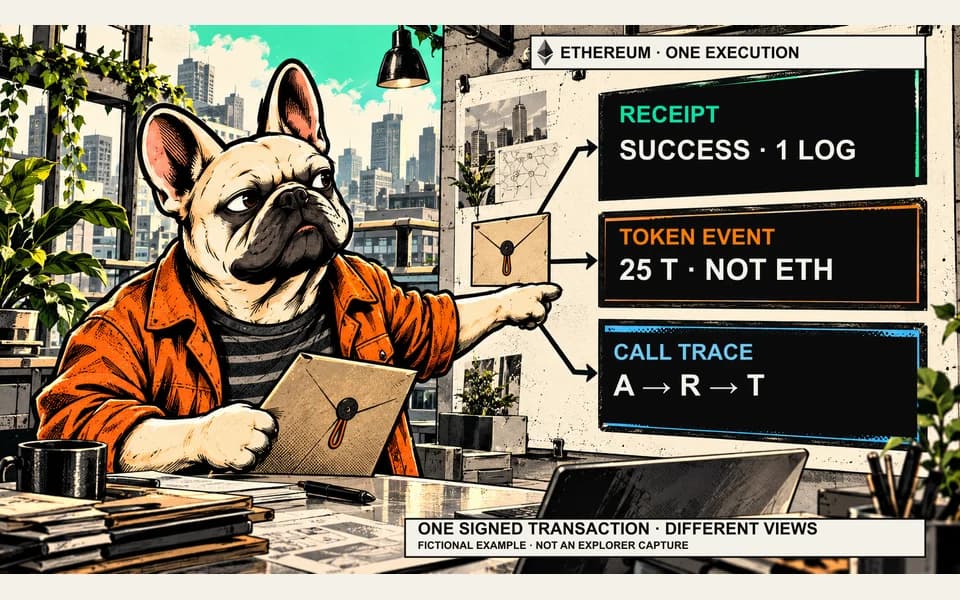
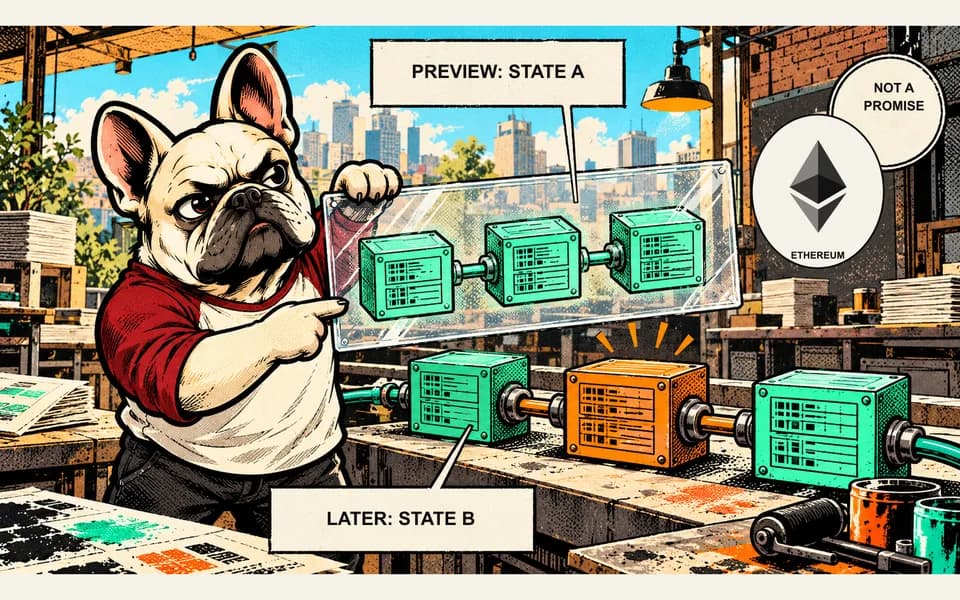
Our guide to Ethereum logs and execution traces explains why those records show different aspects of execution. A transaction simulation adds another boundary: it is a preview under assumptions, rather than proof that the same sequence was included onchain.
Temporary does not mean automatically safe
The security considerations in EIP-1153 warn that a value left in transient storage can affect later calls in the same transaction. End-of-transaction cleanup does not remove the need to reason about those intervening calls.
For example, treating a successful call's return as if it cleared the shared store can produce the wrong expectation for a later frame. Transient storage also does not, by its name or lifetime, establish protection against reentrancy or other contract bugs.
EIP-1153 is marked Final in the specification checked on 23 November 2026. That document status is not a network-by-network activation check. This article does not establish a current compiler's behavior, benchmark gas costs, audit code or test a wallet, node or deployed application.
The useful question is where the value stopped existing
When an explanation says “the contract remembered it,” ask for which contract, across which frames and until which boundary? A transient value can connect calls within one transaction and still leave no lasting value in persistent storage.
The whiteboard can be useful before it gets wiped. Finding it clean afterward does not tell you what was written on it—or prove that anything was written there at all.
Sources
- EIP-1153: Transient storage opcodes — the Final specification, including store ownership, frame rollback, static-context behavior and security considerations. Created 15 June 2018; complete document checked 23 November 2026. The example in this article is a fictional explanation of those rules, not an executed test.
See something wrong? Brokzi logs material changes. Prepare a correction note.