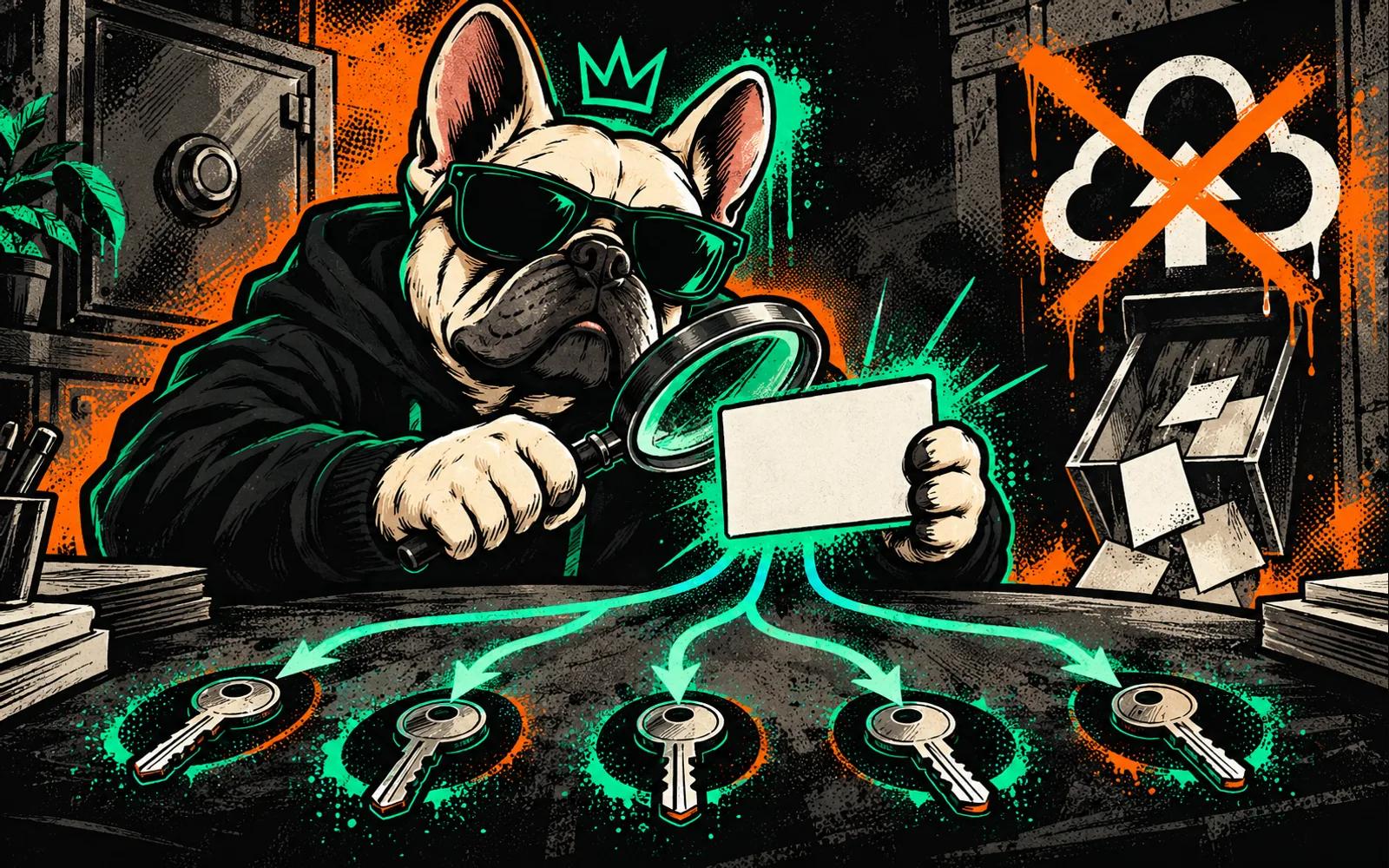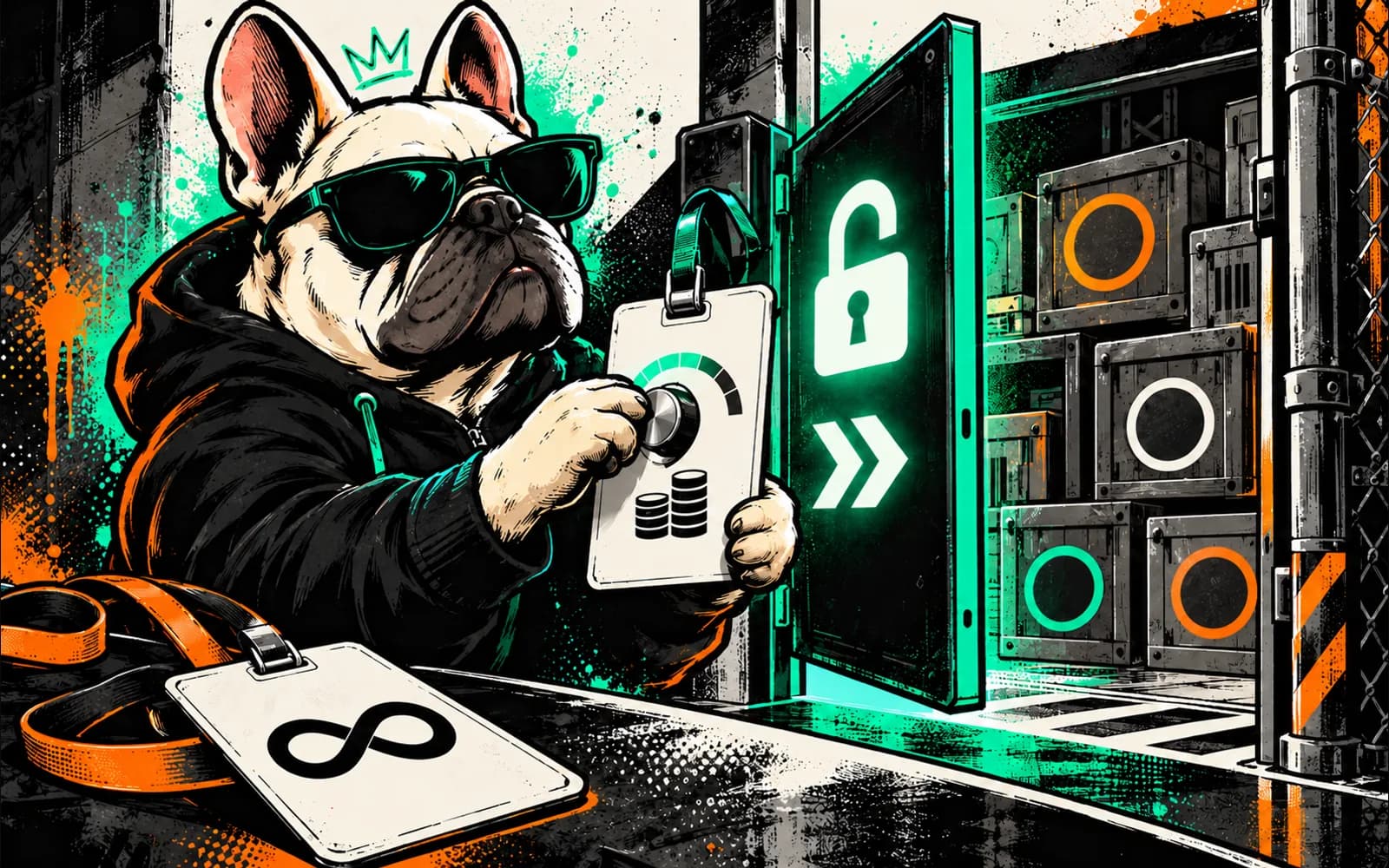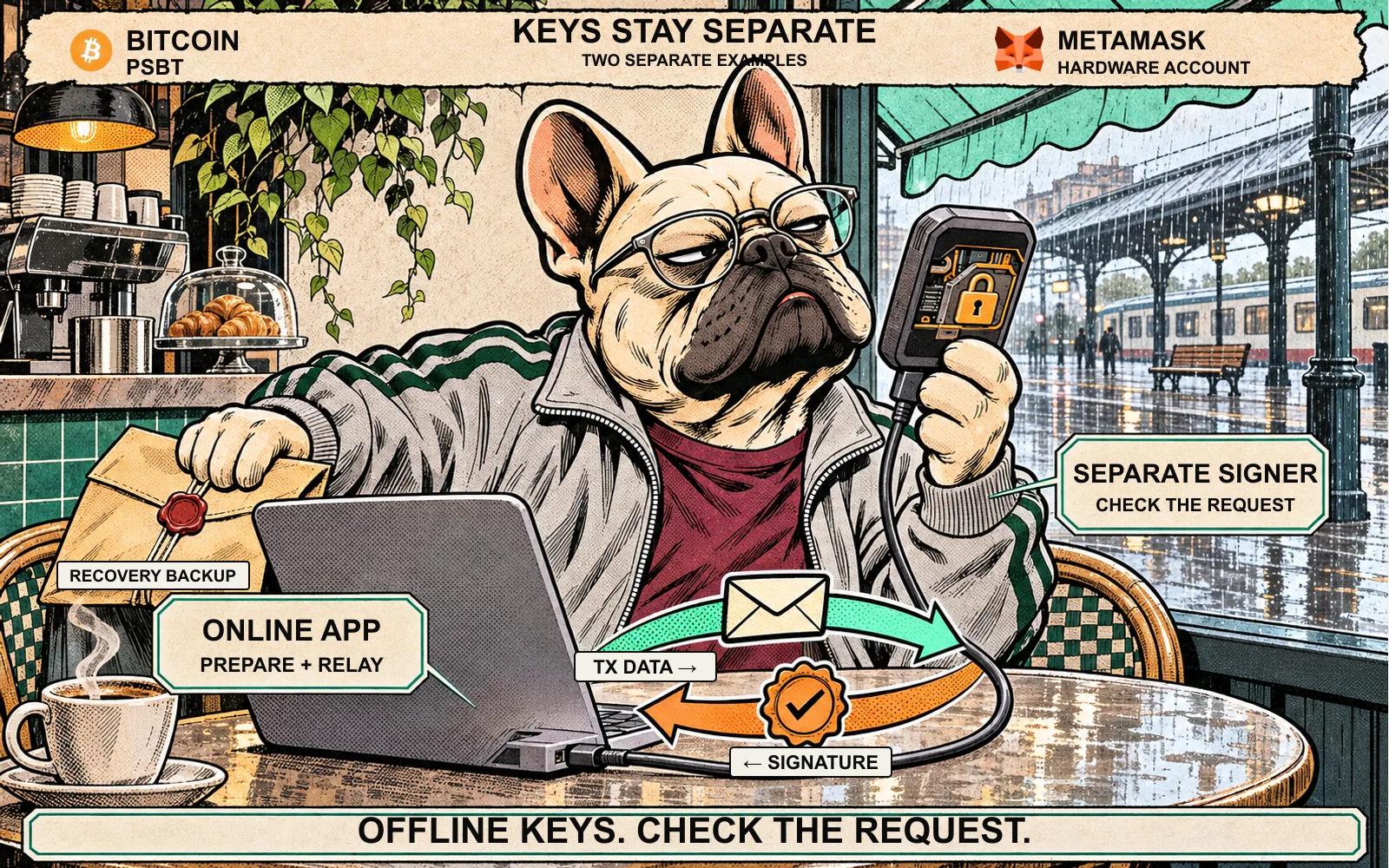
A cold wallet does not put your bitcoin or ETH into a small device and take the coins off the internet. The network still holds the asset record. The important difference in a hot wallet vs cold wallet comparison is where the signing keys live, and what happens when you use or recover them.
Start with the whole arrangement: the online app, the signing environment and the backup. A product name or a disconnected cable tells you less than that map.
Hot and cold wallets at a glance
Blockstream's wallet definitions distinguish a hot wallet's key on a connected device from a cold setup's offline key. The same guide describes pairing an online watch-only app with a separate signing device.
| Question | Hot-wallet setup | Cold-signing setup |
|---|---|---|
| Where are signing keys used? | On an internet-connected phone or computer | In a separate signing environment intended to keep them isolated |
| Can an online app show balances? | Yes | Yes; viewing does not require moving the signing key into that app |
| What crosses to a separate signer? | A separate signer may not be involved | Transaction information; signatures can return to the online component |
| What needs protection? | Device, software and recovery material | Signer, online companion, recovery material and the review process |
| What is not guaranteed? | That convenience means safety | That offline keys make every requested action safe |
These are workflow descriptions, not certifications. Implementations differ. This article focuses on ordinary key-based wallets; multisignature and smart-account recovery can add other rules.
A wallet can have an online view and an offline signer
The Bitcoin wallet developer guide separates a networked wallet from a signing-only wallet. The networked part can track relevant outputs, prepare transaction information and broadcast a completed transaction. The signing part holds the private-key material used to authorize spending.
That separation explains a confusing screen: you can see a balance in an online app while a separate signing device is switched off. Seeing a record is different from having the key needed to spend it.
Public wallet information also has privacy implications. A watch-only view can reveal activity without being able to authorize a spend. Do not treat it as confidential-key material, but do not assume it is harmless to share widely either.
Our crypto-wallet explanation covers what the app stores and how that differs from the blockchain record.
Does connecting a hardware wallet make it hot?
A cable alone does not answer the question. The relevant boundary is whether the connected computer receives or can use the private key, rather than whether any data moves between two devices.
Trezor describes its hardware-wallet design as signing inside the device, then returning a signed transaction to the connected computer for broadcast. That is the manufacturer's explanation of its design, not an independent security test by Brokzi or a guarantee covering every device and firmware version.
An isolated signer still communicates. A system using USB is not literally air-gapped merely because its private keys are intended to remain inside a dedicated device. Other workflows transfer data by QR code or removable media. The transport and the key-isolation design are separate things to examine.
Equally, turning off a phone does not undo any earlier exposure of keys used on that phone. An offline state now is not evidence of a key's entire history.
Bitcoin PSBT: move the request, not the secret
BIP 174 defines the Partially Signed Bitcoin Transaction format, or PSBT. It packages a transaction and information needed by signers, allowing the signing component to operate without directly consulting the online network.
The Bitcoin Core v32.1 PSBT guide separates preparation, updating, signing, finalizing and extraction into roles. One program can perform several roles; the labels do not require five different devices.
A simplified information flow is:
- An online component prepares the proposed transaction and relevant metadata.
- A signer checks the information it needs and produces signatures for inputs it can authorize.
- Finalization and extraction produce a network-format transaction, which an online component can broadcast.
The private key is not the item being passed around in that workflow. But “it is a PSBT” is not enough reason to sign it. The standard includes signer checks, and the destination, values and fee still matter. No PSBT, wallet or transaction was opened or tested for this article.
MetaMask can be the companion without receiving the recovery phrase
MetaMask's hardware-wallet guide distinguishes hardware-wallet accounts used through the app from the app's own software-generated recovery phrase.
The important distinction is connecting an account backed by a separate signer versus importing its recovery secret into software. An online interface does not, by itself, tell you which arrangement you are using.
The guide also warns against assuming that importing an existing software-wallet phrase into hardware creates the intended never-online secret. A new device cannot erase copies or exposure that may already exist. This is a boundary to understand, not an instruction to enter a phrase or move funds here. Current manufacturer instructions determine supported accounts and recovery methods.
What cold signing does not solve
An isolated key can still authorize an unwanted action if the signer is asked to sign it and the user accepts. A familiar app logo is not a substitute for checking the actual request.
Ethereum's security guidance tells readers to verify transaction details and protect recovery secrets. For contract activity, also distinguish a payment from an ongoing token approval. Disconnecting an app does not automatically cancel an onchain allowance.
The online companion and the signer both remain relevant. Check what the signer can display and verify for the particular action. If a request is not meaningfully decoded, do not assume that a confirmation button establishes that its consequences match your intention.
Hardware isolation also does not establish the authenticity of a device, the correctness of its firmware or the security of its backup. We have not inspected a particular product, supply chain or software build. A generic hot/cold label cannot settle those questions.
The backup is another route to the keys
A seed-based setup can have an isolated signing device and an exposed recovery phrase at the same time. The device's physical location does not protect a copy photographed, uploaded or typed into an untrusted page.
Ethereum's security guidance specifically warns against sharing recovery phrases and against screenshots that may sync to cloud storage. For the distinction between a recovery phrase, a private key and an optional passphrase, read our seed phrase vs private key guide.
Recovery also depends on the actual wallet scheme and compatible software or hardware. Keep the documented recovery method and any additional required settings in mind. Do not assume every wallet uses the same phrase format, accounts or recovery process.
Five questions for a useful comparison
- Where were the signing keys generated, and where have they been used? Include any earlier imports or software copies.
- What does the online app know? Distinguish public viewing information from private-key or recovery material.
- What does the signer actually verify and display? A trusted-looking interface is not an explanation of a signature.
- What can restore access? Account for the backup and wallet-specific recovery requirements, not just the device.
- Who controls authorization? A custodian's internal hot/cold storage does not give its customer direct control of those keys.
Custody and online exposure are different axes. An exchange account can depend on a provider regardless of how that provider stores its keys. A self-custodial setup can still expose keys through software or poor backup handling.
Read the specific wallet's documentation before treating a setup as cold storage. The useful result is a clear picture of its signing and recovery boundaries, not a promise that one category cannot fail.
Scope and sources
Primary documentation checked on November 5, 2026. This is an educational comparison, not a device review, recovery service, product ranking or financial recommendation. No wallet was connected, no recovery material was requested or entered, and no transaction or message was signed. The cover is a fictional explanatory scene; it does not show a tested product or an actual account.
- Blockstream: What is a Bitcoin wallet? — hot/cold and watch-only definitions; its product recommendations are not adopted here.
- Bitcoin developer guide: Wallets — networked and signing-only components, offline and hardware workflows.
- Trezor: What is a hardware wallet? — manufacturer's description of device-contained signing, not independent assurance.
- BIP 174 — PSBT format, signer roles and required checks.
- Bitcoin Core v32.1: PSBT how-to — preparation, signing, finalization and extraction roles; no RPC was executed.
- MetaMask: How to use a hardware wallet — hardware-backed accounts and the distinction from importing a previously online recovery phrase.
- Ethereum.org: Security and scam prevention — recovery-secret protection, transaction review and approval risks.
See something wrong? Brokzi logs material changes. Prepare a correction note.