

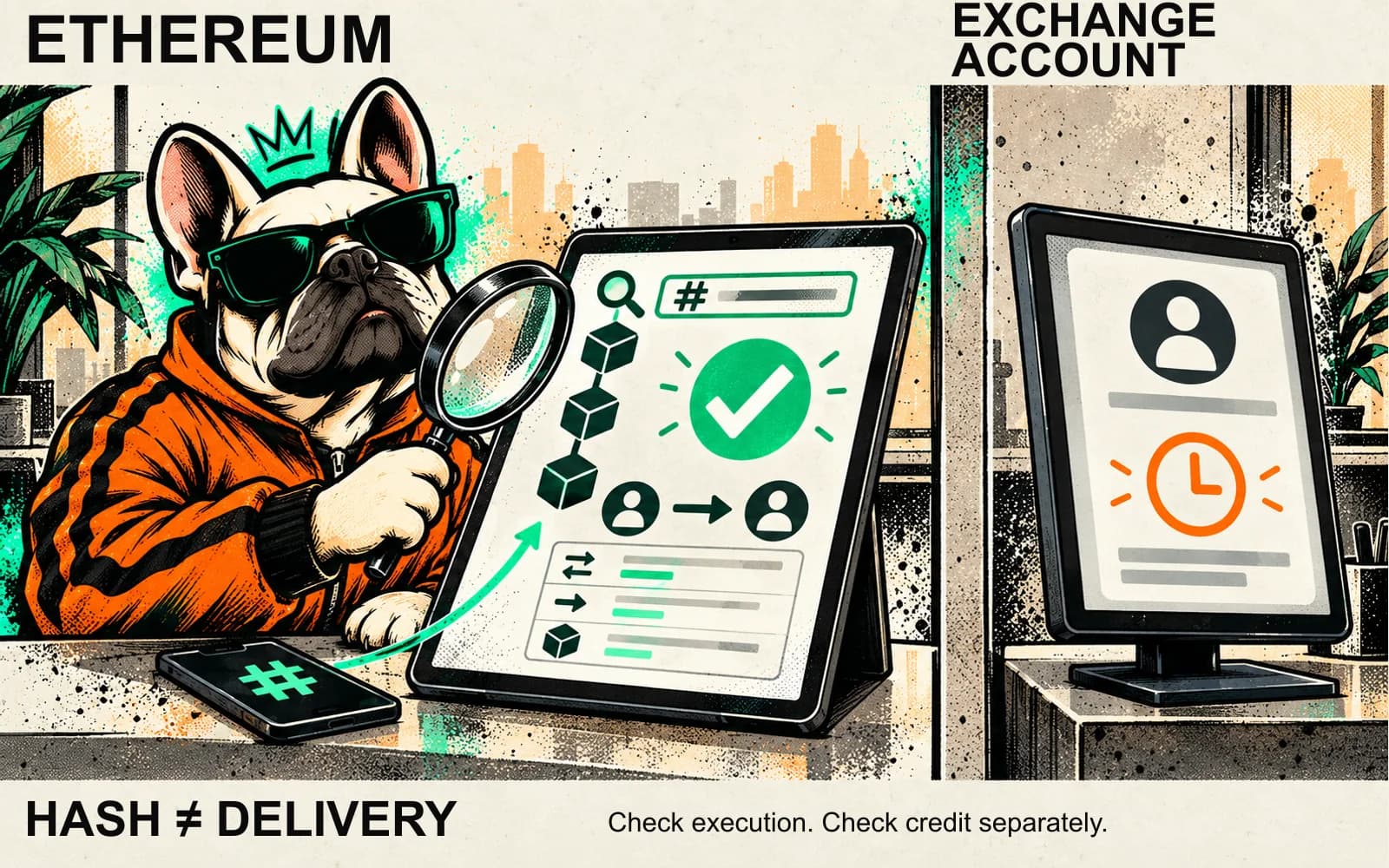
Your wallet has handed you a very long string. It helps you find the transaction, but it does not tell you whether the recipient got what you intended to send.
This guide walks through an Ethereum transaction hash. Other EVM networks can show familiar fields while using different settlement rules. Bitcoin uses a different transaction model. For the network basics, see Ethereum explained.
What a transaction hash tells you
A transaction hash, also called a tx hash or transaction ID, is a lookup identifier. Ethereum exposes it as 32 bytes, normally written as 0x followed by 64 hexadecimal characters. It is different from a public address, which identifies an account rather than a particular transaction. These formats are documented in Ethereum's JSON-RPC API.
The hash can exist before a transaction reaches a block. A string in a message or screenshot therefore proves very little on its own. Look up the actual record and read what happened. Ethereum's transaction lifecycle separates creating the hash, broadcasting and inclusion.
1. Choose the network before the explorer
A block explorer is a website for reading blockchain records. Match its network to the network shown in the sending wallet or withdrawal record. Ethereum Mainnet, a test network and a Layer 2 are not interchangeable places to search. Ethereum's network documentation explains why an account can appear on different networks without sharing its history or balance.
Open an explorer through an independently checked route, then paste the complete hash. Basic public transaction lookup does not require a wallet connection, a signature or recovery words. Avoid ads or unsolicited "verify your transfer" links. Ethereum.org lists block explorers as data-reading tools; listing is not a guarantee about an explorer's safety.
2. Separate execution status from settlement
Read the status and block information together:
- Pending: the transaction has not been included in a block in that view. A pending transaction has no execution receipt yet.
- Failed: an included transaction's top-level execution failed. Gas used for the attempt can still cost money.
- Success: the top-level execution succeeded. Check its effects before deciding that it did what you expected.
The receipt's success/failure distinction comes from EIP-658. An explorer's wording is a presentation of that result, not a customer-service verdict.
Next, look for the containing block and the explorer's confirmation or finality information. A count of blocks after inclusion is not the same thing as Ethereum's finality, the consensus commitment to a block that cannot be reversed without a critical consensus failure. Gasper documentation describes that separate mechanism. Do not substitute a universal countdown or a Bitcoin confirmation rule for it. Other networks and receiving services have their own requirements.
3. Read the action, not just the green badge
Use this compact field check. Explorer labels vary, but the questions stay useful.
| Field | Question to answer |
|---|---|
| Network and hash | Am I looking at the intended record on the intended network? |
| Status and block | Was it included, and did execution succeed or fail? |
| From / To | Which address submitted it, and which address or contract did it call? |
| Value | How much native ETH accompanied the transaction? |
| Token transfers | Which token contract, recipient and amount are shown? |
| Transaction fee | What was actually charged, rather than estimated or capped? |
For a simple native ETH transfer with no contract execution, To is the destination and Value is the ETH sent. For a contract call, To can be the contract being called, not the final token recipient. A transaction with Value: 0 ETH can still move tokens. These are different actions, even if the wallet calls both "Send". See Ethereum's transaction types.
For an ERC-20 transfer, inspect the token-transfer details, including the contract address. A familiar ticker alone is not enough to identify the asset. ERC-20 specifies transfer events and optional token metadata. Custom contracts can behave differently, and a decoded label is not a safety certificate. An approval changes permission rather than necessarily moving tokens; token approvals explained covers that distinction.
4. Work through a clearly fictional receipt
This is a teaching mockup using Ethereum Mainnet rules, not a real transaction, explorer screenshot or event. There is no searchable hash. Sender A and Destination B are labels, not addresses to use.
Assume a successful, simple native ETH transfer with no input data or contract execution:
| Mock field | Illustrative value |
|---|---|
| Network | Ethereum Mainnet |
| Transaction hash | Omitted: this record is fictional |
| Status | Success, assumed for the example |
| Block / finality | Included, but not finalized in this mockup |
| From / To | Sender A / Destination B |
| Value | 0.05 ETH |
| Token transfers | None; this is a native ETH transfer |
| Gas used | 21,000 gas units |
| Effective gas price | 12 gwei per gas unit, assumed |
| Transaction fee | 0.000252 ETH, calculated |
The arithmetic is 21,000 × 12 = 252,000 gwei, or 0.000252 ETH. Under these assumptions, the sender pays 0.050252 ETH in total and the destination receives 0.05 ETH. The network fee is separate from the transferred value.
Ethereum's gas documentation supports the simple-transfer gas assumption and units. This is not a current fee quote. Contract execution can use different amounts of gas. For the wider mechanism and failed-transaction costs, read crypto network fees.
What even a successful record cannot prove
A confirmed record can identify addresses and onchain effects. It does not establish the real-world identity, honesty or intentions of the person behind an address. Ethereum's account model concerns keys and code, not identity checks. An explorer label adds context; it does not replace verification through the recipient's own official channel.
An exchange account has a separate record. The blockchain cannot show its internal crediting decision. Coinbase's deposit guidance, for example, distinguishes network confirmations and support for the chosen network. That is Coinbase's policy, not a universal rule or endorsement. Check your receiving service's current asset, network and regional requirements separately.
Two questions that often cause confusion
What if the transaction hash is not found?
First compare the complete hash and network with the sending record. "Not found" means that this explorer has no matching record in its current view. It does not, by itself, establish failure or justify sending again. The JSON-RPC API distinguishes a missing transaction from a missing receipt; consult the sender's official support route if the records disagree.
Can Success appear without the token transfer I expected?
Yes. Success describes top-level execution, not every business outcome. An approval can succeed without moving tokens. ERC-20 also requires callers to handle a false return rather than assume every call transfers successfully. Inspect the actual effects and token details. A green badge does not establish that a service credited your account. ERC-20 and EIP-658 define those separate checks.
Keep a record, not a guess
Keep the network name, complete transaction hash, relevant addresses and observed status together. Check the asset movement and fee, then verify any receiving-service credit separately. That gives you a useful record to discuss with official support without handing over keys or signing another request.
This is an educational reading guide, not an instruction to send funds, reverse a transfer or choose an investment.
Sources
- Ethereum.org: Block explorers — read 5 October 2026.
- Ethereum.org: Transactions — read 5 October 2026.
- Ethereum.org: JSON-RPC API — transaction and receipt fields, read 5 October 2026.
- Ethereum.org: Networks — read 5 October 2026.
- EIP-658: Embedding transaction status code in receipts — specification, read 5 October 2026.
- Ethereum.org: Gasper — finality, read 5 October 2026.
- ERC-20: Token Standard — specification, read 5 October 2026.
- Ethereum.org: Gas and fees — read 5 October 2026.
- Ethereum.org: Accounts — read 5 October 2026.
- Coinbase Help: Pending crypto transactions — provider-specific deposit guidance, read 5 October 2026.
See something wrong? Brokzi logs material changes. Prepare a correction note.