
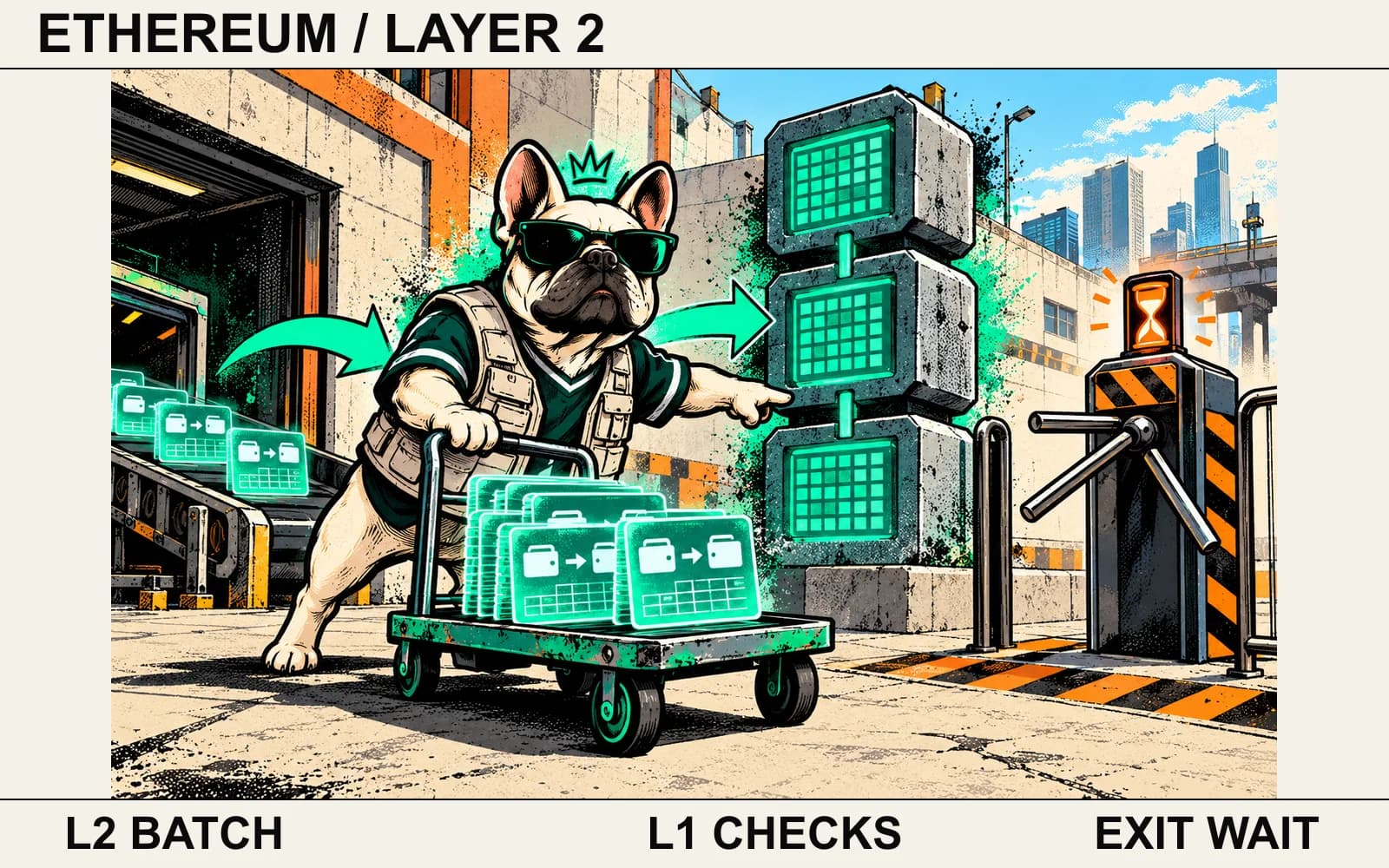
The fee looks smaller. The wallet address looks familiar. Then the withdrawal screen says you have to wait.
A Layer 2 blockchain changes where work happens and how the result is checked. It does not turn every network, token and exit route into interchangeable copies of Ethereum. Here is the map to read before treating a quick confirmation as the end of the journey.
Layer 1 vs Layer 2: who does which job?
Layer 1 is the base blockchain. On Ethereum mainnet, its nodes execute transactions and its consensus system establishes the agreed chain. A rollup moves execution to another environment while using Ethereum for data availability and settlement. Settlement here means checking and accepting claims about the resulting state, such as balances and contract storage.
Ethereum's scaling documentation distinguishes these jobs. It is not describing a second floor inside your wallet. The wallet is an interface; the network determines which ledger and contracts it is interacting with. Start with Ethereum explained if that distinction is new.
In a rollup, transactions can share the cost of posting compressed batches to Ethereum. The base chain does not need to repeat all the rollup's execution work in the same way. What it checks depends on the proof system. “Uses Ethereum” is the beginning of the explanation, not a complete security assessment.
Rollup, validium and sidechain are not the same thing
The broad Layer 2 label is used differently across the industry. For this guide, an Ethereum rollup publishes the data needed to reconstruct its state to Ethereum. Data availability means that the information needed to check or reconstruct the chain is accessible; a fingerprint of missing information is not the information itself.
| Design | Where execution happens | Data and checking boundary |
|---|---|---|
| Ethereum mainnet | Ethereum's execution layer | Ethereum's own execution, data and consensus rules |
| Optimistic rollup | Outside Ethereum's base execution layer | Data on Ethereum; state claims can be challenged through the rollup's fault-proof rules |
| Validity-proof rollup, often called a ZK-rollup | Outside Ethereum's base execution layer | Data on Ethereum; an Ethereum contract verifies a proof of a valid state transition |
| Validium | Outside Ethereum's base execution layer | Validity proofs, but required data is kept outside Ethereum; additional availability assumptions |
| Sidechain | A separate chain | Its own consensus and bridge security; not Ethereum consensus merely because it connects to Ethereum |
These are design distinctions, not a safety leaderboard. Ethereum's Layer 2 overview gives the user-facing rollup model; the individual technical documents explain where the assumptions differ.
Validium documentation describes why a valid proof cannot solve missing data: withholding the information needed for an exit can freeze withdrawals. Sidechain documentation describes independent consensus. Ethereum-compatible contract code does not make a sidechain inherit Ethereum's consensus security.
There are also optimistic systems with external data availability. Arbitrum's Nitro documentation distinguishes Arbitrum One's rollup mode from Arbitrum Nova's AnyTrust mode, which adds a data-availability committee assumption. AnyTrust is not the validity-proof design in the validium row. A family name alone does not tell you the data model of each chain.
Optimistic and validity proofs check results differently
An optimistic rollup submits claims about state and provides a challenge process for incorrect claims. That process needs working rules, data and participants able to challenge. “Optimistic” means the system's treatment of claims, not optimism about a token price.
A validity-proof rollup supplies a cryptographic proof that a state transition satisfies the relevant rules. An Ethereum verifier contract checks it instead of rerunning every transaction. The proof is not an audit of the app you used, and it does not make a malicious app request sensible.
Despite the ZK name, scaling with validity proofs does not automatically make your transactions private. Privacy depends on what that particular system actually implements. Neither proof category removes every contract bug, operational dependency or upgrade risk.
A sequencer's confirmation is an early milestone
A sequencer orders transactions for the rollup. Execution applies the network's rules to that order. In the usual sequencer path, the interface can show an outcome before the transaction data reaches Ethereum. OP Stack's transaction-flow guide separates execution, batch posting and state proposals.
For an Ethereum-data OP Stack rollup, its finality documentation uses these protocol labels:
| OP Stack label | What has happened | What it does not establish |
|---|---|---|
| Unsafe | The transaction is in an L2 block, but its data has not been posted to Ethereum | Ethereum data finality |
| Safe | Its data is in an Ethereum block | That Ethereum block cannot still reorganize |
| Finalized | Ethereum has finalized the block containing the data | That a bridge withdrawal is already executable |
“Unsafe” is a technical stage, not a verdict that somebody stole your funds. These labels are not a promise that every L2 wallet will display the same words. Batch timing, network conditions and configuration affect the journey; a fast spinner is not a universal finality clock.
Why withdrawing can take longer than transacting
A transaction within the L2 and a withdrawal to Ethereum are different operations. The withdrawal must satisfy the bridge's rules for an action on the destination chain.
For OP Stack's native withdrawal flow, the current documentation describes initiation on L2, proving on Ethereum and finalization on Ethereum. A relevant state proposal must be available before proving. Finalization also depends on proof maturity and the dispute game's valid resolution and finality conditions. Read the withdrawal flow, not only a countdown badge.
The OP Mainnet Standard Bridge has a minimum seven-day withdrawal wait, as its finality documentation explains. That is not a seven-day wait for every ordinary L2 transaction, nor a guarantee that any withdrawal finishes exactly seven days after initiation. A late proof, unresolved game or additional required step can extend the route.
Arbitrum's child-to-parent messaging likewise requires a confirmed state assertion before a message can execute on the parent chain. Posting a batch alone is not enough. A ready message still needs execution on Ethereum; elapsed time does not itself send the funds.
Validity-proof rollups do not use the same optimistic challenge wait. They still need the relevant batch and proof accepted, plus the implementation's withdrawal and claim steps. Do not translate “no optimistic challenge period” into “instant withdrawal on every ZK network.”
A faster bridge is a different route, not a broken stopwatch
Some services use liquidity or other cross-chain arrangements to deliver assets sooner. That changes the route and its assumptions; it does not make the native settlement process disappear. Ethereum's bridge documentation describes different transfer mechanisms and contract, counterparty and liquidity trade-offs.
Check the destination network and exact asset, who supplies or verifies the transfer, available liquidity, fees and any later claim step. A familiar ticker is not enough to identify the token contract. This is route selection, not a recommendation of a bridge or an instruction to connect a wallet.
Lower fees do not answer the security question
An L2 fee can include more than execution. OP Mainnet's fee documentation lists execution, L1 data and operator components. Other networks have their own accounting. Include bridge transactions and destination-chain gas when comparing the cost of the whole trip; there is no fixed saving percentage in this guide. Network fees explained covers the work-versus-price distinction.
Also check who can change the system or pause it. The OP Stack's privileged-roles documentation describes upgrade and withdrawal-pause powers. The exact chain's configuration matters. “Has proofs” does not mean “has no powerful administrators,” and an audit is not a guarantee against bugs.
Three questions people ask about Layer 2
Is Layer 2 the same as a sidechain?
Not in this guide's Ethereum-rollup sense. A rollup uses Ethereum data and settlement mechanisms; a sidechain runs its own consensus and connects through a bridge. Broad marketing labels vary, so inspect the named chain's execution, data availability, proof system and administrative powers instead of relying on the label.
Does a ZK-rollup mean private transactions?
No. A validity proof establishes that execution followed rules; it does not automatically make transaction history confidential. Data availability is a separate requirement. Check the particular network's privacy documentation rather than relying on the ZK label.
Do all Layer 2 withdrawals take seven days?
No. Withdrawal rules depend on the network, proof system, asset and bridge route. An optimistic native exit can include a challenge-related wait; a validity-proof exit has different proof and claim conditions. A faster liquidity route adds its own assumptions. Check the current route rather than borrowing another network's timer.
Read the route before the fee
For a Layer 2 blockchain, keep five questions together: where is the action executed, where is its data available, what checks the state, who can change or interrupt the system, and what completes the exit?
The Layer 2 glossary is the compact definition. The bridge glossary explains why moving between ledgers is another operation. The useful decision is not “L2 or no L2?” in the abstract. It is whether you understand the specific network and route you are about to use.
Sources
Primary documentation read 5 October 2026. This is a mechanism explainer, not a live bridge test, network ranking or promise of withdrawal time. Named implementations are examples, not endorsements. Current route documentation takes precedence over a generic diagram or timer.
- Ethereum.org: Layer 2 — overview and terminology.
- Ethereum.org: Scaling — execution and settlement roles.
- Ethereum.org: Optimistic rollups — claims and challenges.
- Ethereum.org: ZK-rollups — validity proofs, data and exits.
- Ethereum.org: Validium — external data boundary.
- Ethereum.org: Sidechains — independent consensus.
- Optimism: Transaction flow — execution, batches and proposals.
- Optimism: Transaction finality — protocol labels versus withdrawal delay.
- Optimism: Withdrawal flow — initiation, proving and finalization conditions.
- Arbitrum: Inside Nitro — One/Nova data modes.
- Arbitrum: Child-to-parent messaging — confirmed assertions and execution.
- Optimism: Transaction fees — fee components.
- Optimism: Privileged roles — upgrade and pause powers.
- Ethereum.org: Bridges — route types and trade-offs.
See something wrong? Brokzi logs material changes. Prepare a correction note.