

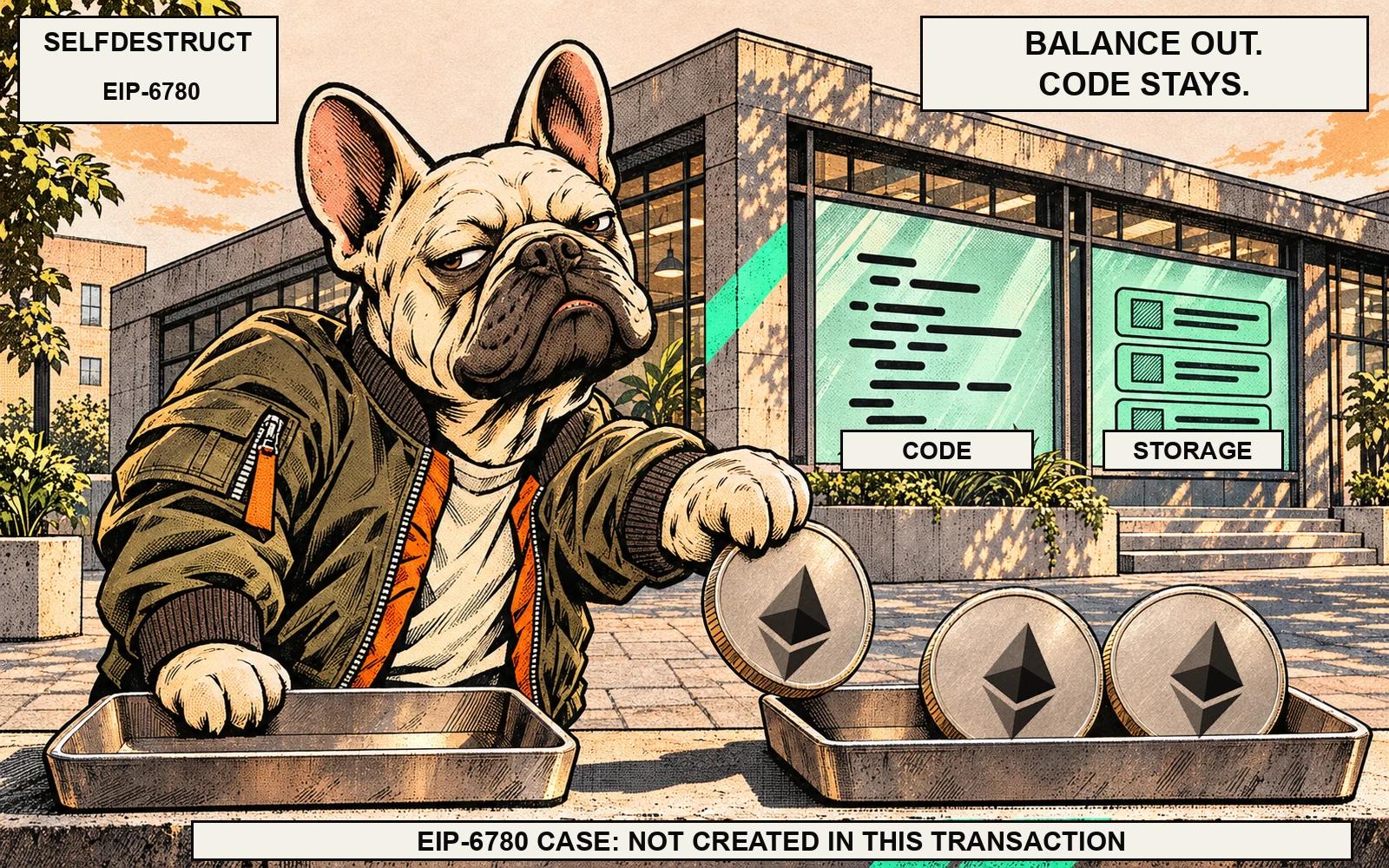
The name SELFDESTRUCT sounds final. A contract's Ether balance moves, so the contract must be gone too. Under the rules described in EIP-6780, that conclusion can be wrong.
When a contract executes SELFDESTRUCT outside the transaction in which it was created, EIP-6780 says its current execution frame stops and its entire Ether balance transfers to the target. Its code, storage and account are not deleted. The specification preserves earlier deletion behavior for the separate case where creation and SELFDESTRUCT occur in the same transaction.
This explainer helps readers interpret a contract-destruction claim. It describes EIP-6780's specified behavior, not the currently active rules of every Ethereum-compatible network. It is not a deployment or destruction tutorial.
A balance, code and storage are different parts of the question
An Ether balance tells you about the native currency held at an account. Contract code and storage describe different state. EIP-6780 makes that separation explicit: in its non-creation-transaction case, moving the balance does not remove the code, storage keys or account itself.
The opcode also halts the current execution frame—the particular execution context running it. That is a narrower statement than saying every part of the surrounding transaction stops or that the contract no longer exists.
| Question | EIP-6780 answer when the contract was created in an earlier transaction |
|---|---|
| Does the current frame stop? | Yes |
| Does the entire Ether balance transfer to a different target? | Yes, under the specified operation |
| Is the contract's code deleted? | No |
| Are its storage keys deleted? | No |
| Is the account itself deleted? | No |
| Does targeting the executing contract itself burn its Ether? | No; that case has no net balance change |
These are the specified effects of this operation in that context. They are not evidence that a particular transaction executed it, or that no other state changes took place during the surrounding transaction.
An empty balance is therefore a poor substitute for a code-and-storage check. Conversely, finding code afterward does not by itself prove that a claim about SELFDESTRUCT execution is false.
The exception is the creation transaction, not the creation block
EIP-6780 retains earlier SELFDESTRUCT behavior when the contract was created in the same transaction. In that case, the specification includes deletion of data as previously specified, transfer of the account's balance and setting the executing account's balance to zero.
Do not widen “same transaction” to “same block,” “same day” or “just deployed.” Two different transactions in one block are still different transactions for this condition.
The specification considers a contract created at the beginning of a contract-creation transaction or when a contract-creation operation begins execution. It also explicitly says that an existing balance at the new address does not prevent this from counting as contract creation.
That last detail keeps two observations separate: an address already having Ether and a contract being created at that address are not the same event. A balance-history entry alone cannot establish which side of the creation-transaction boundary applies.
This article does not give a sequence for triggering the exception, deleting a contract or deploying another contract at an address.
A fictional comparison: two balances move, two different state outcomes
Consider Contract A and Contract B, invented labels rather than real addresses. Assume the EIP-6780 behavior described here applies, both operations reach execution successfully, and the target is a different account. This is a specification-reading example, not a test result.
| Fictional case | Creation context | Specified balance effect | Specified code-and-storage effect |
|---|---|---|---|
| A | A was created in an earlier transaction | Its entire Ether balance transfers to the target | SELFDESTRUCT does not delete A's code or storage |
| B | B was created in the transaction executing SELFDESTRUCT | Its entire Ether balance transfers to the target; its balance is set to zero | The earlier deletion behavior is preserved |
The visible balance movement can look similar while the specified deletion behavior differs. Creation context supplies the distinction that the balance alone cannot.
No funds were moved, address checked, contract deployed or opcode executed for this comparison. Establishing an actual case would require evidence about the applicable execution rules, the relevant creation and the transaction's execution context.
Self-targeting has its own distinction
There is another reason to avoid summarizing SELFDESTRUCT as “it burns the balance.” In the EIP-6780 case where the executing contract was not created in that transaction, making that same contract the target produces no net change in balances. The specification says Ether is not burned in that case.
For a contract created in the same transaction, EIP-6780 retains the earlier self-target behavior, including burning the Ether. These two statements concern different creation contexts; they do not contradict each other.
This is a description of the specification's branches, not a suggested action. It supplies no target address, transaction instructions or tested burn method.
It is also a native-Ether question. Our token-burn explainer addresses the separate task of distinguishing token supply reduction from token movement. A statement about SELFDESTRUCT and an account's Ether balance does not calculate a token's supply change.
What evidence should a “contract destroyed” claim contain?
Before accepting that label, separate the following questions:
- Which network and execution rules apply? A specification's Final status is not a check of that network's active rules at the relevant block.
- Which contract and transaction are being discussed? A balance change alone does not identify the executed operation.
- Was the contract created in that same transaction? Earlier funding, a recent-looking address or a shared block number is not a substitute for creation context.
- What actually happened to the code and storage? Distinguish the operation's specified effects from observed state and other changes in the transaction.
- What does “destroyed” mean in the claim? A stopped frame, moved Ether, deleted account and unusable application are different claims.
Our Ethereum logs and execution-trace guide explains the limits of those execution views. A label supplied by an interface needs enough underlying context to support the conclusion attached to it.
Likewise, “the address stayed the same” is not a complete explanation of an upgrade. The proxy-contract explainer covers the separate roles of implementation code, stored state and upgrade authority. SELFDESTRUCT should not be treated as a generic upgrade mechanism.
Final specification does not mean a permanent promise
The complete EIP-6780 document checked on 23 November 2026 is marked Final. It says the change requires a hard fork and that SELFDESTRUCT remains deprecated. It strongly discourages its use in newly deployed contracts and notes that future EVM changes could reduce its functionality further.
Those limits matter when reading older tutorials or later proposals. This article does not establish a current network activation, client implementation, deployed contract's behavior or future fork outcome. No live node, explorer or wallet was tested.
The useful reading habit is to replace the dramatic name with the specific claim: did the frame stop, did Ether move, or were code and storage deleted? Under EIP-6780, those answers depend on the creation-transaction boundary. The balance can leave while the rest of the contract stays.
Sources
- EIP-6780: SELFDESTRUCT only in same transaction — Final specification, including the two creation contexts, self-target behavior, pre-existing-balance qualification and deprecation warning. Created 25 March 2023; complete document checked 23 November 2026. The comparison above is fictional and was not executed.
See something wrong? Brokzi logs material changes. Prepare a correction note.