

A project posts a burn transaction. The tokens left one wallet. Has the supply fallen?
For readers checking that announcement, the useful next step is to identify which record changed. This token burn explainer follows OpenZeppelin Contracts version 5.6.1, with fictional amounts. Other implementations can behave differently.
What a contract burn changes
The OpenZeppelin ERC-20 documentation describes _burn as an internal operation that lowers total supply. Its version 5.6.1 source shows the accounting: the holder's balance falls, and the contract's supply counter falls by the same amount.
An ordinary transfer follows a different branch. It subtracts from the sender and adds to a nonzero recipient. The supply counter stays unchanged in this implementation. Calling the recipient a burn wallet does not change that branch.
That is why "tokens sent away" and "lower totalSupply()" need separate evidence.
One fictional starting balance, two different outcomes
Assume token T has 1,000 units in total. Alice holds 400 T and other holders have 600 T. The destination used in the transfer example starts with zero. Ignore fees, rebases, custom hooks and other activity.
Compare two independent scenarios, each starting from that same state:
| Record after a 100 T operation | Ordinary transfer to a nonzero address labelled dead | Contract burn using the checked implementation |
|---|---|---|
| Alice's balance | 300 T | 300 T |
| Other holders | 600 T | 600 T |
| Destination balance | 100 T | No 100 T recipient balance is created |
| Reported total supply | 1,000 T | 900 T |
The transfer still accounts for 300 + 600 + 100 = 1,000 T. The burn accounts for 300 + 600 = 900 T. Both reduce Alice's balance by 100 T; only the second reduces the supply counter.
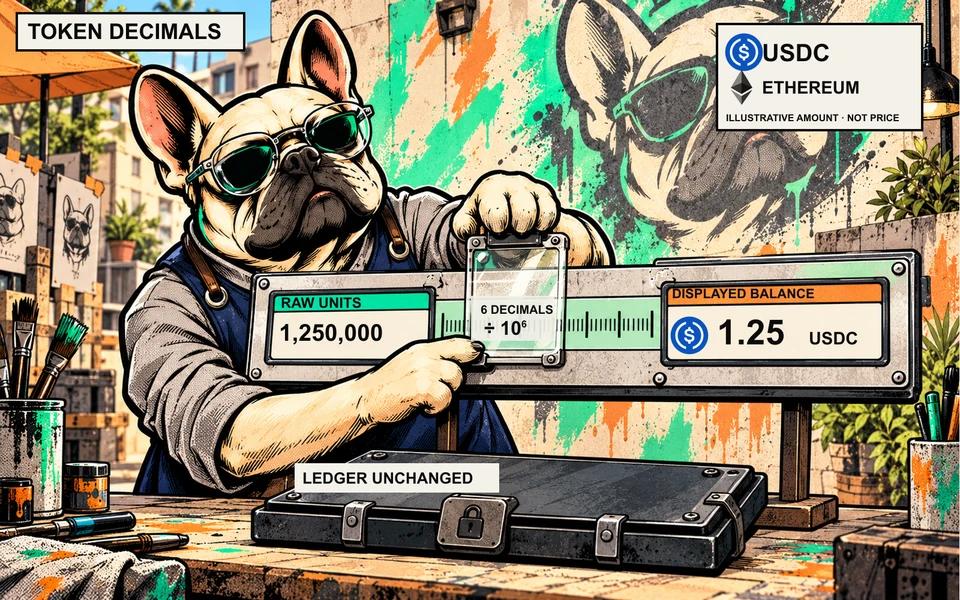
These scenarios are alternatives, not consecutive steps. Token T, Alice and the quantities are teaching examples, not an actual wallet or asset. The decimals explainer covers how raw integer amounts convert into displayed token units.
A dead-address label does not establish a spending proof
A block explorer's label describes an address. It does not establish, by itself, who can control it or prove that no one can ever move a particular token balance.
For the ordinary-transfer example, the important accounting fact is narrower: a nonzero recipient receives a balance, and the checked contract's total supply remains unchanged. Whether those units are spendable or excluded from a circulating-supply estimate is another question.
Do not test an address by sending funds. This article provides no destination to use and makes no claim that a named address is cryptographically unspendable.
The zero address also needs care. In the checked base implementation, an ordinary transfer to the zero address reverts. The internal burn path uses it as a special accounting case; it does not credit a normal recipient balance there. Typing a zero address into a transfer form is not a substitute for understanding the contract.
Events help, but the implementation sets their meaning
The ERC-20 standard defines supply and balance queries alongside transfer events. It does not require every token to expose a public burn function.
In the checked OpenZeppelin implementation, a burn emits a Transfer event whose destination is the zero address. An ordinary transfer records its actual recipient. Read those records together with the relevant contract and its state, rather than relying on an explorer's friendly transaction label.
OpenZeppelin's separate ERC20Burnable extension exposes burn for the caller's tokens and burnFrom using an allowance. The internal _burn name is not evidence that every ERC-20 holder has the same public route.
A customized implementation can override accounting. A matching function name or library reference does not certify the deployed code, permissions or upgrade arrangements. We checked source files, not a live token contract.
A lower supply counter does not answer the market questions
Our burn example contains no buyers, trading price or pool reserves. It cannot calculate a price gain or create liquidity. The market-cap versus liquidity guide explains those separate measurements.
Nor does one burn establish that future supply cannot increase. Check the asset's minting rules and controls before turning a past supply change into a permanent maximum.
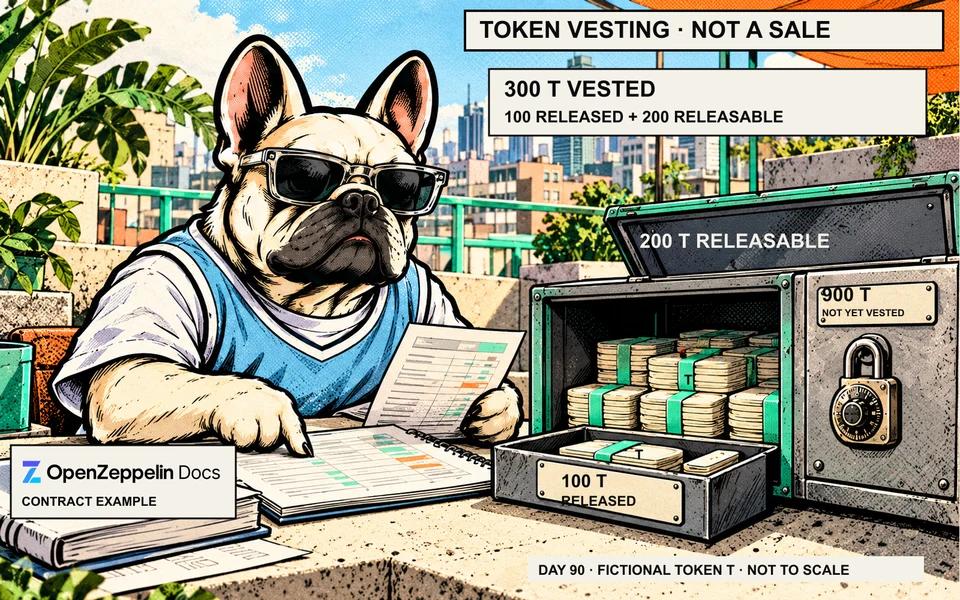
An unlock concerns a different record again: when an allocation becomes available. The vesting explainer separates availability from release and sale. A burn-and-mint bridge can remove units on one chain and create units on another; the bridge explainer covers that route. Do not read a source-chain burn alone as a measured reduction across every chain.
A short checklist for a burn announcement
Keep the exact network and token contract with the transaction, amount, units and comparison time. Then ask:
- Was this an ordinary transfer, a supply-reducing operation, or a crosschain step?
- What did the relevant supply field report before and after, and was there other activity in between?
- Does the implementation match the mechanism being claimed?
- Is "circulating supply" a separately defined estimate rather than the contract's total?
- Is any claim about permanent removal, future issuance or price supported independently?
You can investigate these questions through public records without signing, deploying or connecting a wallet. For token burns, check the accounting result before repeating the headline quantity.
Sources
Checked October 18, 2026. This is a library-scoped explanation, not an audit, transaction tutorial or recommendation. The 5.x documentation is a moving reference; the code examples are pinned to release 5.6.1. All quantities are fictional and calculated separately.
- OpenZeppelin Contracts 5.x: ERC-20 API: documented transfer and burn behavior.
- ERC20.sol, release 5.6.1: balance and total-supply accounting.
- ERC20Burnable.sol, release 5.6.1: the public burn and allowance-based burnFrom routes.
- ERC-20 token standard: interface and event requirements, not a universal burn API.
See something wrong? Brokzi logs material changes. Prepare a correction note.