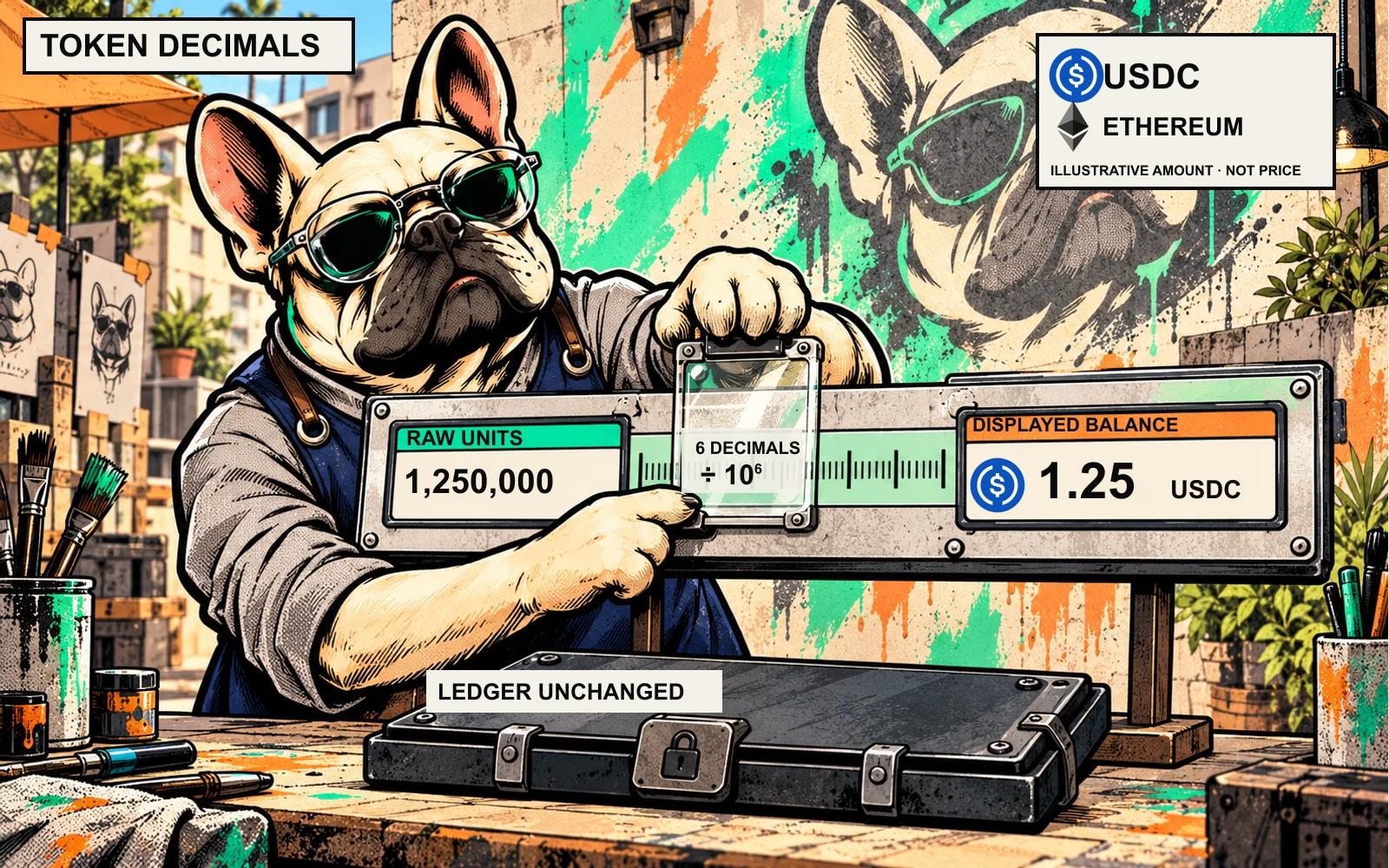
An explorer shows 1250000. A wallet shows 1.25. That difference can be a unit conversion, not a missing balance.
Token decimals set the scale between a contract's integer amount and the balance people read. This guide covers ERC-20 tokens and a checked Ethereum USDC reference, not every blockchain's asset model.
What token decimals actually describe
The ERC-20 standard defines integer-returning balance and supply methods. Its optional decimals() metadata describes the scale used for the user-facing quantity.
For a token using d decimals:
displayed token amount = raw integer amount ÷ 10^d
Here ^ means mathematical exponentiation, not a programming-language operator. With six decimals, the divisor is 10^6 = 1,000,000. A raw amount of 1,250,000 therefore represents 1.25 tokens.
The conversion leaves the contract's integer record unchanged. The interface expresses the same quantity in different units.
The same-looking number can mean different quantities
These are fictional conversion examples, not actual account balances or transfer instructions:
| Decimals | Raw integer units | Displayed token quantity |
|---|---|---|
| 0 | 125 | 125 |
| 2 | 125 | 1.25 |
| 6 | 1,250,000 | 1.25 |
| 18 | 1,250,000,000,000,000,000 | 1.25 |
For the six-decimal example, one raw unit is 0.000001 token. That is its unit scale, not a promise that an exchange accepts a deposit that small.
If an interface mistakenly interprets 1,250,000 raw units using eighteen decimals, it displays 0.00000000000125, rather than 1.25. The ledger did not lose tokens. The two screens used different scales.
Eighteen decimals is a default, not an ERC-20 rule
OpenZeppelin's ERC-20 guide explains that its implementation defaults to eighteen decimals and can override that value. The guide separates integer contract arithmetic from display formatting.
That is a library default, not a universal token property. ERC-20 explicitly makes decimals(), name() and symbol() optional. Software cannot safely infer eighteen, six or any other value just because a contract is called an ERC-20 token.
If metadata is unavailable or conflicting, the amount needs verification against the exact asset's documentation and implementation. A familiar ticker is not enough.
A checked reference: USDC on Ethereum
Circle's contract directory identifies its Ethereum Mainnet USDC contract as 0xA0b86991c6218b36c1d19D4a2e9Eb0cE3606eB48. The matching Etherscan token profile lists six decimals.
Checked October 16, 2026: at that scale, a hypothetical 1.25 USDC corresponds to 1,250,000 raw units. These figures are not a real holder's balance, a dollar-price observation or a recommendation to use USDC.
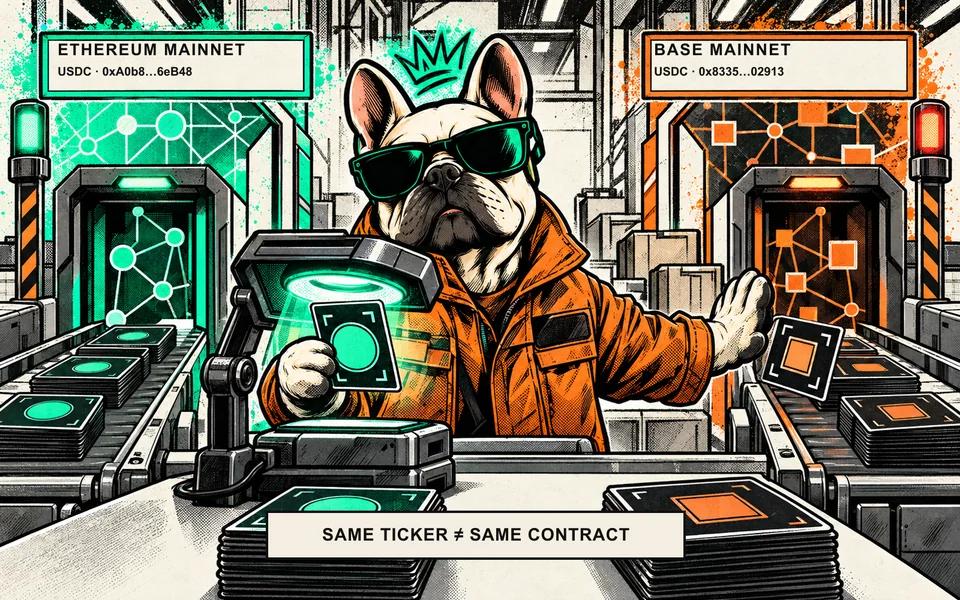
The address identifies a token contract, not a deposit recipient. This check does not audit the contract or establish an exchange's supported deposit route. Use the network-and-contract checklist to keep identity separate from quantity formatting.
Converting back requires a whole number of raw units
The reverse calculation is:
raw units = displayed token quantity × 10^d
For our fictional six-decimal token, 1.25 × 1,000,000 = 1,250,000.
But 1.0000001 × 1,000,000 = 1,000,000.1. That is not an integer, so this quantity cannot be represented exactly with that six-decimal scale. Software needs an explicit rejection or rounding policy; it should not silently treat the fractional result as an exact onchain amount.
Keep large integers exact while checking these examples. Rounding a long raw value first can change the quantity before the decimal point is placed. A calculation for display is not a transaction preview or permission to sign.
Decimals are not supply, price or allowance
Decimals specify units. totalSupply() answers a different question: how many raw units the token reports in total. Apply the scale before comparing quantities; the number of decimal places alone does not tell you the supply.
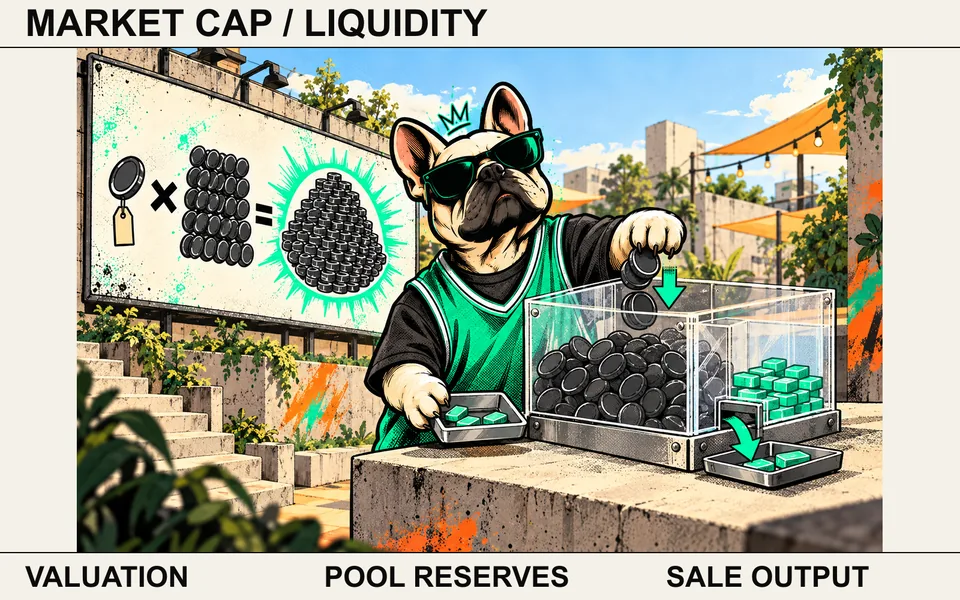
Price needs a separately identified market and quote currency. More decimal places do not make a token cheaper, scarcer or more valuable. Our market-cap and liquidity guide explains why valuation and executable trading value need more information.
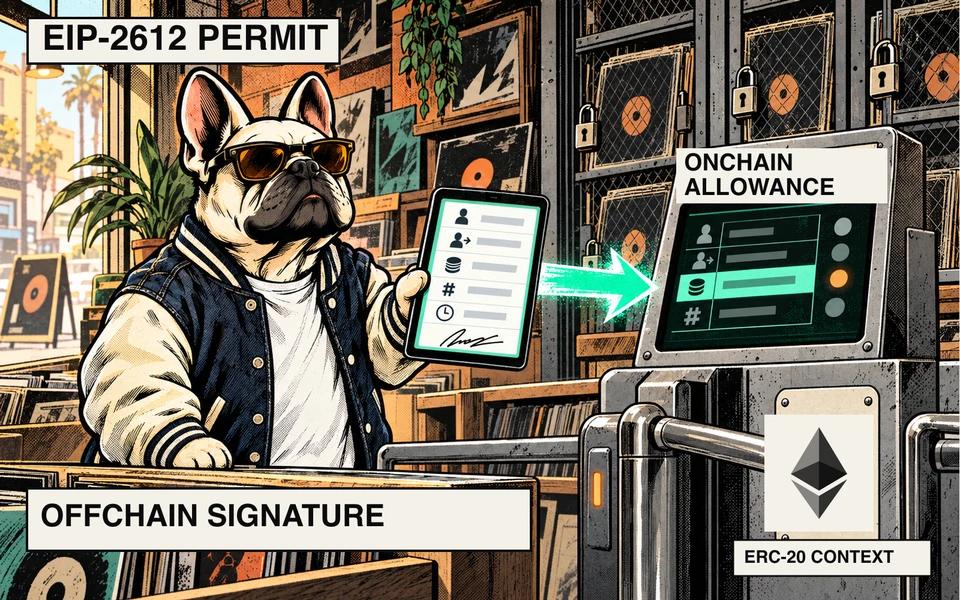
An allowance is another integer amount with a permission attached to a particular owner and spender. Understanding its scale helps you read the amount; it does not grant or revoke that permission. The EIP-2612 permit explainer covers the separate signature mechanism.
When two balance displays disagree
Compare the exact network and contract, the raw amount and the scale each interface uses. Check whether one screen rounds away small fractions. If the underlying raw records differ too, formatting alone cannot explain the discrepancy.
You do not need to connect a wallet, change its settings or submit a transfer to understand this calculation. If a payment is involved, read its transaction record separately. A display correction does not prove a transfer succeeded or an exchange credited it.
Sources
Checked October 16, 2026. Numerical balances and conversions are teaching examples, not live holdings, quotes or transfers. The named token reference is scoped to the Ethereum contract above.
- ERC-20 token standard: integer amounts and optional metadata.
- OpenZeppelin Contracts 5.x: ERC-20: display scaling and its eighteen-decimal default.
- Circle: USDC contract addresses: the Ethereum Mainnet identity.
- Etherscan: that Ethereum USDC token profile: the six-decimal field, not a safety or price verdict.
See something wrong? Brokzi logs material changes. Prepare a correction note.