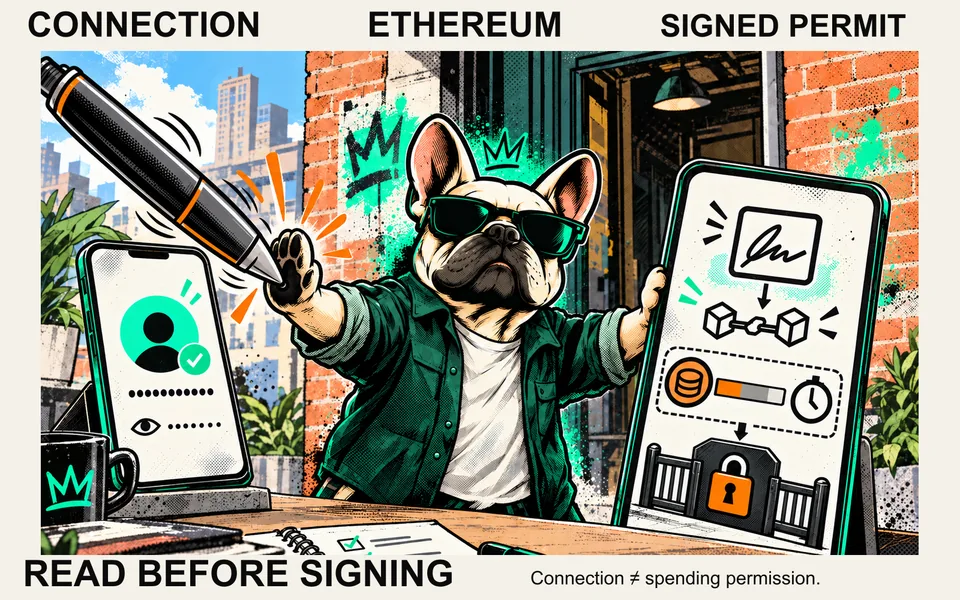
The wallet asks for a signature without an immediate gas payment. It can still be asking you to authorize a token allowance. With EIP-2612, the signature is portable: someone else can submit it later.
This explainer is for readers comparing an ERC-20 permit with approve or trying to interpret a spending signature. It covers the EIP-2612 specification, not every feature called "permit". If the basic permission layers are unclear, start with connection, signing and approval.
Permit changes who can submit the allowance request
In the ordinary ERC-20 interface, approve(spender, value) sets the calling owner's allowance for a spender. The spender can then use transferFrom within its authorization. An approval is separate from the transfer that uses it.
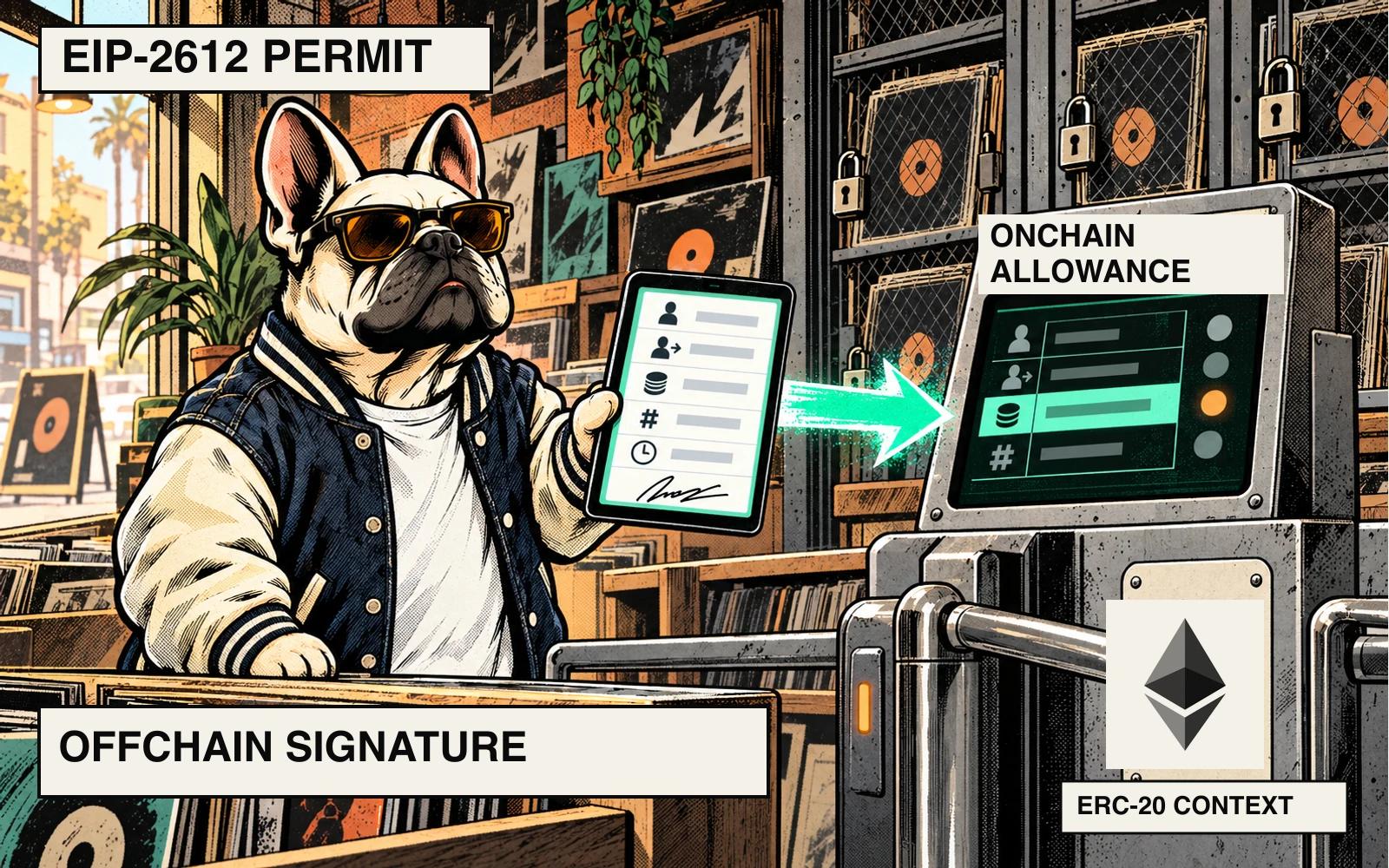
EIP-2612 adds a signature route. The owner signs structured data offchain; a caller submits permit to the token contract. If the specified checks pass, that call sets allowance[owner][spender] to the signed value, increments the owner's permit nonce and emits an Approval event.
The signed value replaces the allowance for that pair; it is not automatically added to the existing amount. Signing the message alone does none of those onchain state updates. A later application transaction may combine permit and a spending action, so also read what that application proposes to do.
| Step | Ordinary approve | EIP-2612 permit |
|---|---|---|
| Authorization | Owner initiates an onchain approval call | Owner signs typed data offchain |
| Submission | Token reads the calling owner's approval | Anyone may submit the valid owner's permit |
| Result of the accepted allowance call | Allowance for owner and spender is set | Allowance is set and the owner's permit nonce advances |
| Token transfer | Separate spending action | Not performed by permit itself; an application may combine calls |
| Network cost | Onchain execution has a gas cost | The later onchain submission still has a gas cost |
The last row matters. A relayer may pay for submission or an application may arrange another fee model. EIP-2612 does not promise a free service, a relayer that always submits, or a particular wallet popup sequence.
Read the signed fields together
The specification's signed Permit structure contains five fields. Wallets may display them differently or incompletely; a tidy screen does not establish trustworthy permission.
| Field | What it means | What to check |
|---|---|---|
owner | Address whose tokens the allowance concerns | The actual token-owning account, not just a connected login |
spender | Address receiving allowance | Full address and intended authority; it is not necessarily a swap recipient |
value | Allowance amount in the token's raw units | Requested limit and the token's actual unit conversion |
nonce | Owner's current permit counter on this token | Whether the signed counter matches the contract's state |
deadline | Latest block time at which this permit may be accepted | Submission window, not an allowance-expiration promise |
The domain is separate from these message fields. EIP-2612 requires a DOMAIN_SEPARATOR following EIP-712; it should distinguish contract and chain. A common domain includes token name, version, chain ID and verifying contract, but that example is not a mandate that every implementation uses the identical field set.
The signing domain is not simply the website's hostname. Check the intended chain and token contract against independently reached documentation. A familiar name in structured data does not prove the verifying contract is genuine. A symbol alone does not identify a token.
For value, ERC-20 makes decimals() optional. Hypothetically, a token using six decimals represents 100 tokens as 100 × 10^6 = 100,000,000 raw units. That is an invented teaching conversion, not a real token's allowance or a reason to assume six decimals everywhere.
What makes a permit acceptable?
EIP-2612 requires a nonzero owner, a valid owner signature over the specified message and domain, the expected current nonce, and a current block time less than or equal to the deadline. Failure of a required condition must revert the permit call.
The signature components v, r and s are passed to the function. The nonce is part of the signed message, but the specified permit function does not take a separate nonce argument: the contract's nonces(owner) supplies the current counter for validation. Confusing those two interfaces can hide what a signature actually commits to.
The protocol changes an allowance, not the token owner's entire account policy. Its specified signature check is secp256k1-based. Do not assume a smart account's custom signing method works with any token's permit just because its wallet can sign data; smart-wallet support depends on the implementation.
EIP-712 provides structured hashing and domain separation; it does not itself provide replay protection. EIP-2612's nonce check supplies that protection for this permit route. Neither specification makes an unknown spender safe.
One owner's nonce can affect different spenders
The specified counter is nonces(owner) on the token contract, not a separate EIP-2612 counter for every spender.
Suppose an owner signs two permits for the same token and signing domain, both using the hypothetical current nonce 7, but naming different spenders. If one is accepted, the nonce becomes 8. The other signature still contains 7, so it no longer matches the current nonce. Signing both did not reserve two usable counter slots.
That invalidates the other permit at that nonce; it does not erase allowances already created for other spenders, and it is not a promise that every outstanding or future-nonce authorization has disappeared. Different token contracts have different state. Read the exact token's implementation rather than applying this counter rule to Permit2 or account delegation.
Deadline expiry and allowance revocation are different
A permit's deadline governs when its signature can be accepted. Once an accepted permit creates an allowance, EIP-2612 does not attach that deadline as an automatic expiry to the allowance.
Here is a fictional sequence, not a live incident or a cancellation procedure. Assume a supporting token, valid signatures, one consistent chain state, no other allowance changes or spending, and an ordinary approve implementation that does not change the permit nonce. Amounts below are displayed token units, not raw integers.
| Observation | Permit nonce | Allowance for the chosen spender |
|---|---|---|
| Owner signs a 100-token permit at nonce 7, before its deadline | 7 | Existing 20-token allowance remains |
| A separate zero-approval is included, without consuming that nonce | 7 | 0 tokens |
| The still-valid signed permit is accepted before its deadline | 8 | 100 tokens, not 120 |
| Its submission deadline later passes, with no further changes | 8 | 100 tokens; deadline alone does not expire it |
ERC-20's approve interface specifies allowance changes, not invalidation of EIP-2612 signatures. This example illustrates why zero allowance at one observation cannot prove an unsubmitted permit is unusable. The real token may have additional methods or different behavior, which need their own evidence.
Use our read-only allowance verification guide for the exact network, owner and spender record. For outstanding permits, also inspect the relevant nonce, signed deadline and actual implementation. A custom cancellation feature is not a universal EIP-2612 function. Submitting a competing authorization involves ordering and execution risk; this article does not provide signing or recovery instructions.
The submitter may differ from the spender
The EIP-2612 caller can be any address. Changing who submits the same valid permit does not change the signed owner, spender or value. A relayer is the submitter; the spender is the address that receives the allowance. Those roles need not be the same.
The specification explicitly discusses someone submitting a permit before its intended submitter. The permit's allowance effect remains the signed one, but that does not guarantee a larger application workflow succeeds or refunds a failed transaction's cost. The intended relayer can also withhold submission until the deadline. A signed message is permission someone may possess, not evidence that a transaction has already happened.
Permit2 and token-specific variants need separate rules
Not every ERC-20 token implements EIP-2612. The specification also documents permit variants whose signed fields and semantics differ, including a boolean allowed instead of value. A function name alone cannot identify the protocol.
Uniswap's Permit2 is a separate contract design with an underlying token approval and two modules. AllowanceTransfer stores time-bound permissions; SignatureTransfer uses one-time signature-based transfers. Their nonce and time rules differ from a token's EIP-2612 permit. This article does not audit Permit2 deployments or provide its transaction flow.
Before signing, identify the actual mechanism, the token contract and chain, the owner and spender, the amount in understood units, and the message's nonce and time conditions. If the interface cannot explain them, pause and consult the protocol's official documentation. Keep recovery words and private keys out of every permission-checking site.
Sources
Primary specifications and documentation read 14 October 2026. This is a protocol explanation for an international audience, not a wallet test, legal claim, investment recommendation or promise about a particular service. The unit conversion and nonce/allowance sequence are hypothetical; no account was connected and no signature or transaction was created.
- ERC-2612: Permit Extension for EIP-20 Signed Approvals — signed fields, acceptance conditions, caller, state changes, variants and security considerations.
- ERC-20: Token Standard — approve, allowance, transferFrom and optional decimals.
- EIP-712: Typed structured data hashing and signing — domain fields, hashing and application-specific replay/front-running controls.
- Uniswap Developers: Permit2 overview — distinct contract/modules, underlying token approval and time/nonce schemes.
See something wrong? Brokzi logs material changes. Prepare a correction note.