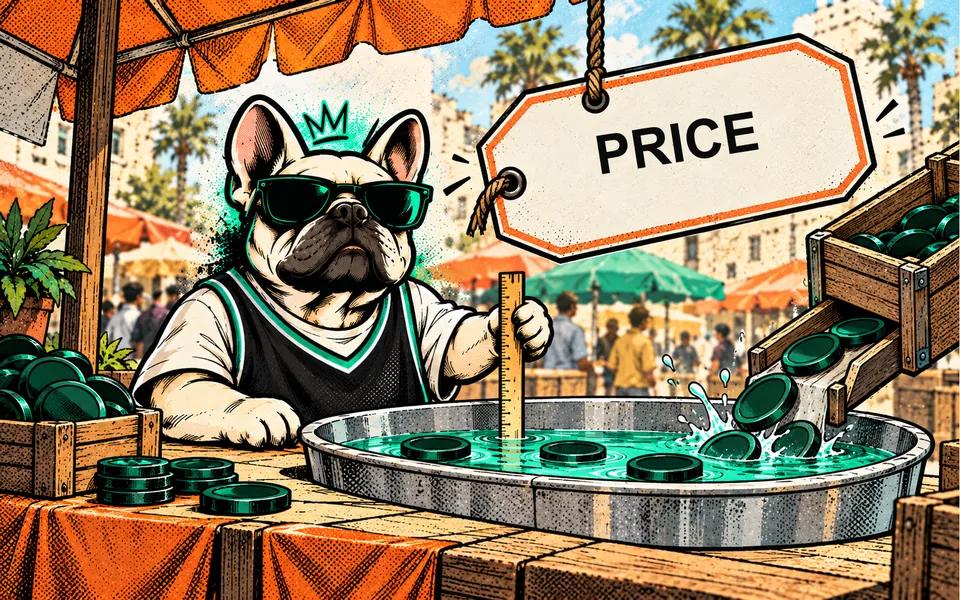
A swap screen gives you a price, a quote, price impact and maximum slippage. It is a lot of numbers for one button. They describe different measurements and limits—not a stack of fees to add together.
The token amounts below are made up so you can follow the arithmetic. They are not live quotes, recommended settings or instructions to trade. Uniswap's documented interface and reference code show how the concepts appear in one real system, within the scope stated here.
Price impact, slippage and tolerance are different
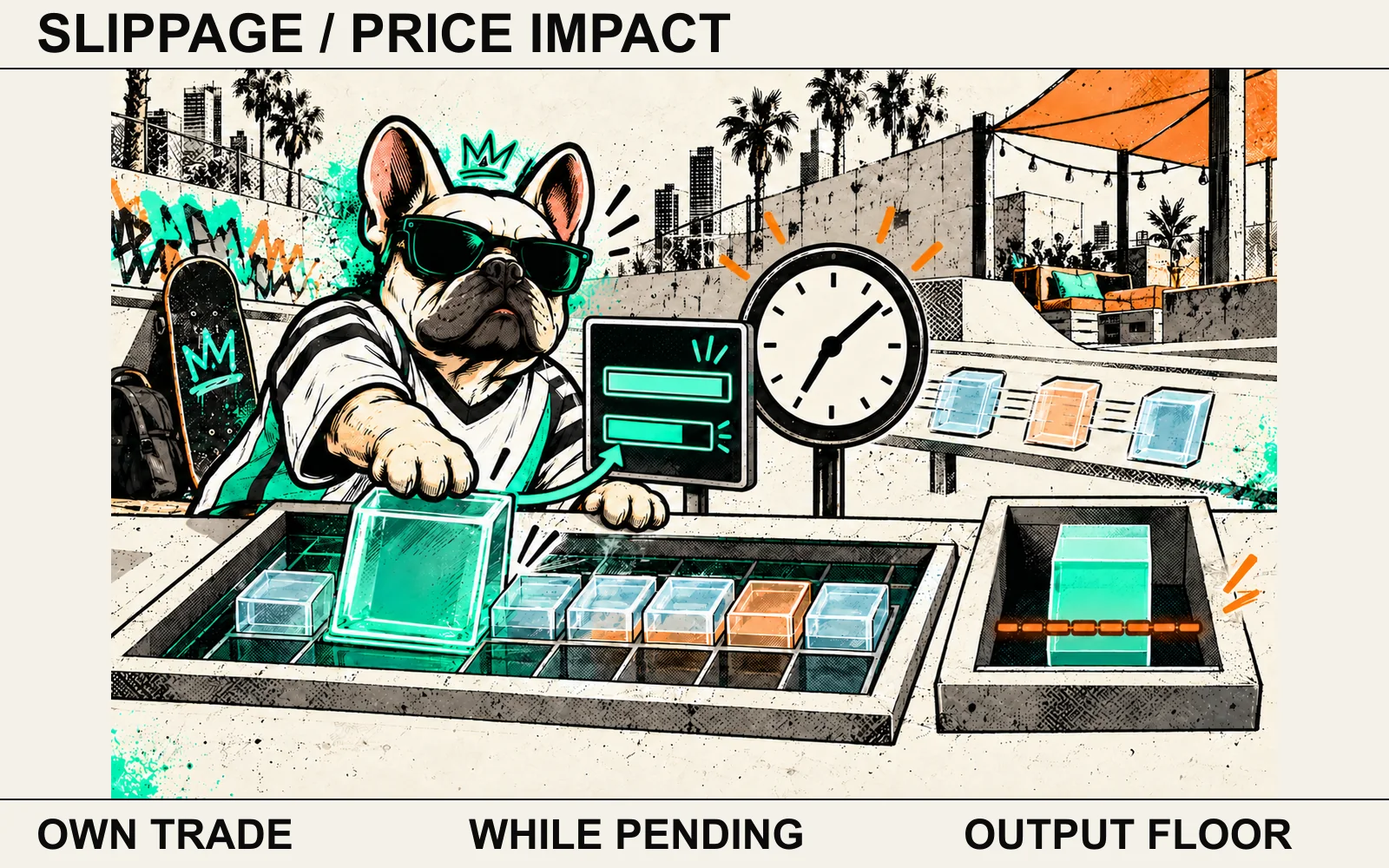
Uniswap Labs describes price impact as a price change caused by the trade itself. Its size depends on the trade relative to available liquidity. It can be anticipated in a full-size quote rather than appearing only after confirmation.
Uniswap's swap documentation distinguishes that effect from changes while a submitted transaction is pending. Other activity can change the state against which the trade eventually executes. For this guide, slippage compares that actual result with the quoted result—not with an unrelated headline market price.
| Label | What it describes | What it does not mean |
|---|---|---|
| Price impact | The trade's own effect on the available price | An extra fee automatically added after the quote |
| Slippage | The difference between quoted and executed results | A setting you paid to the exchange |
| Slippage tolerance | The boundary the swap is allowed to accept | A promised execution result or a safety rating |
A quote can already include your own price impact
Consider a fee-free hypothetical swap. At the starting spot ratio, the fixed input would correspond to 110 output tokens if the whole trade could use that unchanged ratio. Accounting for the trade's effect on available liquidity, the full-size quote is only 100 output tokens.
The output shortfall against that spot benchmark is (110 - 100) / 110 × 100 = 9.09%, rounded to two decimal places. This illustrates the distinction between a spot reference and a full-size execution quote. It is not an observed token price or a claim that every application's price-impact field uses the same adjustments.
The Uniswap v3 SDK reference compares spot-derived output with trade output for its price-impact calculation. This getter does not separately remove pool fees from the trade output before that comparison. Real routes also have fees and implementation details; our fee-free example removes those to isolate the mechanism. Reading this reference is not verification of the code deployed by a current website.
Crucially, the quote is 100, not 110. Do not subtract the illustrated price impact from 100 again as though the screen had forgotten it. The next comparison is between the quoted 100 and the actual execution result.
Minimum received: the separate execution boundary
Now suppose an illustrative exact-input swap quotes 100 output tokens and uses a 1% output-reduction tolerance. Its minimum is 100 × (1 - 0.01) = 99 output tokens. In the captured v3 SDK reference, minimumAmountOut applies (1 - tolerance) to raw output units, takes the integer quotient and clamps a negative result to zero. For an output token with six decimal places, 100 tokens means 100,000,000 raw units; the illustrative 1% reduction gives 99,000,000 units, or 99 tokens. A non-whole result is rounded down in positive raw units: 100.000001 quoted tokens gives a 99.000000-token floor in this example. For an exact-output trade, this method instead returns the fixed output amount.
The percentage in this example explains a bound; it is not a recommendation. Use the actual displayed and encoded minimum for the relevant route. Other interfaces, versions, token rounding or order types may present the calculation differently.
| Possible output | Difference from quoted 100 | Minimum of 99 satisfied? | What the boundary says |
|---|---|---|---|
| 99.5 | 0.5 fewer tokens, or 0.5% | Yes | The output floor alone permits this result |
| 98.5 | 1.5 fewer tokens, or 1.5% | No | A correctly enforced floor rejects this result |
| 100.4 | 0.4 more tokens, or 0.4% more | Yes | A minimum is a floor, not a cap on improvement |
These are alternative outcomes, not three executed trades. Satisfying the floor does not guarantee success: a deadline, allowance, balance, contract or other execution condition can still fail. An exact-input guard defines minimum output; it does not guarantee that the quote remains unchanged.
For exact-output swaps, the corresponding question is maximum input. If the quoted input is 50 input tokens and the illustrative permitted increase is 1%, 50 × 1.01 = 50.5 sets a maximum of 50.5 input tokens. Do not confuse that input limit with the output floor above. With six input-token decimal places, that is 50,000,000 raw units becoming 50,500,000. The captured SDK's maximumAmountIn uses the positive integer quotient of (1 + tolerance) × raw input for exact-output trades; for exact-input trades, it returns the fixed input amount. These examples describe the reference methods, not proof of a current interface's deployed code or a real order.
Where to look on an actual swap screen
The Uniswap Web App's documented screen separates the current market price, fee, network cost, route, price impact and maximum slippage. Its explanation says the maximum-slippage detail exposes minimum output.
Read the quantities and units, not just the percentage. Is the number a spot price, full-route quote, minimum received or maximum input? Which network, input contract, output contract and route does it belong to? The same ticker or a refreshed price label does not answer those questions.
A deadline is another constraint, not a price-protection substitute. A quote is prepared against a state that can change; the transaction's actual bounds are what the relevant contract enforces.
Slippage is not the pool fee or network cost
Keep the quote's fee treatment explicit. A route may account for liquidity-provider or protocol fees, and an interface may describe additional charges. Do not subtract a fee twice if the quoted output already includes it, or assume every displayed number is net of every cost.
At our 9 October 2026 source check (Asia/Tbilisi), Uniswap Labs' fee page states that it stopped charging interface fees on 27 December 2025. The page expressly separates that policy from protocol fees. This is an attributed, dated interface policy—not a promise that all swaps, interfaces or future routes are fee-free.
Uniswap's network-cost explanation separately covers transaction processing costs, including failed transactions. Here the fee-on-failure example is specifically an Ethereum transaction included onchain that reverts: it can still consume paid gas. An unsubmitted transaction, rejected wallet signature or dropped/unmined attempt is not the same event; a failed interface message alone does not establish that an onchain fee was paid. Network fees explained provides the broader context.
A minimum-output guard therefore does not promise a cost-free failure or protect every aspect of a token. Transfer restrictions and the exact contract's behaviour still matter.
Why “just increase tolerance” is not a diagnosis
Uniswap Labs' slippage guide warns that a low limit can cause a failure while a high limit can allow fewer tokens than expected. Increasing the range changes what is permitted; it does not repair shallow liquidity, an unsuitable route or a token's contract rules.
There is also transaction-ordering risk. Ethereum's MEV overview describes sandwich trading, in which transactions placed around another trade worsen its execution. A generous bound can leave more room for an unfavourable result, but a disappointing swap is not proof that a sandwich occurred. This guide does not diagnose a specific trade or promise protection from ordering attacks.
There is no universally “safe” tolerance supplied here. Identify the cause and the encoded constraints before interpreting an error message as a request to weaken them. The slippage definition and liquidity definition are compact starting points, not recommended settings.
What to compare after execution
Compare the transaction's actual token transfers with the quote you recorded, using the same token contracts, network, units and fee scope. A later refreshed screen is not necessarily the original quote. Separate tokens delivered, any retained position or custody balance, and the network fee.
An output that satisfied your boundary can still be economically unattractive. The setting defines what the transaction may accept, not what makes a trade sensible. Meme coins explained covers broader concentration, control and liquidity questions without predicting returns.
Read the numbers in order: spot reference, full-size quote, transaction bound, actual execution. The quote is not a time machine. Keeping those stages separate stops price impact, later slippage and fees from turning into one misleading number.
Sources
Sources checked 9 October 2026 (Asia/Tbilisi). Two Uniswap support pages were read as complete official web extracts supplied by Media Factory; their original direct-fetch HTTP 403 responses remain in the research record. Their displayed update dates are 25 September 2025 for the swap screen and 22 September 2026 for network costs, not new event dates. Other sources were revalidated through bounded public HTTP retrieval. No swap, wallet connection, deployed-code audit or specific MEV diagnosis was performed.
- Uniswap Labs: What is price impact?
- Uniswap Developers: Swaps, protections and pending-state changes
- Uniswap Labs: The Web App swap screen
- Uniswap Labs: Slippage settings and their limits
- Uniswap Labs: Current interface-fee policy
- Uniswap Labs: Network costs
- Uniswap: v3 SDK Trade reference implementation
- Ethereum.org: MEV and sandwich trading
See something wrong? Brokzi logs material changes. Prepare a correction note.