The token has a bitcoin-looking name. Your wallet shows a balance. That still does not make it bitcoin on the Bitcoin network: contracts, custody and conversion arrangements sit behind the label.
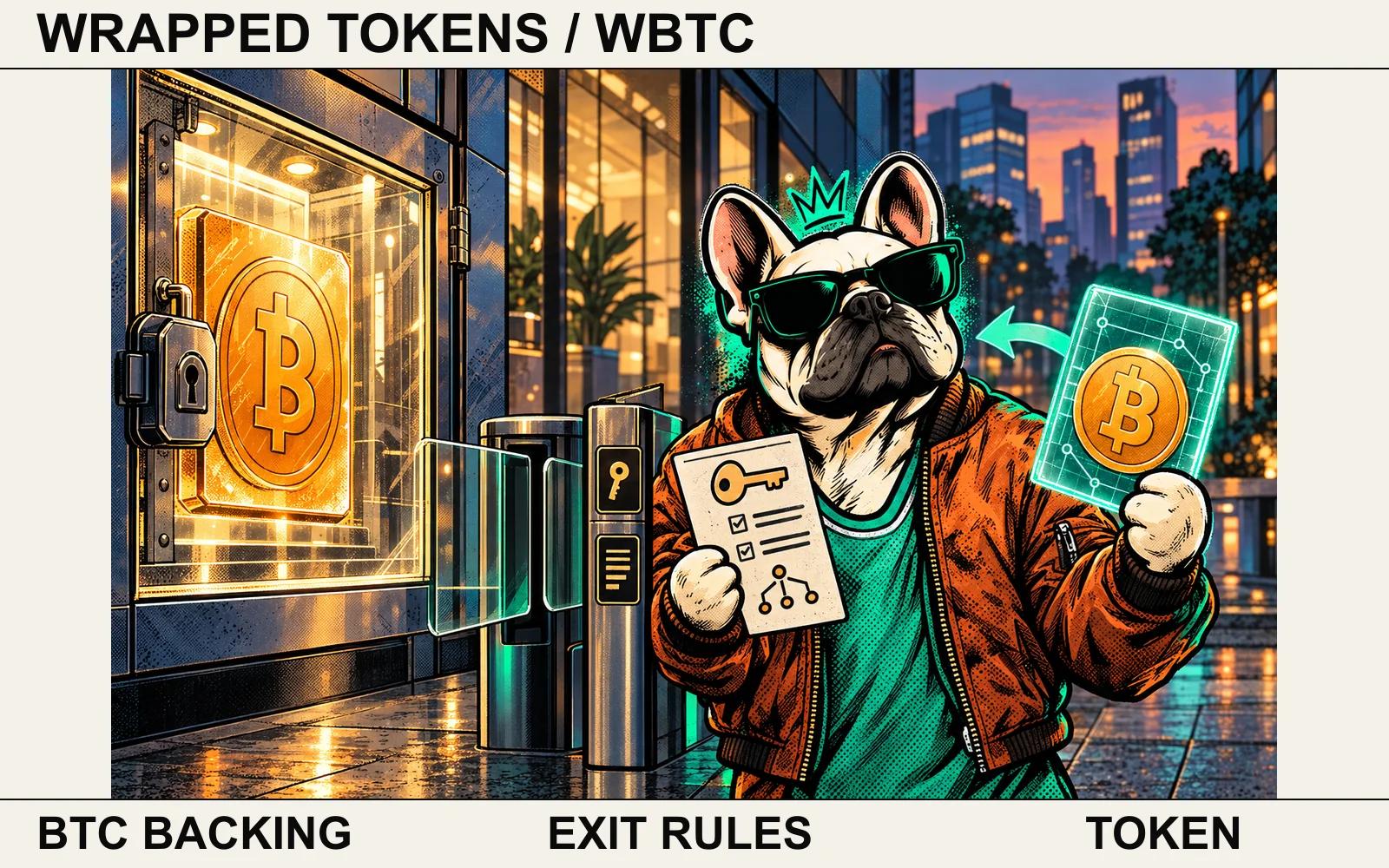
“Does it track BTC?” is only the first question. What do you hold, who controls the backing, and what would have to happen to receive the original asset? WBTC is our documented example, not a recommendation to buy, bridge or lend it.
What is a wrapped token?
A wrapped token represents another asset in a token format a particular network or application can use. The token has its own state and contract rules. Its connection to the represented asset depends on the specific wrapping mechanism, not on a familiar name or icon.
Ethereum's bridge overview describes lock-and-mint systems in which a source asset stays locked while a destination contract creates a representation. That is one model, not the definition of every wrapped token. Some wrapping happens on the same network; some relies on off-chain custody.
Think of the wrapper as a second set of rules, not bubble wrap that makes the original asset safer. A token balance and the arrangement behind that balance are separate things to examine.
Wrapped bitcoin versus bitcoin: the WBTC case
BTC is the native asset of the Bitcoin network. WBTC is a token used on other networks. Its current overview describes a BTC-backed custody architecture managed by authorised custodians. Those are the project's stated arrangements, not our independent audit of reserves or custody.
On Ethereum, WBTC interacts with token contracts and applications rather than becoming a Bitcoin-network balance. The WBTC FAQ describes its use in lending and liquidity applications. Those integrations explain the token's purpose; they do not remove the risks of the application, token contract or backing arrangement.
In its 7 October 2026 announcement, WBTC says it is exploring additional custodians and evaluating a shortlist. Selection and transition details are not finalised. That announcement describes an evaluation, not a completed reserve migration or an independently verified improvement in safety.
| Question | Native BTC | WBTC example |
|---|---|---|
| What balance is being transferred? | Native bitcoin on the Bitcoin network | A token balance on the specific supported network |
| What additional backing arrangement applies? | No WBTC custody arrangement | The project's BTC custody and issuance arrangement |
| What does receiving BTC require? | A Bitcoin-network transfer | A supported conversion or redemption route and its conditions |
This compares the asset mechanisms, not every way of holding them. BTC held through an exchange can introduce custody too. A self-custodied WBTC token removes neither its backing dependency nor the rules of a separate application using it.
Minting, burning and who can use those routes
WBTC's current FAQ describes minting through an authorised merchant after a custodian confirms the BTC deposit. For redemption, the described flow involves an authorised merchant, burning WBTC and the custodian releasing BTC. These steps connect token supply to the backing arrangement.
The project's current home page states that only identity-verified institutions approved through its governance can mint and burn. A retail holder's ability to send WBTC is therefore not the same as unrestricted access to institutional issuance and redemption.
The documentation does not establish that every individual holder, in every country, has a direct claim or an available account with a particular merchant. This guide does not infer that right. The actual service, legal entity, eligibility rules and transaction terms would need to be identified separately.
A market swap is not institutional redemption
Selling WBTC to another participant transfers the token; it does not necessarily burn that token or release its backing. A market exit depends on the counterparty or venue and the available trade. Institutional redemption changes supply and involves the custody route described above.
WBTC's FAQ lists several kinds of conversion venue. Treat that as the project's general description, not evidence that every listed venue currently offers a direct WBTC-to-native-BTC withdrawal in your country. A swap inside an Ethereum application can result in another token, not BTC delivered to a Bitcoin address.
Keep the trade, the asset received and the withdrawal network separate. “Converted successfully” does not answer all three. A familiar BTC-like ticker on the destination screen is not enough to identify its issuer, contract or network.
What a reserve display can and cannot establish
The WBTC transparency dashboard displays reserve addresses, token supply and issuance or redemption activity. These are useful records to examine. This article does not independently attest control of the displayed wallets, reconcile every chain's supply or test an actual redemption.
The project's proof-of-reserve documentation treats sufficient displayed reserves as establishing solvency. That is the project's assertion. A comparison between reported assets and token supply alone does not establish all liabilities, legal rights or operational ability to redeem when requested.
A 2023 SEC staff investor bulletin explains why proof-of-reserve reports are not equivalent to financial-statement audits, including their incomplete picture of liabilities. It is general US staff guidance, not a finding about WBTC, a new rule or a statement of European law.
The distinction is about evidence: “these balances are visible” and “this holder can obtain BTC under these terms” answer different questions. Neither a reserve badge nor this article substitutes for the second answer.
Website terms are not your redemption agreement
WBTC's website terms, dated 1 September 2025, address use of the website and its information. They include accuracy and availability disclaimers. They are not, by themselves, proof of an individual's agreement with a merchant or custodian to redeem tokens.
If a route is relevant to you, identify the terms offered by the actual service and legal entity. Eligibility, fees, minimum amounts, withdrawal availability and applicable jurisdiction are route-specific questions to verify, not universal conditions supplied by this guide. We did not obtain or review an individual holder's signed redemption agreement.
Do not send assets to an address simply because a page or support message calls it an “unwrap” address. This article supplies a reading checklist, not a wallet-connection, transfer or recovery procedure.
Does every wrapped token have an off-chain custodian?
No. The canonical WETH9 reference contract provides a different example: deposits of native ETH credit token balances, and the withdrawal function deducts the caller's balance before transferring ETH. The wrapping takes place within the Ethereum contract mechanism rather than WBTC's off-chain BTC custody arrangement.
That is a reading of the reference implementation, not an audit of a particular deployed contract. It does not prove that every token called WETH uses that code or that every bridged version has the same exit path. Ethereum explained provides the network context; the actual token still needs to be identified.
“Wrapped” describes a broad family of representations, not one uniform risk rating. Ask which mechanism this exact token uses before transferring conclusions from another wrapper.
Five questions before treating tokens as interchangeable
- Which network and exact token contract does the balance belong to?
- Is the original asset held in a contract, by a custodian or through another arrangement?
- Who can initiate conversion or redemption, and under which service's current terms?
- Will the proposed exit deliver the original native asset or another representation?
- What does the reserve evidence actually cover, and what remains unverified?
These questions also help distinguish stablecoin backing and redemption from a claim that any token tracking another asset must have identical rights. A bridge can add another dependency layer; the word “wrapped” does not tell you whether that layer exists.
The wrapper is not the whole story. Read the token, its backing and its exit route separately. This guide explains documented mechanisms; it does not rank safety, offer a legal opinion, predict prices or promise that redemption will always work.
Sources
Primary sources checked 8 October 2026. WBTC disclosures describe the project's arrangements and claims; they are not our reserve or redemption audit. The custody-exploration date comes from the matching announcement card on its home page; the source hour is unknown. The WETH9 discussion is a reading of the reference code, not a deployed-contract safety assessment.
See something wrong? Brokzi logs material changes. Prepare a correction note.