An updated client and a readable archive are not the same result.
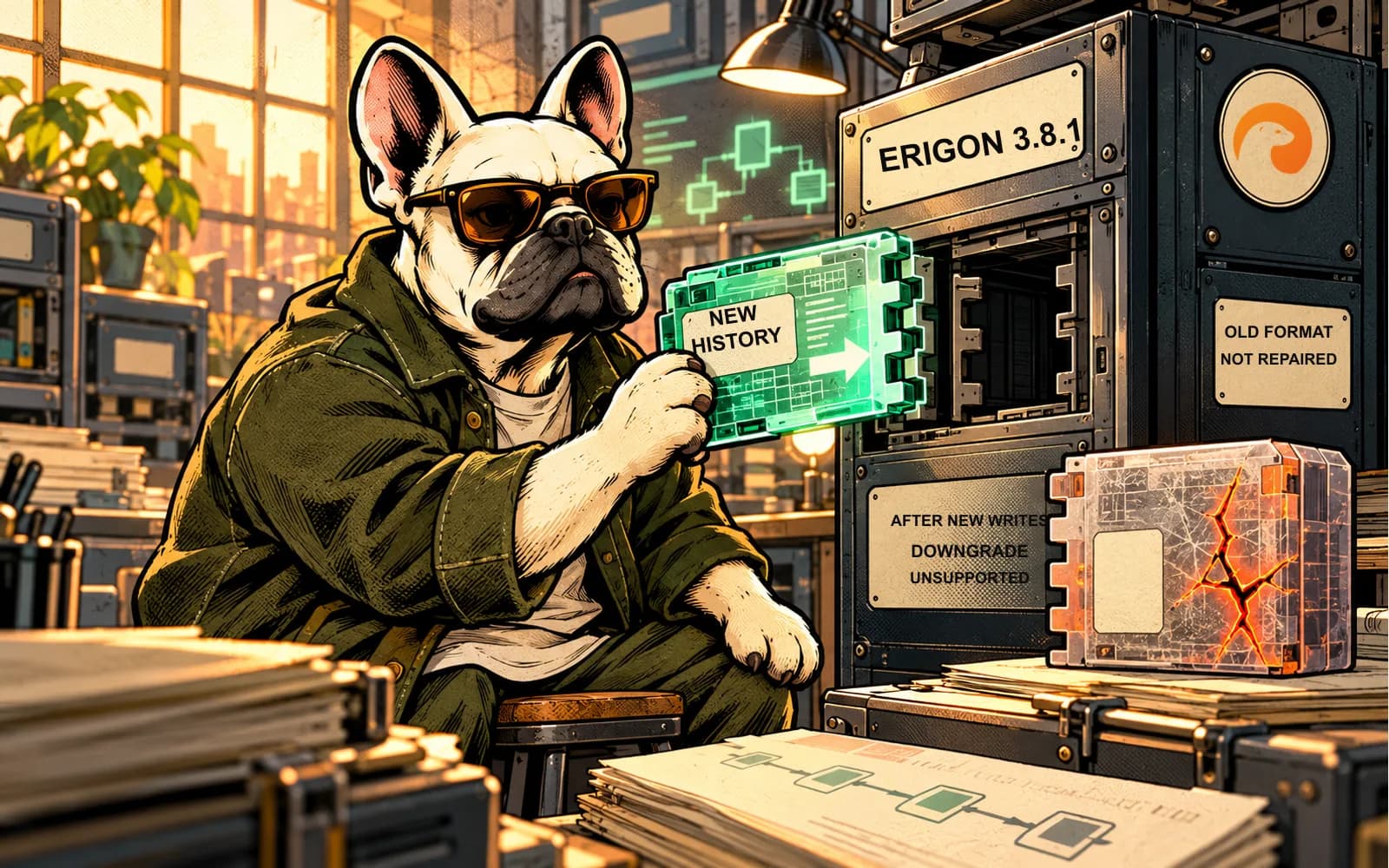
Erigon 3.8.1, published October 23, 2026, at 21:30 UTC, changes how its embedded Caplin consensus client stores Gloas builder history. The release notes put two limits beside the fixes: a downgrade is not supported after the new records have been written, and an upgrade alone does not repair affected frozen history in the old format.
We reviewed those notes on October 26. This is coverage of that dated release, not a claim that a new release or fork happened today.
What happened
Erigon is an Ethereum execution client that can use its embedded Caplin consensus client or an external consensus client. The version-tagged project README describes that arrangement. An archive keeps historical data used to answer questions about earlier states; it is not just the latest chain view.
Version 3.8.1 includes validation, validator and block-production fixes. The archive-specific change concerns historical-state handling around Gloas. Its backport, pull request 25256, brings several history fixes into the 3.8 release line, including changes to builder records and an epoch-indexed PtcWindowEpoch history table.
That distinction matters: a change to stored records can have consequences beyond replacing an executable.
What is confirmed about the archive limits
The release notes make three points about Caplin archive history:
- Nodes that already processed Gloas may rebuild historical states from before the fork. Where
PtcWindowEpochsnapshots are unavailable, post-fork history is processed locally. - Downgrading after the new builder-history records have been written is not supported. This is a conditional storage-compatibility limit, not a statement that every installation immediately loses every downgrade option.
- Existing frozen Gloas history in the old format is not repaired by upgrading. The notes include affected Sepolia snapshots in that warning: historical reads continue failing until those snapshots are rebuilt or replaced.
These are the maintainers' stated conditions. We have not run a rebuild, attempted a downgrade or examined an operator's database.
Why it matters: three checks, not one green light
For an operator or a service consuming historical data, "the new version is running" answers only one question. The archive's stored format and the behavior of API consumers need separate checks.
| Area | Change described by Erigon | What a successful version update alone does not prove |
|---|---|---|
| Builder history | New record format for Gloas historical-state fixes | That an older version can read newly written records |
| Frozen archive snapshots | Old-format affected history is not automatically repaired | That historical queries now succeed |
| Beacon API consumers | Metadata fields and some error responses change | That an existing parser handles the new response correctly |
The table is a reading guide to the release, not a repair procedure. It supplies no commands, snapshot source or recommendation to rewrite production data.
Beacon API responses change too
For the node-identity endpoint, pull request 25194 changes seq to seq_number, adds 0x prefixes to attnets and syncnets, and includes custody_group_count from Fulu. A consumer expecting the previous field or encoding can need a corresponding parser change.
The release also describes a different response to sync committee messages from validators outside the slot's committee: HTTP 400 with failing message indices instead of a silent 200. It links pull request 25131. A successful-looking HTTP status and an accepted message should not be treated as interchangeable evidence.
What remains unknown here
This report does not establish which operators hold affected snapshots, whether a particular service's historical queries fail, or how long rebuilding would take. It does not independently measure performance gains or report an exploit, loss of funds or whole-network failure.
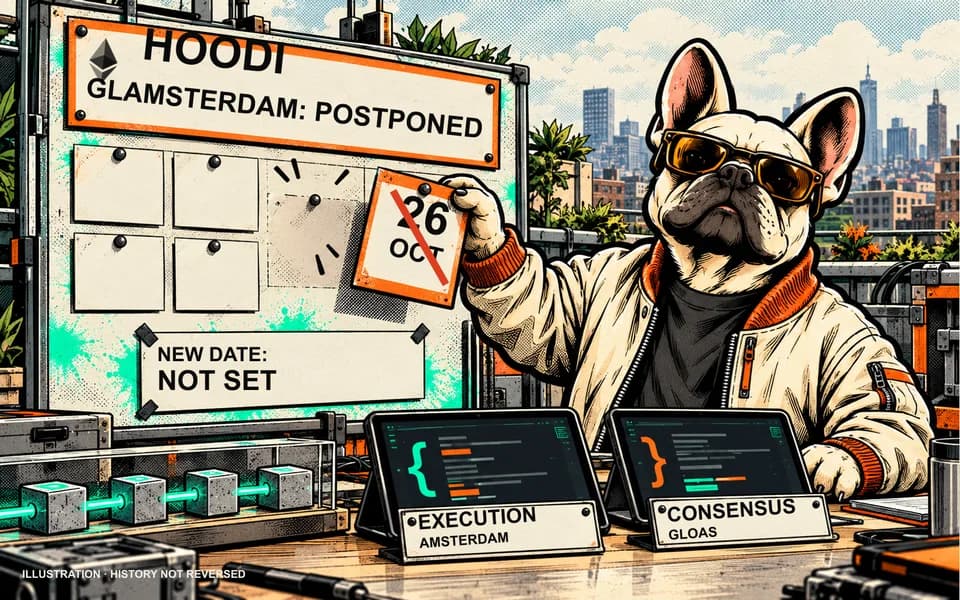
The notes also remove the previously scheduled Glamsterdam activation on Hoodi, with no replacement date stated. That is context for the Hoodi postponement already covered by Brokzi, not a new activation. Earlier pull-request references to the old schedule do not override the later release notice.
The maintainers say non-archive nodes can move from 3.8.0 without a resync. That statement should not be stretched into a promise that every archive, snapshot or API integration is unaffected.
Brokzi's Take
The important part of this release is not just the version number. Read the condition attached to each claim: new records affect downgrade support, old frozen snapshots keep their own limitations, and API consumers have their own compatibility work. One green status light cannot answer all three.
For the underlying network roles, see Ethereum's execution, consensus and application layers.
Sources
Primary project material checked October 26, 2026. Release statements and merged pull requests support this report; Brokzi did not install software, operate a node, test APIs or audit storage. The illustration is fictional, not documentary evidence of a repaired archive. Educational reporting, not operational or financial advice.
See something wrong? Brokzi logs material changes. Prepare a correction note.