
Your stETH balance changed, but the transfer history has no matching incoming payment. That can be a feature of the token's accounting. It is still a reason to check the record, rather than assume either free money or a wallet problem.
stETH is a rebasing token: its balance depends on the holder's shares and the protocol's pooled accounting. A rebase can change that balance without an incoming or outgoing holder transfer, and Lido does not emit an ERC-20 Transfer event for each holder's rebase. Adding up transfer-history rows alone therefore does not reconstruct every stETH balance change.
This explainer concerns Lido's documented stETH accounting on Ethereum. We compare two invented snapshots, not a real account or live pool. For market sales, wrapping and protocol withdrawals, use the separate liquid-staking exit guide.
A stETH balance is calculated from shares
The Lido contract documentation describes a share-based balance. Instead of storing only a fixed token quantity for each account, the contract records its shares in the pooled accounting. The documented relationship is:
token balance = holder shares × total pooled ether ÷ total shares
The returned balance is an integer. Fractions from the division do not become fractional raw units in the result. The integration guide explains the rounding implications of this conversion.
Keep three quantities separate: the holder's share count, the total share count and the pooled amount. If the holder's shares stay unchanged while the amount represented by each share changes, its calculated token balance can change too.
This is accounting for an identified token, not a price feed. It does not tell you what a buyer will pay for stETH or how much native ETH an exit will deliver.
Two fictional snapshots, with no holder transfer
For a small, inspectable example, name the observation context Ethereum mainnet, documented canonical stETH, ACCOUNT-A. ACCOUNT-A is an invented label, not an address. SNAPSHOT-A and SNAPSHOT-B are invented observation labels, not block numbers or captured responses.
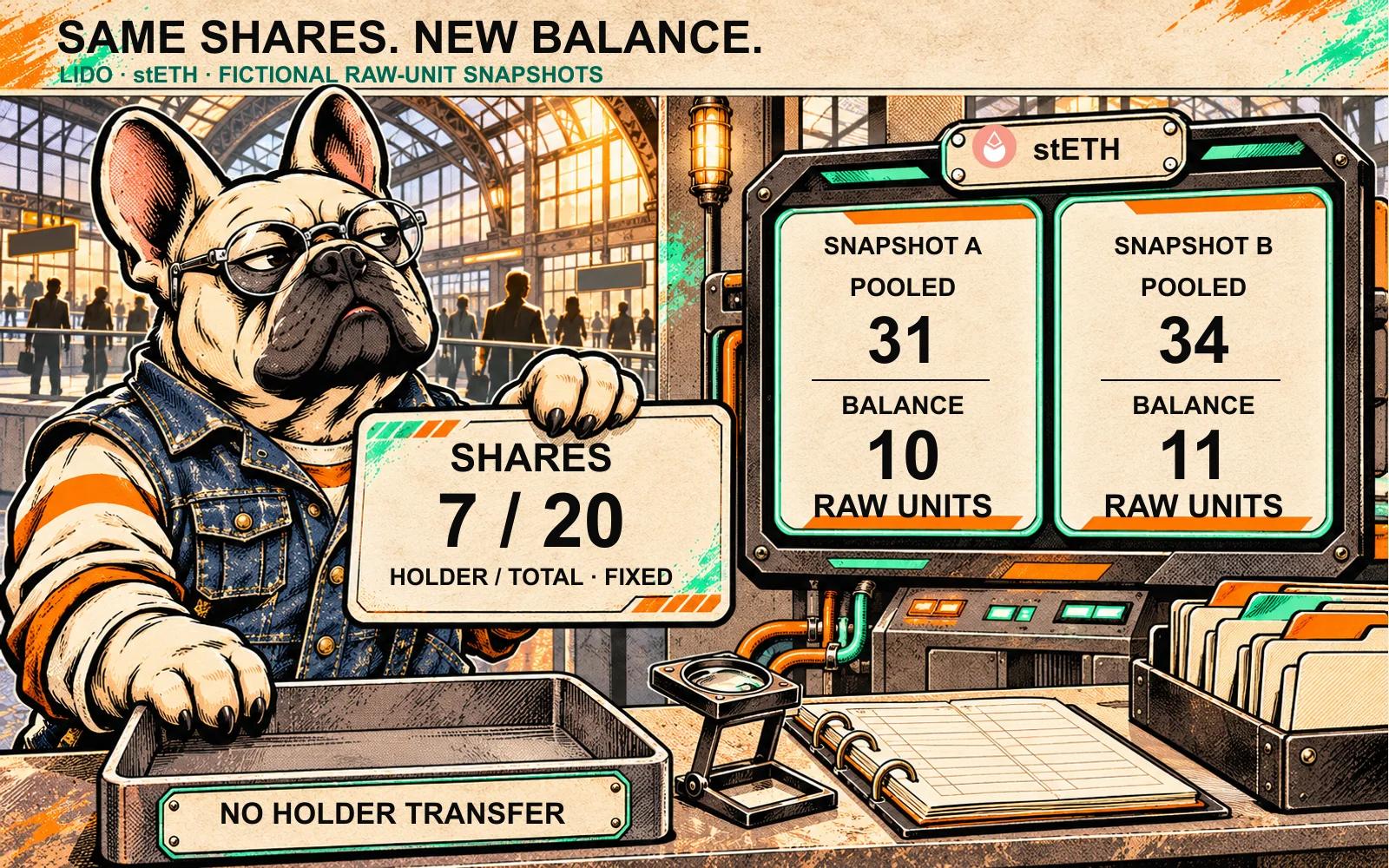
Use deliberately tiny raw-unit inputs, not whole stETH amounts. Assume exactly 7 holder share units and 20 total share units in both snapshots. Assume no holder transfers, deposits, withdrawals, minting or burning between them, and no fee-share issuance or other change to the total share count. Only the assumed pooled amount changes.
| Fictional quantity | SNAPSHOT-A | SNAPSHOT-B |
|---|---|---|
| ACCOUNT-A's raw share units | 7 | 7 |
| Total raw share units | 20 | 20 |
| Pooled amount in raw wei units | 31 | 34 |
| Calculated raw stETH balance | 10 | 11 |
| Holder transfer between snapshots | None assumed | None assumed |
The calculations are:
- A:
7 × 31 ÷ 20 = 217/20, giving 10 raw units after rounding down. - B:
7 × 34 ÷ 20 = 238/20, giving 11 raw units after rounding down.
The holder's share count remains 7. Its calculated balance rises by 1 raw unit because the assumed pooled amount changes relative to the fixed total shares. That difference does not require an incoming holder transfer in this example.
stETH's documented decimal scale is 18, so these tiny raw quantities are not 10 and 11 whole stETH. The numbers are chosen to expose the accounting and integer rounding, not to imitate a real pool's size, share rate or reward.
The fixed denominator is an explicit simplification. Actual accounting can involve new shares, burns, fees, withdrawals and other changes. Do not apply this two-row exercise as a complete reconciliation of an unidentified real account.
Why the transfer list can miss this change
Lido's integration guide explicitly notes that stETH balance changes on rebase without incoming or outgoing user transfers and without an ERC-20 Transfer event for that change. The contract documentation explains why updating every holder with a separate event would require an unbounded loop.
A transfer-history list answers which transfer events it has indexed. That is a different question from what a rebasing token's balance is at a particular observation. A complete sum of those events can still omit a balance effect that does not produce that event.
In our isolated example, starting from 10 raw units and adding zero incoming transfers would leave a transfer-only calculation at 10. The second assumed accounting snapshot instead gives 11. The missing ingredient is the share-to-pooled relationship, not a secretly delivered extra token.
This does not mean nothing happened in the protocol. The accounting update is activity. Nor does an empty wallet tab prove that the provider indexed every relevant event, that the token is genuine or that an unexplained balance change is harmless.
Our logs and transaction-views explainer follows a conventional transfer through its different records. stETH adds a reason to check the token's own accounting before treating an event list as a complete balance ledger.
Rounding and decimals solve different problems
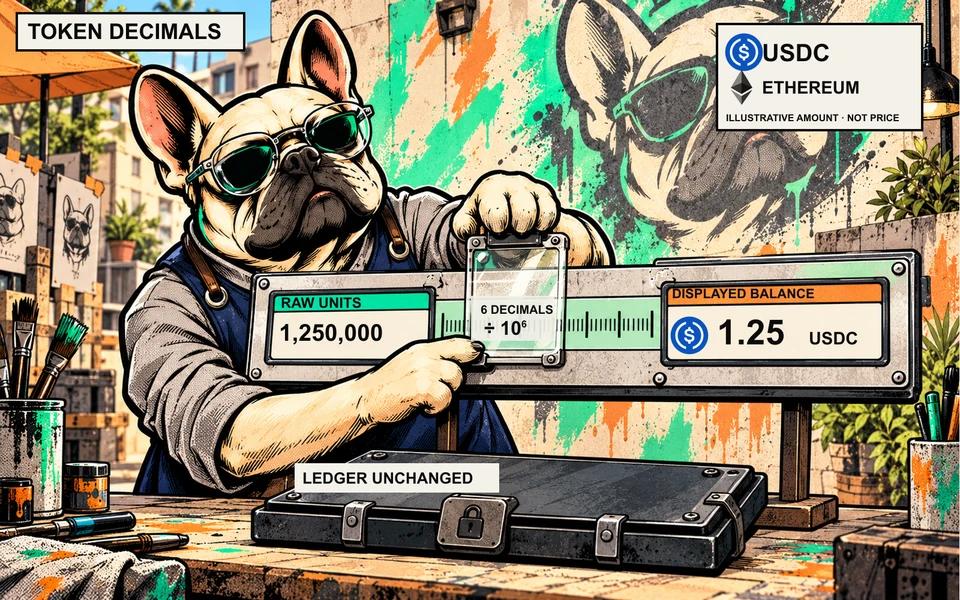
Decimals give raw units a display scale. Share conversion determines the raw balance first. Moving a decimal point cannot repair a comparison that used the wrong share count, pooled amount or observation context.
The toy fractions above are mathematical ratios. They are not a claim that a contract computes with floating-point numbers. Integer division returns whole raw units; a rounded wallet display may hide a small underlying change again.
Lido's guide describes a familiar 1–2 wei transfer-rounding corner case and warns that the discrepancy can become larger as the share rate changes. Do not turn that example into a universal maximum error. A particular transfer or balance comparison needs its actual inputs and implementation context.
For the separate task of converting a raw token amount into display units, see token decimals. A formatting discrepancy and a rebase can look similar on a screen while having different causes.
What to compare before explaining a real difference
Keep a short record of what each screen or saved observation actually describes:
- The same chain, token and account. A familiar ticker is not enough. A bridged representation on another network may use different accounting.
- The observation contexts. Retain the relevant block identifiers and observation times when they are available. A cached wallet display and a newer chain record need not describe the same state.
- The units. Distinguish raw share units, raw stETH units and displayed token quantities. Do not compare shares directly with whole tokens.
- The accounting changes. Identify the documented ratio and any transfers, mints, burns, fee-share issuance or other state changes affecting the comparison. The holder and total share counts cannot simply be assumed constant.
- The explanation's limits. A rebase is one possible explanation under this token's rules. Missing or conflicting evidence remains unresolved; it is not proof of a benign update or of theft.
This is a reading checklist. It requires no wallet connection, recovery phrase, signature, new transfer or attempt to “sync” funds. Do not give secrets to a service offering to correct a displayed balance.
wstETH changes the representation, not the exit promise
The integration guide describes wstETH as a non-rebasing representation: its holder token count does not change merely because stETH rebases. Instead, the stETH represented by each wstETH changes with the accounting relationship.
An unchanged wstETH count therefore does not mean the represented stETH amount must be unchanged. Neither quantity is automatically an executable market quote or a native ETH payment. The existing liquid-staking guide owns those conversion and exit-route questions; this article's task is reconciling a balance with its accounting.
A rebase also need not arrive at a guaranteed daily time or always increase balances. The documentation allows delayed reports and negative outcomes. No current yield, loss probability, reward schedule or live share rate is measured here.
Sources and scope
Both complete official documents were checked on 21 November 2026. They are rolling developer documentation, not an independent audit or a measurement of deployed chain state.
The contract page describes Lido V3 external-share accounting and documents getContractVersion() as returning 4. That is what this captured document says; no deployed bytecode, version or account state was queried. Its source commit, release build and documentation build date were not established. The simplified fixed-share example does not model every Core, stVault or withdrawal-accounting change.
The guide also contains historical integration examples, operational instructions and promotional statements. Those are not used as current safety, availability, oracle-committee or “never negative” findings. No code sample, contract method, RPC request, wallet, deposit, transfer, wrap, trade or withdrawal was executed.
- Lido: Tokens integration guide — share bookkeeping, rounding, rebasing versus non-rebasing representation, and the wallet-integration warning about absent
Transferevents. - Lido: Core contract documentation — the documented balance formula, rebase mechanism, dynamic balances and version/context limits.
See something wrong? Brokzi logs material changes. Prepare a correction note.