The token can move while the underlying stake still needs an exit process. That is the attraction of liquid staking, and the source of a common misunderstanding: a balance labelled ETH-like is not necessarily ETH ready to withdraw.
This explainer follows Lido's stETH and wstETH on Ethereum mainnet. It is for readers trying to identify what they hold and what an exit would involve, not choosing a yield product. Other liquid staking tokens can use different accounting and withdrawal rules.
What liquid staking makes transferable
Ethereum's staking overview explains the underlying activity: validators participate in consensus with ETH at stake and face rewards and penalties. Liquid staking adds a token representation that can circulate separately from that validator position. Transferability changes how the holder can use the position; it does not remove the staking exposure.
In the Lido Core deposit route described by its integration guide, ETH deposits mint stETH, subject to the protocol's staking limits. The token's share accounting reflects pooled ETH and staking results. stETH balances can rebase when accounting reports are accepted, including downward changes under adverse conditions. Do not assume every daily update is a gain.
The current guide also describes issuance through Lido V3 stVaults. This article does not assess vault configurations or treat the Core deposit route as the only source of canonical stETH. Its focus is the token and the documented wrapper and withdrawal mechanisms.
stETH and wstETH display the position differently
The wstETH contract documentation describes a wrapper around stETH. Its balance does not rebase with each accounting report; instead, the stETH represented by each unit changes. Unwrapping burns wstETH and returns the corresponding stETH. It does not, by itself, deliver native ETH.
The wrapper exposes conversion methods such as getStETHByWstETH and stEthPerToken. These describe token accounting, not an executable market quote. A trading venue can offer a different exchange rate, with its own liquidity and costs.
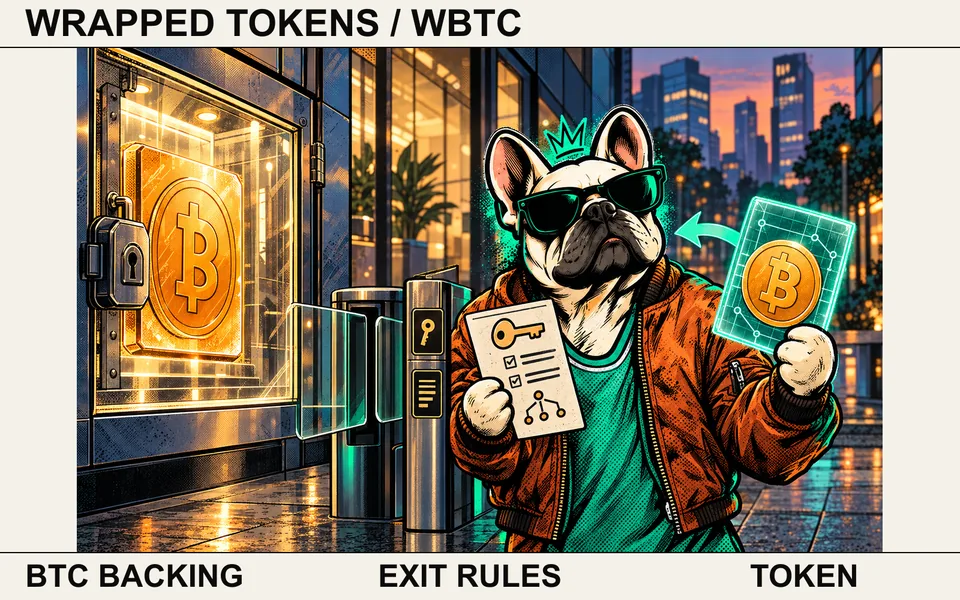
Our wrapped-token explainer covers the broader distinction between a representation and its exit route. Here the specific wrapper returns stETH, so there is another step between unwrapping and a protocol ETH claim.
One balance, three different calculations
Suppose a fictional holder has 5 wstETH. Invent a conversion rate of 1.6 stETH per wstETH solely for this example, ignoring integer rounding. The wrapper conversion would give:
5 wstETH × 1.6 stETH/wstETH = 8 stETH
Now suppose a hypothetical market offers an average executed rate of 0.99 ETH per stETH for selling that whole 8-stETH amount, before separately charged costs. The sale proceeds would be:
8 stETH × 0.99 ETH/stETH = 7.92 ETH
The difference from an 8-ETH comparison amount is 0.08 ETH, or 1% of 8 ETH. That is a comparison between invented quantities. It is not a measured discount, current Lido rate, fee estimate or prediction that a protocol withdrawal would pay 8 ETH.
| Route in this fictional example | What the calculation or record means | What it does not establish |
|---|---|---|
| Unwrap 5 wstETH | 8 stETH at the assumed wrapper rate | Receipt of native ETH |
| Sell 8 stETH at the assumed average market rate | 7.92 ETH before separately charged costs | The current quote or a guaranteed future price |
| Request protocol withdrawal for 8 stETH | A request governed by the withdrawal contract | An immediate 8-ETH payment or a fixed completion date |
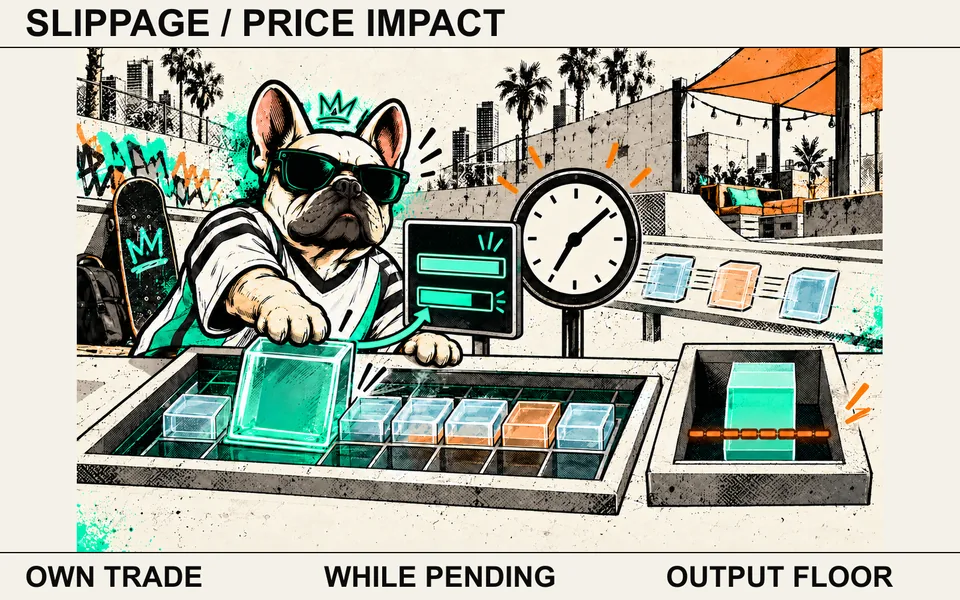
These are alternative routes for understanding the position, not instructions to perform them all. A quote for a tiny trade is also not necessarily the average price available for a larger sale. See slippage and price impact for that distinction.
Lido's withdrawal request is not the payout
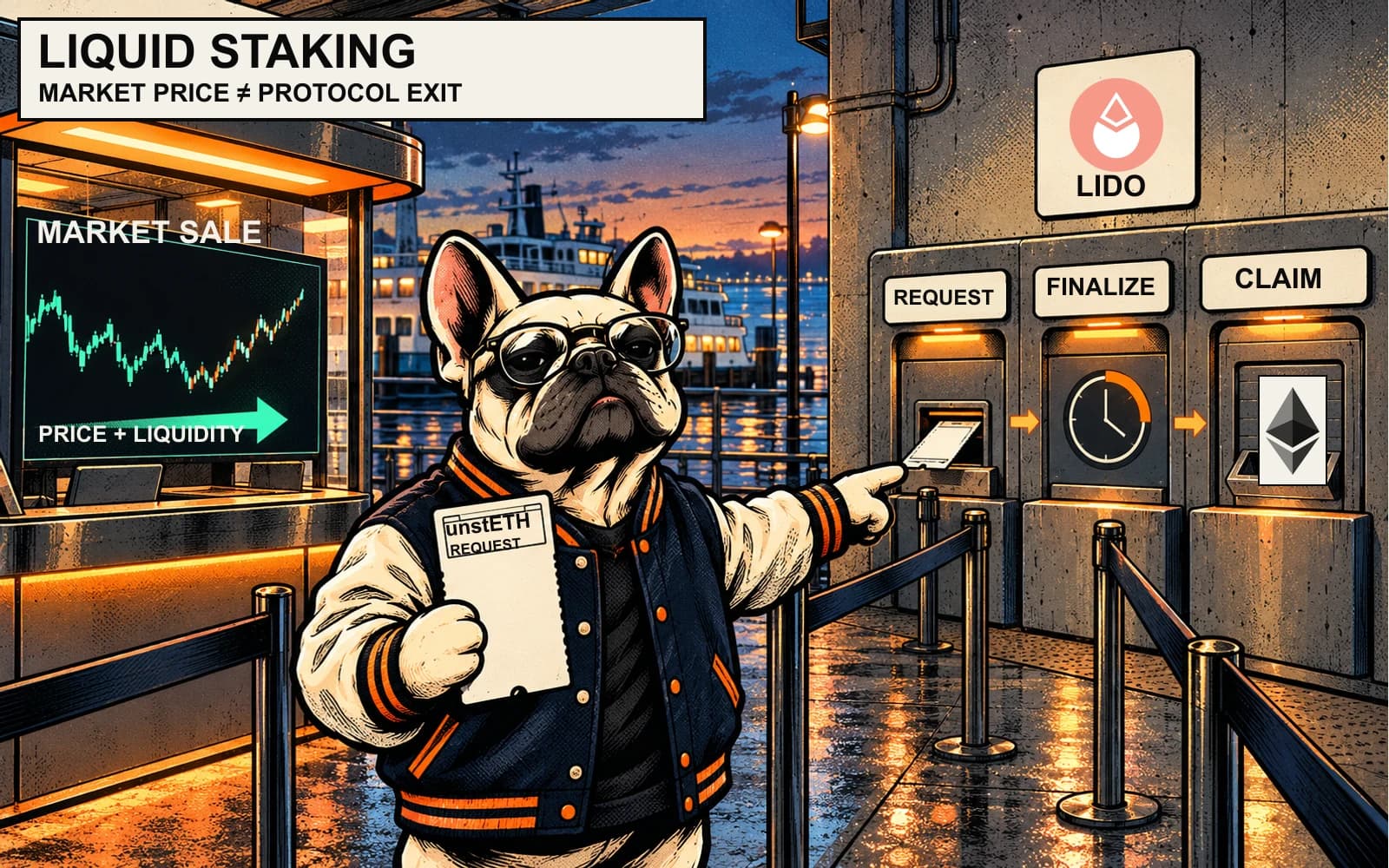
Lido's WithdrawalQueueERC721 documentation says a request transfers stETH into the queue and creates an unstETH claim NFT. Its wstETH route unwraps to stETH within that process.
The request is not an immediate ETH payout. Finalization values the request, reserves ETH and burns the underlying stETH. Claim transfers the reserved ETH to the current NFT owner's chosen recipient and burns the NFT.
Available ETH, timing conditions and accounting affect finalization; losses can reduce the outcome. Queued tokens earn the holder no waiting-period rewards but retain loss exposure. A displayed estimate is not a universal waiting-time guarantee.
This is Lido's documented mechanism, not a rule for all staking services. It is also not a live check of queue length, claimability or the amount available for any holder today.
A market sale solves a different problem
Selling a token transfers it to a buyer or trading pool under that venue's terms. The sale need not unwind the underlying stake. A protocol withdrawal instead follows the token's own exit mechanism.
Lido's public risk disclosure separates these pathways. Secondary trading exposes the holder to spreads, slippage and price deviations; protocol withdrawals expose them to timing and accounting conditions. A discount can persist when the exit process constrains arbitrage. Neither route is a universally better choice supplied by this guide.
Keep the received asset and network explicit. ETH, wrapped ETH and another chain's token representation are not interchangeable labels for one withdrawal result. This article's mainnet example does not establish a local unwrap or exit route for a bridged token on another network.
The risks still attached to a transferable token
Validator performance affects the stake behind the token. Ethereum distinguishes ordinary missed-duty penalties from slashing for provable misconduct; a token wrapper does not switch those conditions off. The protocol also adds contract, oracle and governance dependencies. The disclosure warns that audits and operator diversification do not eliminate loss risk.
Using the token as collateral adds the lending application's rules too. A borrower's liquidation threshold is not a promise that a staking withdrawal will finish before collateral is needed. Likewise, an upgradeable contract has authority and code dependencies that a market price cannot certify.
No APR, safety ranking or loss probability is estimated here. Rewards, conversion accounting and the price somebody will pay are separate observations.
A read-first exit checklist
Before interpreting a staking-token balance as spendable ETH, establish:
- The exact network, token and contract. Distinguish stETH, wstETH and a bridged representation.
- Whether the screen shows a token balance, a wrapper conversion or a market quote, with its units and observation time.
- What asset the proposed route delivers, and whether it is a sale, an unwrap or a protocol withdrawal.
- For a withdrawal, who owns the claim and whether it is requested, finalized or already claimed.
- Which timing, cost, loss and application conditions remain outside the displayed number.
Liquid staking makes a position easier to transfer. It does not make every exit immediate or fix the amount a sale will realize. Read the route behind the balance before treating the token as ETH in hand.
Sources
Primary documentation checked October 21, 2026. Lido sources describe that protocol's programmed mechanisms and disclosed risks, not an independent contract audit or guarantee of current operations. The worked quantities and illustration are fictional. No wallet connection, staking deposit, swap, withdrawal request, signature or claim was performed.
- Ethereum.org: Staking: validator participation, penalties and slashing; displayed live yield and totals are not used in this article.
- Lido: Tokens integration guide: stETH share/rebase accounting, Core and stVault issuance context.
- Lido: wstETH contract: wrapper conversion and the asset returned by unwrapping.
- Lido: WithdrawalQueueERC721: request, finalization, claim, waiting-period reward treatment and loss boundary.
- Lido: Public risk disclosure: protocol and secondary-market risks; document dated February 20, 2026, checked for this guide.
See something wrong? Brokzi logs material changes. Prepare a correction note.