What happened
The Ethereum Foundation's dAI team introduced zkAPI on October 1, crediting Open Anonymity with building it in collaboration with the Foundation. The goal is to separate a metered API's billing from the identity behind the payment.
The announcement discusses AI services first, with blockchain RPC among possible uses. It is not an October 6 launch or evidence that every RPC service accepts the system.
What is confirmed
The Foundation says zkAPI is live on Ethereum Mainnet and links a vault described as holding USDC credits. That is the announcement's claim; we have not independently verified the deployment.
There is a material difference in the current sources: the repository calls the protocol experimental, while its v2 documentation describes native ETH funding. The native billing guide explicitly says this is not a stable-dollar deposit or conversion into USDC.
We have not reconciled the announcement's vault with the current deployment configuration. Do not treat the two descriptions as interchangeable funding instructions. Our stablecoin explainer explains why an ETH balance and a dollar peg are different exposures.
How the documented credits work
In the current protocol description, a user funds a private note through an onchain deposit. The blockchain deposit remains public; the private part is the proof used to authorize later spending.
The browser proves that a valid funded note covers the requested usage without identifying which note supplied it. A state nullifier prevents conflicting reuse of the same spending state. After usage settles, the server signs the next private balance.
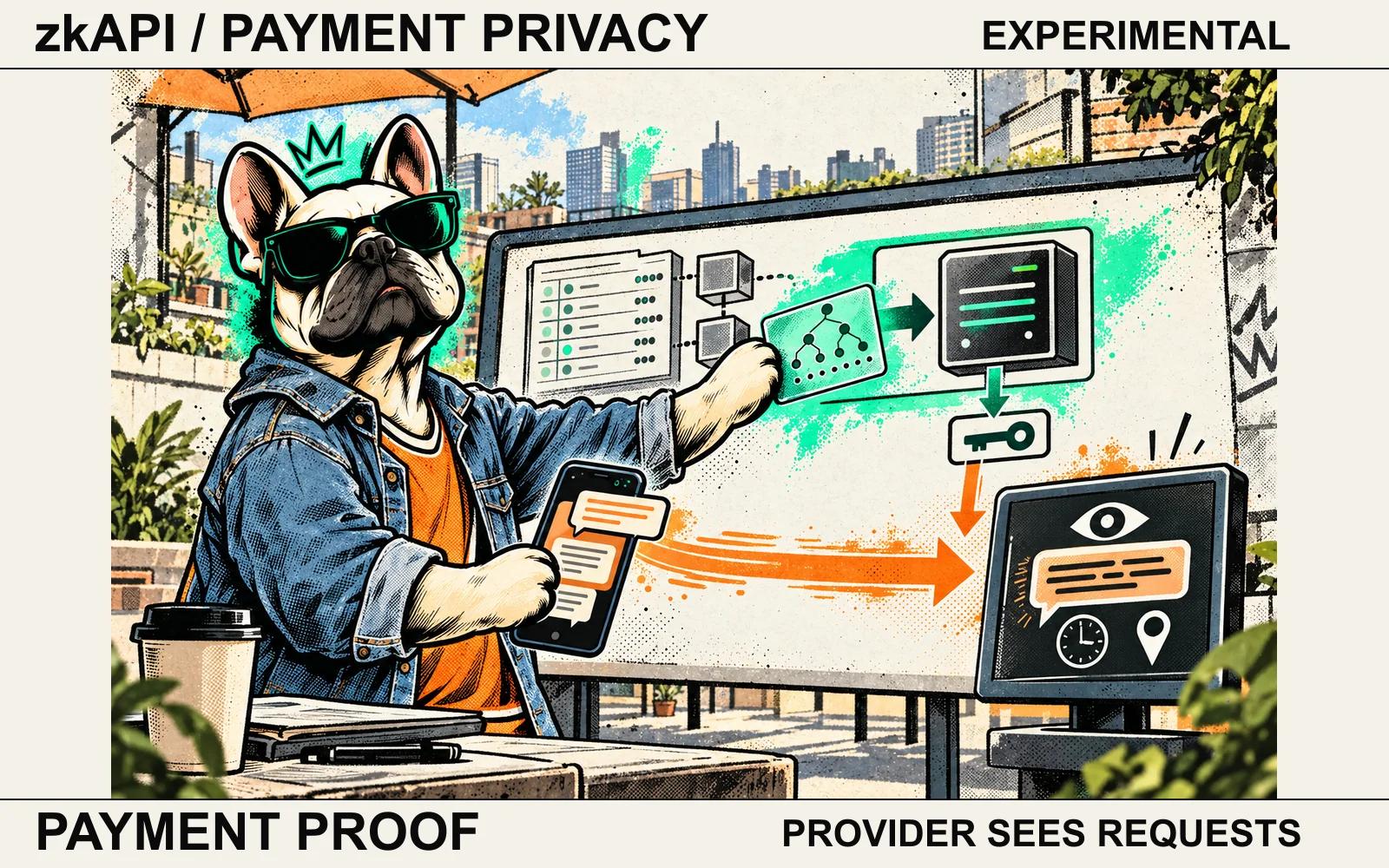
The documented direct-key flow issues a short-lived, spending-bounded OpenRouter key. Prompts go from the client to OpenRouter rather than through the billing server. Metered usage reduces the private balance; the cap is not a claim that the entire allowance was spent. No separate onchain payment is required for each API request in that described flow.
Why it matters
For a crypto app using paid RPC or an AI service, billing information is one possible link between activity and a funding source. Reducing that link can matter without making the activity itself secret. See how Ethereum's public network works for the distinction between a public record and private local data.
| Layer | What remains visible | What a payment proof does not do |
|---|---|---|
| Ethereum | Deposits and withdrawals | Conceal the funding transaction |
| API provider | Requests, responses and network clues | Encrypt content from the service processing it |
| Network and timing | IP-related metadata and usage patterns | Supply network anonymity |
The October 1 post also describes a proxy mode whose relay sees traffic. That should not be confused with the current direct-key path. Reused personal details or conversation history can help a provider reconnect sessions even when the payment proof hides the note.
What remains unknown
We have not verified the cited vault's deployed code, tested request unlinkability or audited the software. Our attempt to inspect the announcement's Etherscan link returned 403; it is not chain evidence.
Withdrawal is not simply an instant refund promise. The current docs describe cooperative close, a challenge-window escape process and note expiry. Deployment-specific keys, proof artifacts and configuration still matter. The docs also identify a single-party setup, not a multiparty ceremony or a security certification.
Brokzi's Take
Keep the privacy question specific: what is hidden, from whom, and through which route? A private billing proof does not stop a prompt from revealing its author. The source-version mismatch is another reason to read the actual deployment before considering a payment. This report explains the design; it does not recommend funding it.
Sources
- Ethereum Foundation: Introducing zkAPI, published October 1, 2026; checked October 6. Announcement, Mainnet/USDC attribution and privacy limitations.
- Ethereum zkAPI repository, checked October 6, 2026. Experimental status and current native ETH direction.
- zkAPI project documentation site, checked October 6, 2026. Private-credit and short-lived-key overview.
- zkAPI v2 introduction, checked October 6, 2026. Direct-key flow, observable metadata and setup assumptions.
- zkAPI v2 protocol, checked October 6, 2026. Notes, settlement, withdrawals and expiry boundaries.
- zkAPI native ETH billing guide, checked October 6, 2026. ETH denomination rather than USDC conversion.
See something wrong? Brokzi logs material changes. Prepare a correction note.