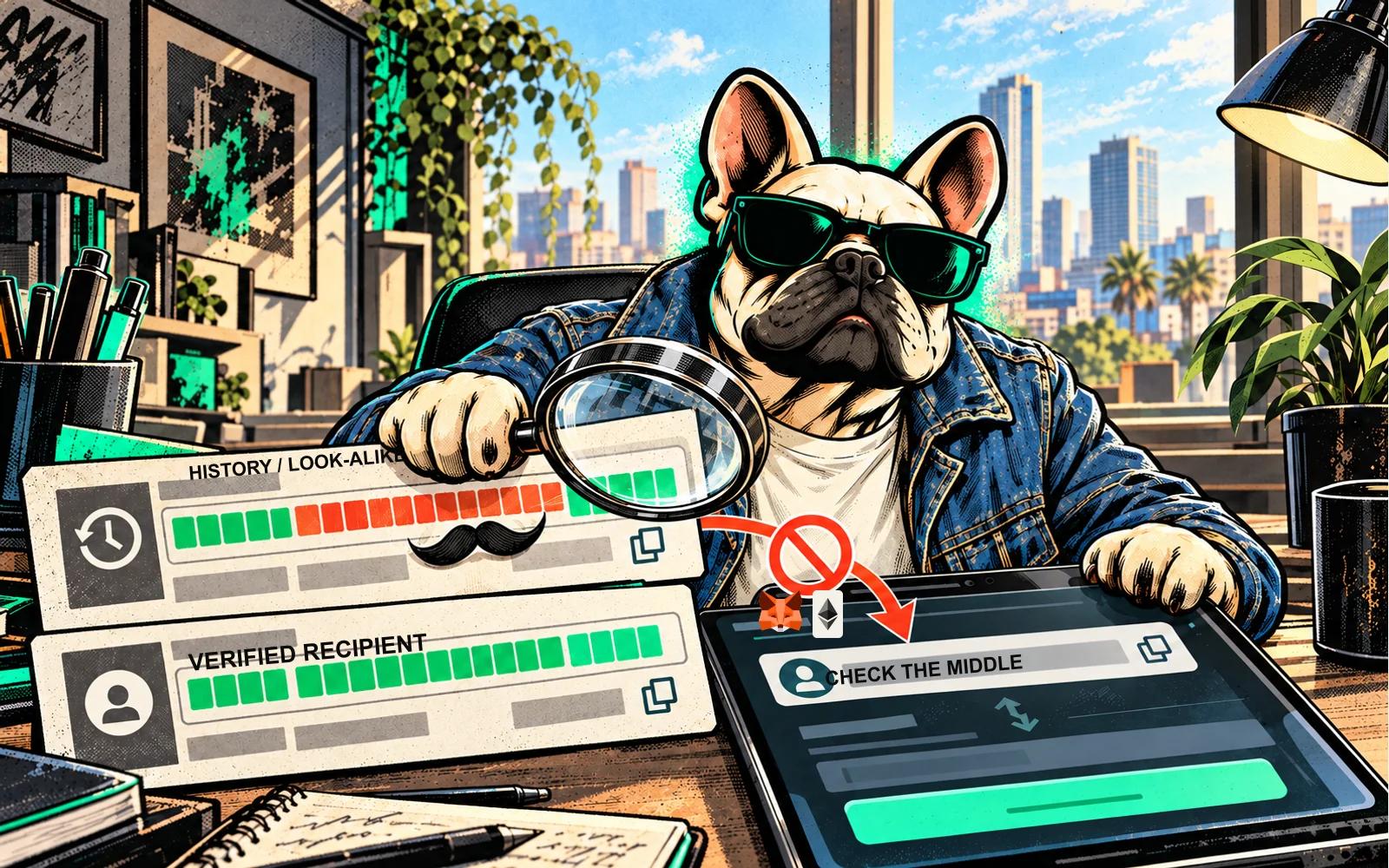
The address begins the way you remember. It ends the way you remember. The middle is someone else's.
Address poisoning exploits that quick visual check. For someone preparing an Ethereum-compatible transfer, the practical question is where the destination came from and whether the complete address matches the intended recipient. This explainer uses EVM-style addresses; other networks and wallet interfaces differ.
How address poisoning uses your history
MetaMask's explanation describes an attacker generating a similar-looking address and sending a negligible or zero-value transaction to make it appear in history. The intended payoff comes later, when the recipient copies that address for a genuine payment.
The history entry is the bait. It is not an authenticated contact record. Trezor also describes imitation token records that can resemble familiar activity. A recognisable name or amount is not enough to identify the asset or recipient.
There is a protocol detail behind some confusing records: the ERC-20 specification requires transfer events even for zero-value transfers. A displayed event and an actual movement of valuable assets are therefore different questions. The implementation and the token contract matter; this is not a claim that anyone can transfer your genuine token balance without authorisation.
A full-address comparison, not a real payment
Ethereum accounts use 20-byte addresses, usually displayed as 40 hexadecimal characters with a 0x prefix. A shortened label hides much of that information.
The following two strings are invented teaching examples, not payment destinations. Neither has been checked onchain. Lowercase lettering is deliberate; these are not demonstrations of a calculated mixed-case checksum.
Intended example:
0x123400001111222233334444555566667777abcd

Look-alike example:
0x123499998888777766665555444433332222abcd
Both could be shortened to 0x1234…abcd. They share the first four hexadecimal characters and the final four. Their middle characters are different, so they are different addresses.
| Check | What it establishes | What remains unanswered |
|---|---|---|
| Matching shortened label | The visible ends look alike | Whether the complete address matches |
| Full address matches the recipient's verified record | The destination string agrees with that record | Whether the network and asset are supported |
| Address appears in history | An interface displayed a record involving it | Whether it belongs to your intended recipient |
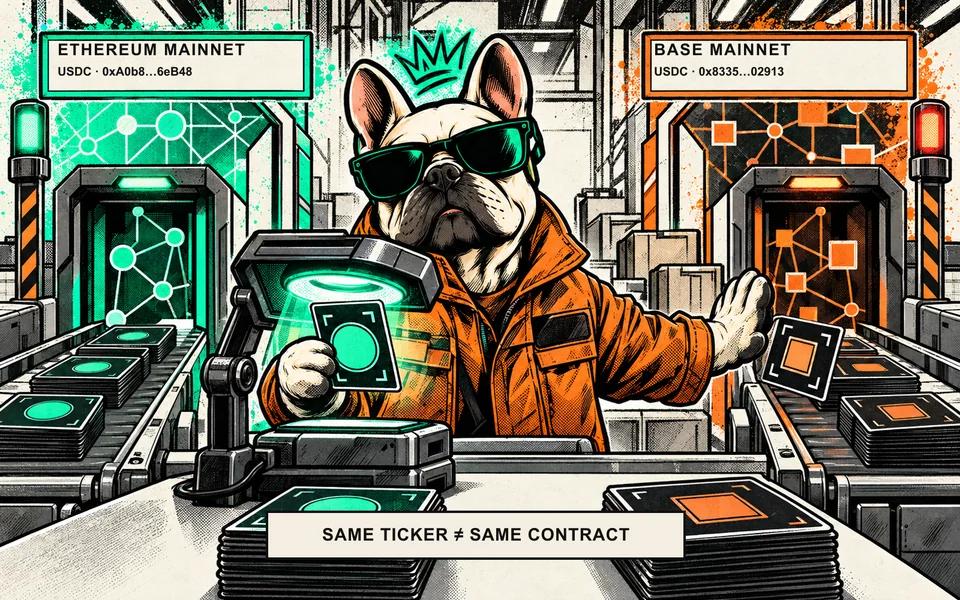
This is separate from checking a token's contract and network. A recipient address answers where the transfer is going. A token contract identifies which token on that network is involved. You need the appropriate checks for both.
Check the destination before signing
Use a recipient address obtained independently of the suspicious history entry. For your own account, use the wallet's receive/account view. For an exchange deposit, use that exact account's official deposit instructions and its supported network. For another person, verify the full address through an established communication route.
Then compare the complete destination in the final confirmation, not only an earlier copy-and-paste field. Saved contacts are useful only if the underlying address was verified when added. Trezor's guidance explicitly recommends checking the destination on the device display where a hardware wallet is used; a device cannot decide whom you intended to pay.
A compact check before signing:
- Where did this recipient address come from?
- Does the complete destination match the independently verified address, including the middle?
- Are the selected network and asset the ones the recipient supports?
- Does the final wallet or device confirmation still show those details?
If a wallet warns about a similar or unfamiliar address, stop and resolve the mismatch through the recipient's verified route. MetaMask currently documents warnings for these situations. That is a provider-specific control, not evidence that every wallet detects every attempt or that an address without a warning is safe.
What a checksum or test transfer cannot prove
ERC-55 specifies a mixed-case checksum encoding for Ethereum addresses. A checksum can help detect typing errors. It does not authenticate the recipient: an attacker's different address can have its own valid checksum.
A small test transfer may limit the amount involved in that test, but it is still a real transaction with fees. It does not replace checking the destination again for a later transfer, and it does not prove that an exchange will credit a different asset or network. This article does not ask you to send a test payment.
If you have already copied or used the address
Copying an address is different from submitting a transaction. If you have not signed or sent anything, replace the unverified destination with the independently checked one and review the details again.
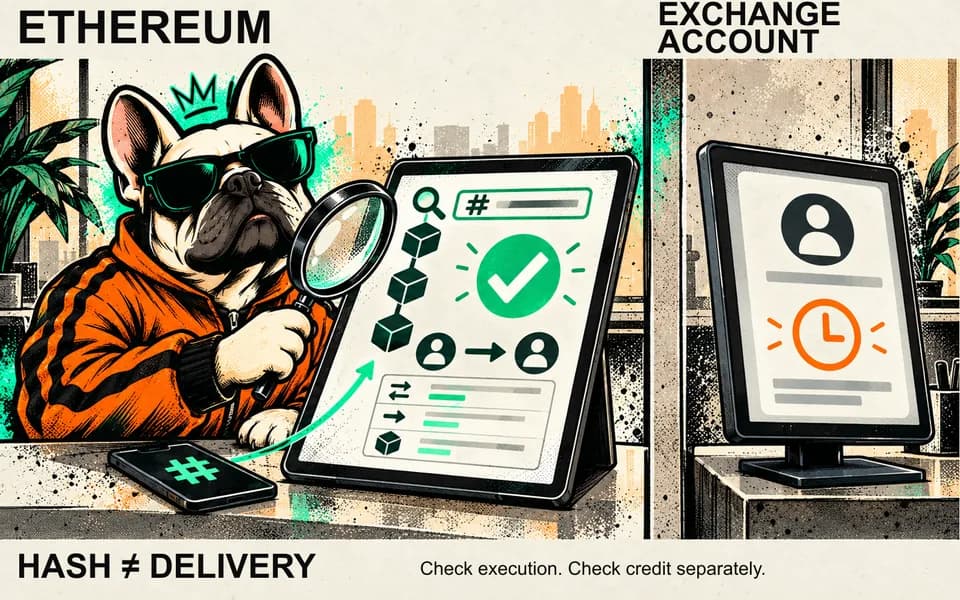
If a transaction has been submitted, read its hash, actual network and result. Do not assume a wallet's "sent" label means the recipient received or credited it. A confirmed transfer is not something a stranger can reverse with a recovery website.
If there are unexplained outgoing transfers, exposed recovery words or suspicious signatures, investigate those as a possible account-compromise incident through the wallet provider's official support route. The presence of address-poisoning spam does not diagnose the entire account either way. Never share private keys or a recovery phrase with someone offering to fix it.
Questions readers ask
Does receiving a poisoned transaction mean my wallet was hacked?
A suspicious incoming or imitation history record alone does not establish that your signing keys were stolen. Address poisoning aims to influence a later recipient choice. Unexplained outgoing transactions or credentials you disclosed require a separate investigation; the spam record does not prove those other risks are absent.
Can a hardware wallet prevent address poisoning?
A hardware wallet can provide a separate display for checking a transaction's destination. You still need to compare that destination with the full address you intended to use. Confirming the wrong address on the device does not make it the right recipient. Follow the instructions for your specific wallet.
Keep the address, not the resemblance
Address poisoning succeeds when a familiar-looking history entry becomes a trusted destination. Keep the full recipient address in a verified record, recheck it at confirmation, and keep network and asset checks separate. Understanding what a wallet stores helps distinguish a display problem from evidence of lost control.
Sources
- MetaMask: Address poisoning scams — mechanism and provider-specific warnings, checked 13 October 2026.
- Trezor: Address poisoning attacks — imitation records and destination verification, checked 13 October 2026.
- Ethereum.org: Accounts — address representation, checked 13 October 2026.
- ERC-55: Mixed-case checksum address encoding — checksum scope, checked 13 October 2026.
- ERC-20: Token Standard — zero-value transfer/event requirements, checked 13 October 2026.
See something wrong? Brokzi logs material changes. Prepare a correction note.