
You send part of your Bitcoin, open a block explorer and see the old output completely spent. Another address now holds the remainder. That can look like a second payment you never intended to make.
For readers checking an onchain Bitcoin transfer from a self-custody wallet, a change address explains the usual pattern. It is not cashback, a second fee or a new wallet account. The useful task is to reconcile what was spent, what the recipient received and what your wallet still controls.
This explainer concerns native Bitcoin transactions, not Lightning or BTC represented on another chain. The example is fictional; no wallet, keys or real transfer were used. Sources were checked on 15 October 2026, Asia/Tbilisi.
What a Bitcoin change address actually does
An unspent transaction output, or UTXO, is an earlier output available to be spent. A transaction input identifies that output. The selected output is consumed in full; a payment does not leave a partly spent version sitting behind. The Bitcoin Developer Guide describes inputs, outputs and this whole-output model.
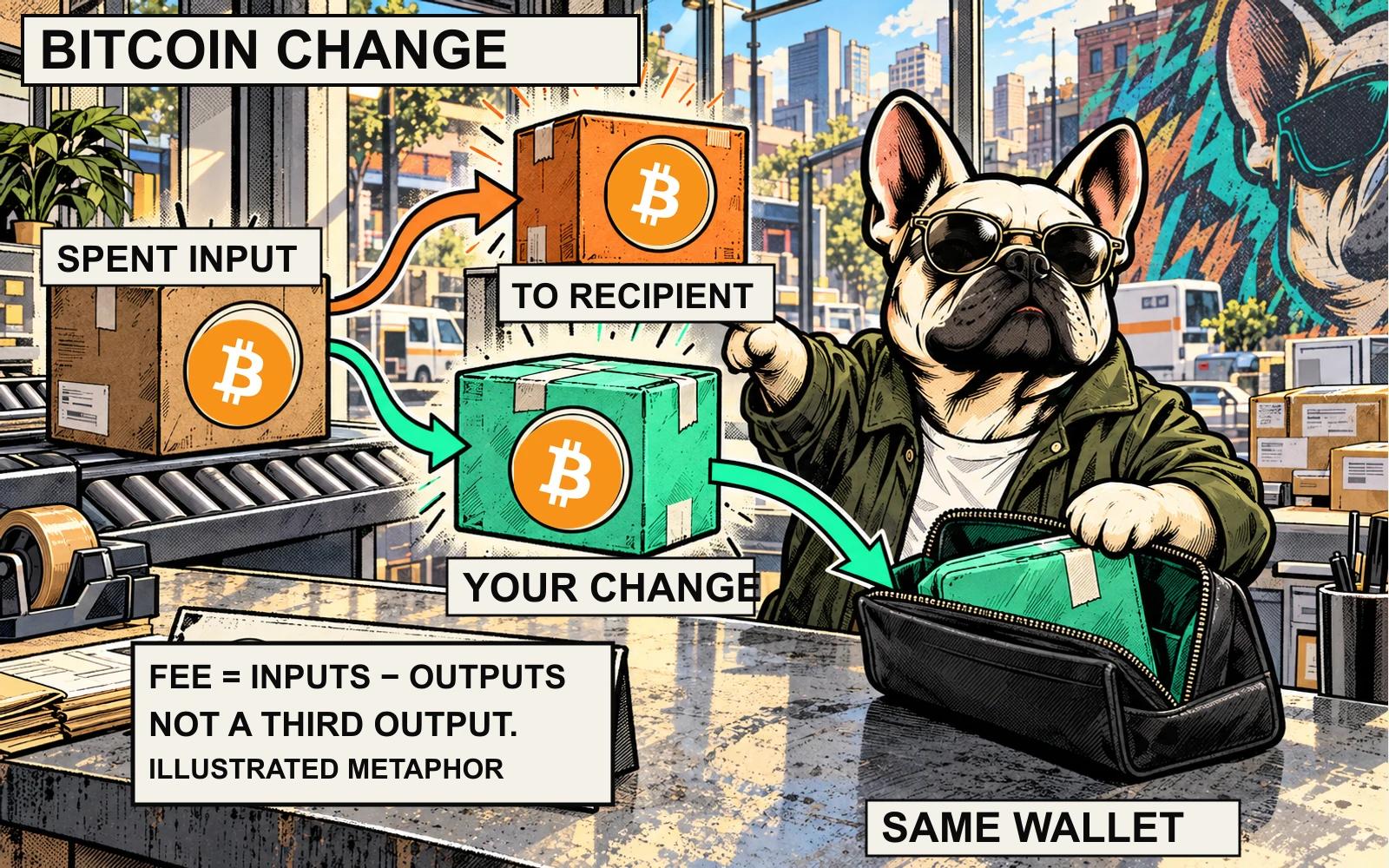
The new transaction creates outputs for the amounts it assigns. One may pay the recipient; another may return the surplus to an address the sender controls. That second output is change. It is an ordinary output, not a special onchain balance bucket.
Think of a banknote handed over at a counter: the original note goes, but you need not give away its entire value. The limit of that analogy matters. Bitcoin does not physically split a coin, and the fee is not a separate output handed to a cashier.
Follow the sats, not just the first address
Consider a deliberately simple example with one selected input. Sat means satoshi, the unit used below. These are invented teaching amounts, not a current network fee, a fee recommendation or a wallet quote.
| Part of the transaction | Illustrative amount | What it means |
|---|---|---|
| Selected input | 100,000 sats | An existing UTXO is spent in full |
| Recipient output | 30,000 sats | The intended payment |
| Change output | 69,000 sats | A new output controlled by the sender |
| Transaction fee | 1,000 sats | Input value minus total output value |
The reconciliation is:
100,000 − 30,000 − 69,000 = 1,000 sats in fees.
There are two outputs, not three. The fee is the difference between the input and output totals. Counting 69,000 sats as another payment to someone else would also misread this example: the sender still controls that output.
The original 100,000-sat UTXO is now spent. The sender's remaining amount from it is represented by the new 69,000-sat UTXO, not by a reduced balance on the original output. Other UTXOs in the wallet are outside this example. One address view is therefore not a complete wallet statement.
Why can change use an unfamiliar address?
Wallets can manage multiple addresses. Trezor's change-address documentation says Trezor Suite selects UTXOs and sends remaining value to a newly generated change address in the wallet. That is a concrete product example, not a promise about every wallet's interface or selection policy.
An address you have not previously used to receive a payment can still belong to the same wallet. Seeing a new destination string is not, by itself, evidence of a new owner. For the broader distinction between keys, addresses and an app's balance display, see what a crypto wallet actually stores.
However, do not assume an output is yours simply because calling it change would make the numbers work. The wallet's own information matters.
How to check an apparent missing balance
Start with the transaction details in the wallet you actually used, then compare the corresponding network record. This is a reading checklist, not an instruction to construct, sign or resend a transaction.
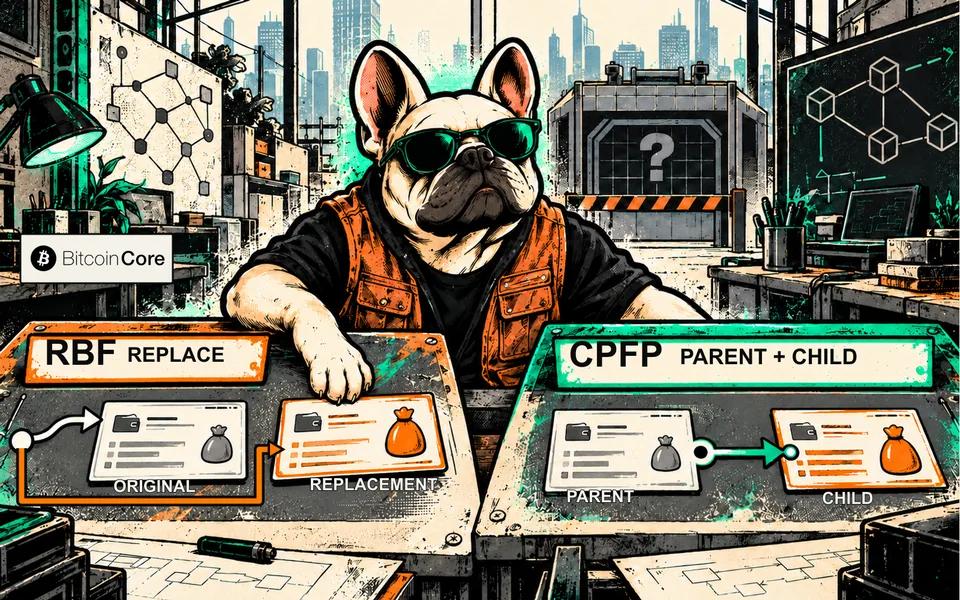
- Match the transaction ID. Avoid comparing an old candidate with a replacement. Our RBF and CPFP explainer explains why those records can differ.
- Separate inputs from outputs. Total the selected inputs and all outputs, rather than treating the input total as the recipient's payment.
- Reconcile the fee. In the fictional example, the difference is 1,000 sats. Do not add another invented fee output.
- Check which output the wallet recognises as its own. A public explorer shows transaction data; it is not your wallet's ownership database.
- Keep confirmation separate from ownership. An output shown in an unconfirmed transaction is not a confirmed payment. Confirmations and exchange credit are also different checks.
For a technical example, Bitcoin Core's 31.0 getaddressinfo documentation includes ismine and ischange fields. Some information depends on the address being in the active wallet. These are wallet-aware fields, not a universal label available to any explorer. No RPC command was run for this article.
Never provide a seed phrase to an explorer, a support message or a site claiming to locate your change. An unresolved wallet record needs wallet-specific investigation, not a second transfer made in panic.
Change is not an anonymity guarantee
Using a new address can reduce address reuse. It does not erase the transaction connecting its inputs and outputs. Bitcoin.org's privacy guidance explains that transaction records are public, while Trezor explicitly cautions that change addresses do not guarantee untraceability.
The practical distinction is a new address, not a hidden transaction. Neither a fresh string nor an explorer's guess establishes who controls an output.
Does every transaction need a change output?
No. In another fictional example, 100,000 sats in inputs could fund a 99,000-sat recipient output and a 1,000-sat fee, leaving zero change. That example has one output. Actual wallets can select different combinations of UTXOs; this article does not prescribe their policy.
Nor is a change address a feature you should expect to see in a custodial exchange account. The provider's account balance and its onchain outputs are different records. This explanation is about the Bitcoin transaction, not how an exchange allocates funds internally.
Brokzi's Take
A Bitcoin change address answers where the remainder went, not whether a payment is safe or confirmed. Before concluding that BTC vanished, reconcile the transaction and the wallet's ownership view. The familiar address may be empty while the wallet still controls the change. Same wallet, different parking space.
Sources
- Bitcoin Developer Guide: Transactions — UTXOs, ordinary change outputs and input/output fee accounting. Historical version-specific policy passages are not used as current fee rules.
- Trezor: What is a change address? — Trezor Suite's change-address behaviour and privacy limitations. Its historical origin claim is not relied on here.
- Bitcoin Core 31.0: getaddressinfo — wallet-specific
ismineandischangefields. - Bitcoin.org: Some things you need to know — public transaction records and privacy cautions.
See something wrong? Brokzi logs material changes. Prepare a correction note.