
A royalty setting on an NFT can look like an automatic payment rule. It is easy to picture money following the token every time it changes hands. ERC-2981 does not make that happen by itself.
The standard provides a common way to ask for a royalty recipient and amount at a supplied sale price. The marketplace or another payer still needs a separate payment mechanism. A quote is useful information; it is not a receipt.
That distinction matters whether you are checking a collection's royalty settings or trying to understand a sale breakdown. This explainer separates the query, its units and the later payment, without testing a live collection or marketplace.
What royaltyInfo returns
The ERC-2981 specification defines royaltyInfo with two inputs: the asset's tokenId and a salePrice. It returns two values:
receiver: the address designated to receive the royalty.royaltyAmount: the amount calculated for that supplied price.
It returns an amount, not just a percentage for the marketplace to interpret. The query does not establish that the supplied price represents a completed sale. It also does not move either the NFT or payment funds.
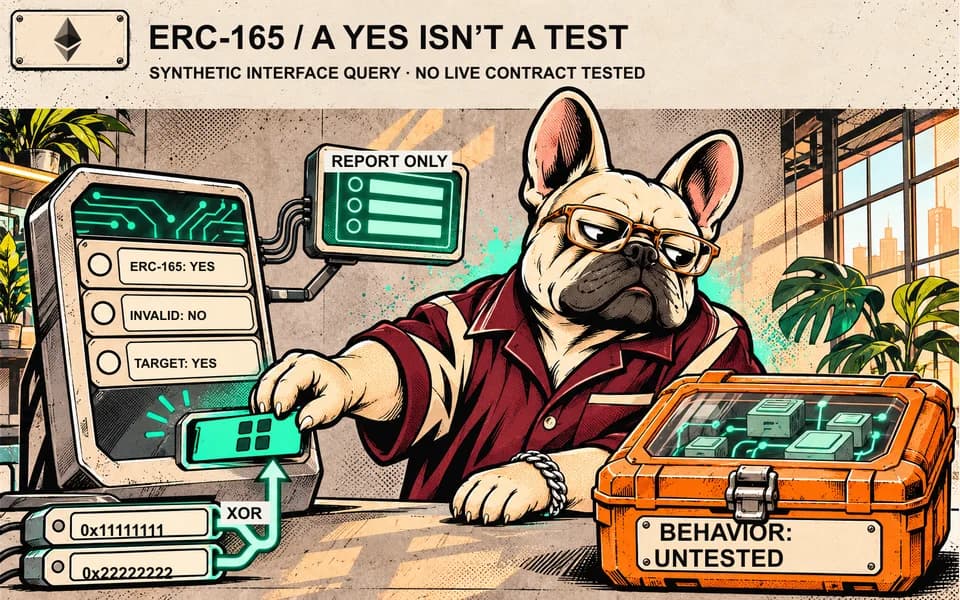
ERC-2981 uses ERC-165 interface detection, with interface ID 0x2a55205a. A positive support response concerns the interface declaration. Brokzi's ERC-165 explainer explains why that response is not a behavior or security test.
Why transferring an NFT does not automatically pay a royalty
A token can move between two wallets belonging to the same holder. It can also move as part of a sale. The transfer alone does not reliably distinguish those situations or tell the contract the sale price.
ERC-2981 therefore does not turn each NFT transfer into a compulsory royalty payment. Its rules describe royalty information and how participating payers should respect it. The standard leaves the actual transfer of payment funds outside this interface.
“Voluntary” has a technical meaning here: ERC-2981 itself does not force payment. It does not establish that a marketplace has implemented the query, what its current commercial policy is, or which separate agreements apply. No named marketplace's policy or legal obligation is assessed in this article.
Keep the two records apart: an NFT transfer shows the asset moved; a royalty payment needs its own evidence.
A fictional 200 Q sale, step by step
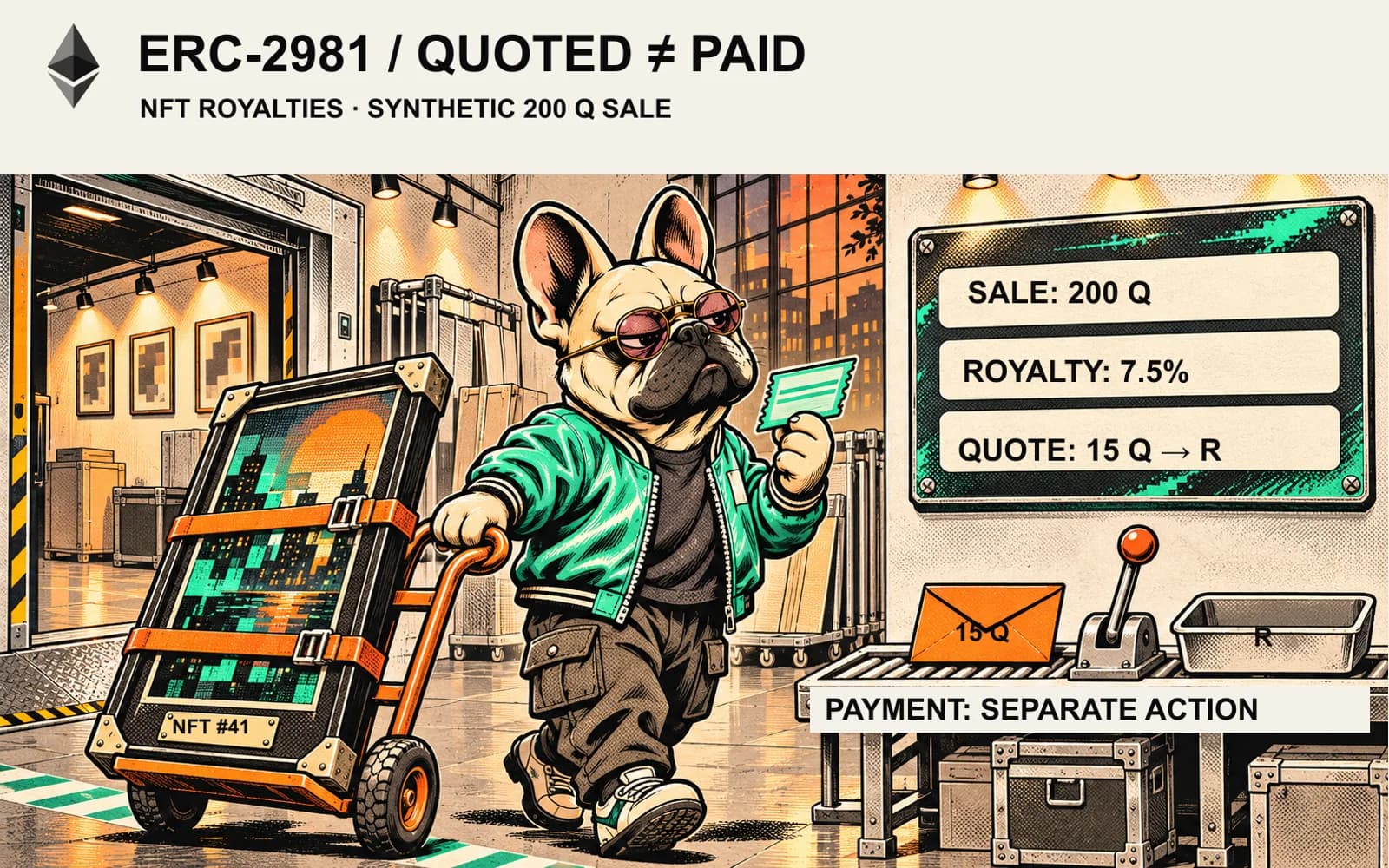
Suppose a fictional contract sets a 7.5% royalty for NFT ID 41, with receiver R. Use an invented payment unit Q, divided into 100 smallest units per Q. Q is not ETH, a real token, a market quote or an investment product. R is a symbolic address, not a payment destination.
For the arithmetic, use OpenZeppelin's default denominator of 10,000 and a numerator of 750. That fraction is 750 / 10,000 = 0.075 = 7.5%. These settings are assumptions for the example, not a royalty rate required by ERC-2981.
At a supplied sale price of 200 Q, the application would express the price as 20,000 smallest units. The calculation is:
20,000 × 750 / 10,000
= 1,500 smallest units
= 15 Q
Under these assumptions, the hypothetical response is receiver R and amount 1,500, meaning 15 Q. It is not a response of “1,500 Q,” and it is not evidence that R received anything. No contract was queried.
Compare three separate stages in the fictional scenario:
| Stage | Observation | Payment established? |
|---|---|---|
| Quote | R and 1,500 smallest units are returned for the supplied price | No |
| NFT transfer | ID 41 moves from seller to buyer | Not by that record alone |
| Settlement | A separate mechanism pays the royalty to R | Only the actual payment evidence establishes it |
For an illustrative settlement, assume 200 Q is the entire amount being divided, the royalty is deducted from it, and there are no other fees. The split would be 185 Q to the seller + 15 Q to R = 200 Q. This is an accounting assumption, not a universal marketplace checkout rule. The query neither chooses that settlement design nor executes the split.
The sale price and royalty use the same unit
ERC-2981 does not receive a currency address as an argument to royaltyInfo. The returned integer cannot identify the payment currency by itself. The application must keep that context with the sale.
The specification requires a payer following the standard to use the same unit of exchange for the supplied sale price and royalty payment. An amount calculated from a price expressed in one currency is not permission to substitute an equal numeral in another currency.
In our invented Q example, a 500 Q price means 50,000 smallest units. With the unchanged 7.5% setting, the quote becomes 3,750 smallest units = 37.50 Q. The amount changes with the price; the assumed rate does not.
The standard requires a percentage-based calculation. It forbids ignoring the supplied price and always returning one fixed royalty amount. It also forbids selecting the rate by comparing the price against constant thresholds that assume a particular currency scale.
Smallest-unit rounding can change the last digit
The OpenZeppelin Contracts v5.5.0 implementation multiplies the sale price by the configured fraction, then divides by its denominator. Its integer division truncates a remainder.
Keep the same fictional 750 / 10,000 setting, but supply 201 smallest units, equivalent to 2.01 Q. The exact arithmetic is 201 × 750 / 10,000 = 15.075 smallest units. That implementation produces 15 smallest units = 0.15 Q.
ERC-2981 allows rounding up or down to the nearest integer. Rounding up in this example would give 16 smallest units = 0.16 Q. The pinned library's downward result is one implementation choice, not a rule that every ERC-2981 contract must follow. Neither result can be interpreted sensibly until you know the unit scale.
One collection label may hide token-specific settings
OpenZeppelin's ERC2981 documentation distinguishes default royalty settings from overrides for particular token IDs. In that implementation, the token-specific setting takes precedence. The denominator defaults to 10,000 but can also be overridden.
A collection-level percentage displayed by an app is therefore not enough to reconstruct every possible token's response. Check what the actual contract returns for the relevant ID and supplied price, and what assumptions the integration uses. This article provides no live lookup or guarantee that a collection uses this library.
The ERC also permits the applicable percentage to depend on other predictable variables rather than the price, such as a transfer count. An earlier quote need not establish every future quote. That possibility does not mean every implementation changes its settings.
What to check when a royalty is marked “paid”
Ask which evidence supports the label:
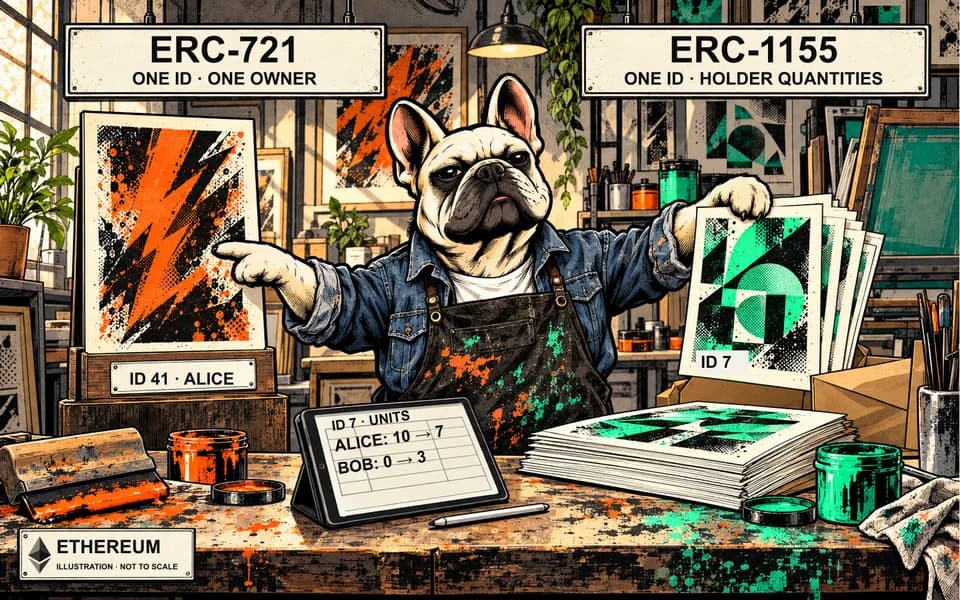
- Identify the asset: network, full contract address and token ID. The ERC-721 versus ERC-1155 guide explains what those IDs identify.
- Identify the quote: supplied sale price, unit scale, receiver and returned royalty amount.
- Identify the integration: which mechanism is responsible for making the payment, separately from moving the NFT?
- Identify the payment: what shows that the correct amount in the correct currency reached the designated receiver?
The receiver field names one address. Any further distribution among collaborators is a separate arrangement; the basic interface does not list everyone's share. Nor does a royalty setting establish copyright, a licence or the legal identity of the receiver.
Read an ERC-2981 result as payment information for a specified asset and price. It can tell a cooperating payer where and how much to pay. It cannot stand in for the payment itself.
Sources
Primary specification, current API documentation and pinned source checked November 3, 2026. The complete current ERC-2981 text was read, including its percentage, units, rounding and voluntary-payment rules. OpenZeppelin v5.5.0 is the selected reference version, not a claim about a deployed collection or the latest release.
ID 41, receiver R, Q, the 7.5% rate and all sale and settlement values are invented. Exact arithmetic and conversions were checked locally. No real sale, RPC request, contract call, wallet connection, signature, token transfer, royalty payment or audit was performed. The illustration is fictional. Marketplace adoption, enforceable legal rights and investment returns are not established here.
See something wrong? Brokzi logs material changes. Prepare a correction note.