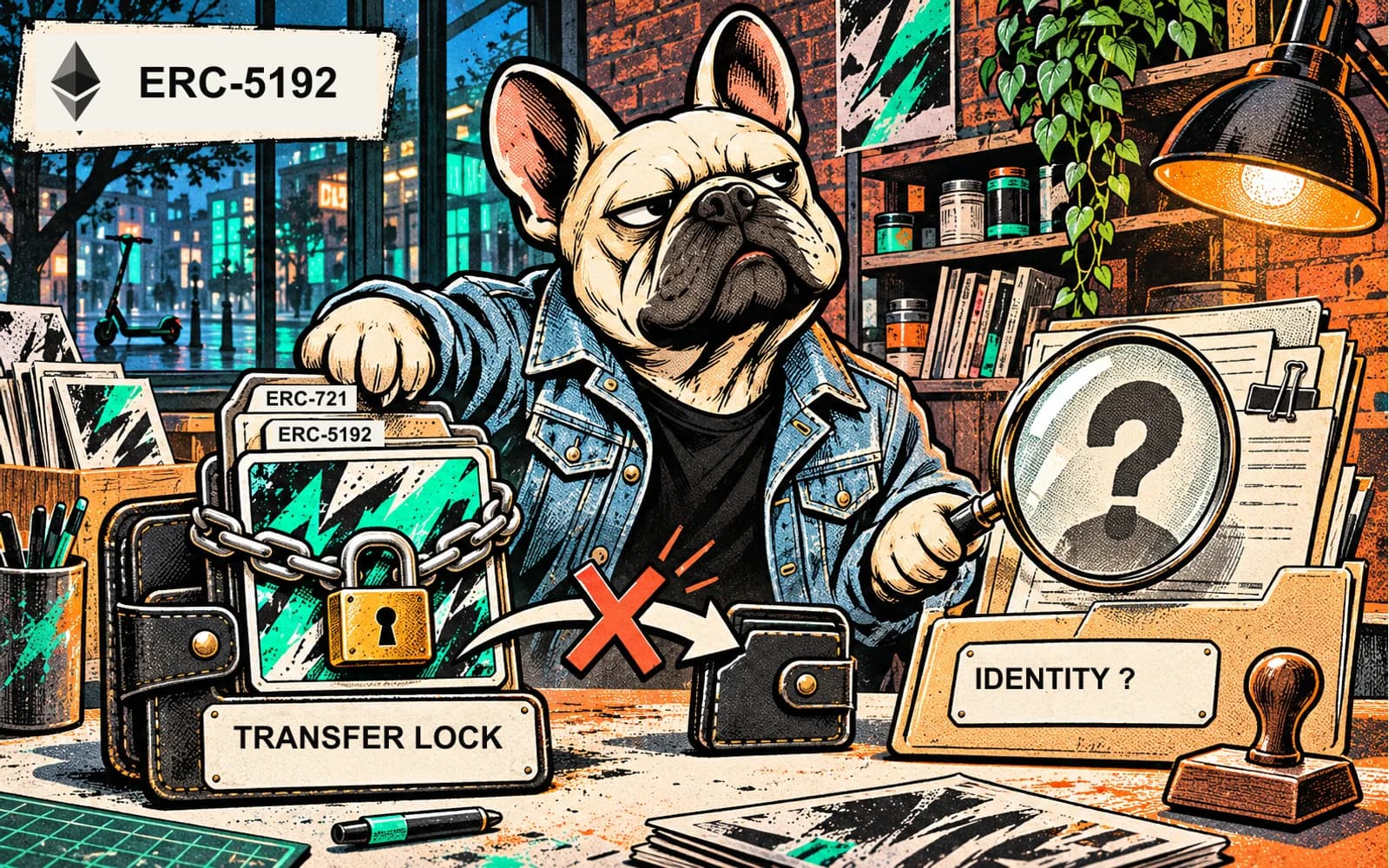
A locked NFT can look like a digital identity badge: it sits with one account and cannot simply be transferred to someone else. That appearance leaves an important question unanswered. Who established what the badge means?
ERC-5192 standardizes a small part of the token's behavior: a lock status and the transfer restriction associated with it. It does not verify a person, assess a qualification or describe an issuer's checks.
For readers comparing a soulbound-token claim with the underlying evidence, this explainer separates the token record from the claims attached to it. No live collection, identity document or credential was examined.
What ERC-5192 actually defines
The ERC-5192 specification, titled Minimal Soulbound NFTs, extends ERC-721. Its interface contains one status function and two events:
| Interface item | What it describes |
|---|---|
locked(tokenId) | A Boolean indicating that token's locking status |
Locked(tokenId) | A change of status to locked |
Unlocked(tokenId) | A change of status to unlocked |
When locked(tokenId) is true, all ERC-721 functions of that contract that transfer the token from one account to another must throw, meaning the call must fail. This is a rule for compliant implementations, not a test we performed on a particular contract.
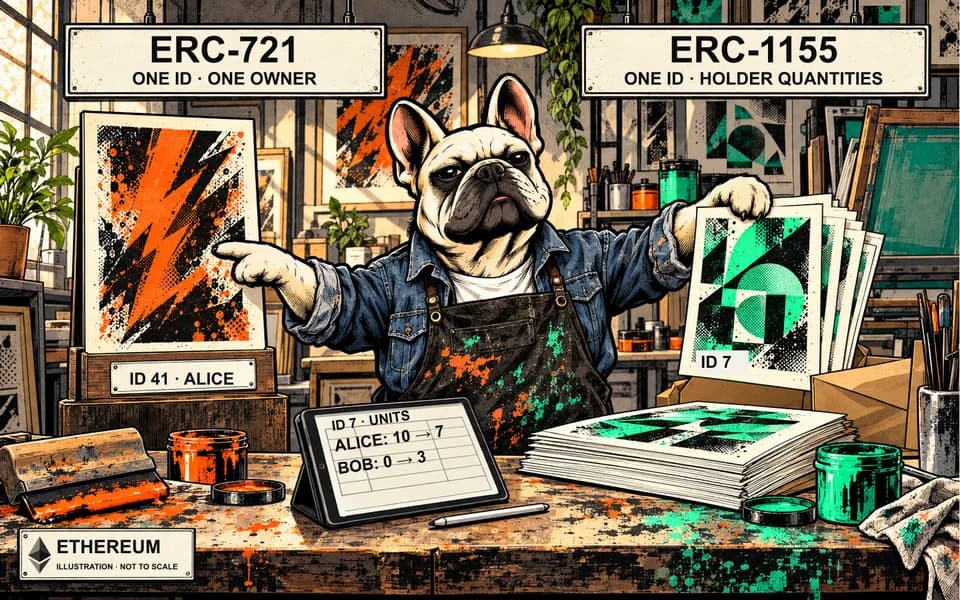
The status belongs to an identified token. Keep the network, full contract address and token ID together. As our ERC-721 versus ERC-1155 guide explains, an ID is not a global identifier, and an ownership record does not establish the rights associated with the pictured item.
A true lock flag is a transfer rule, not an identity result
Consider fictional NFT ID 41, held by symbolic address O. Suppose its contract reports locked(41) = true and implements the standard correctly.
That gives us a specific conclusion about account-to-account transfers through the contract's ERC-721 functions. It does not tell us whether O belongs to a particular human, whether that human passed a check, or whether an institution recognizes the token as a credential.
These observations answer different questions:
| Observation | Conclusion it does not establish |
|---|---|
locked(41) returns true | O is a verified individual |
| The contract reports ERC-5192 support | The implementation has been audited |
| A token displays a certificate-like image | The issuer checked the claimed qualification |
| The token remains with one account | Its claim is current, recoverable or accepted by another service |
The standard binds the token to an account under its transfer rules. An account address is not, by itself, evidence of a person's legal identity. A badge's meaning requires information about the actual issuer, claim and verification process beyond this interface.
ID 41, O and the reported status here are invented. No address or token was queried, and no identity check took place.
False does not mean a transfer will succeed
The specified restriction applies when the lock status is true. A false result does not establish that every other requirement for transferring the token has passed. Ownership, approval and other actual contract rules still need to be understood.
Nor is a query failure interchangeable with false. ERC-5192 describes soulbound tokens assigned to the zero address as invalid and requires queries about them to throw. An error is therefore not a reliable way to infer an unlocked, usable token.
These distinctions matter when an application compresses several outcomes into one icon. A current true result, a false result and a failed query are different observations; none should silently become “identity verified.”
Events describe lock changes, not the issuer's checks
The two events identify the token whose lock status changed. Their interface does not carry a person's name, qualification, verification method or credential expiry.
The specification's event comments also say the appropriate event should be emitted when a token is minted in a locked or unlocked state. A historical event still needs its context: what contract emitted it, which token it concerns, and what later changes may have occurred.
A previous Locked event is not a substitute for establishing the current status. More importantly, neither event proves that an issuer performed an identity or qualification check. It records a token-state event, not the evidence supporting the token's message.
Who can unlock, revoke or recover it?
The minimal interface has no standardized setter for the lock status. It also does not define who can change that status, how a token is issued or burned, or how an account recovers access.
The existence of an Unlocked event does not prove that a particular implementation offers a public unlock button. Equally, a token being locked today is not enough to conclude that its status can never change. Read the actual implementation and the issuer's policy before making either claim.
Credential revocation is another separate question. Changing a token's transfer status is not automatically the same as withdrawing a qualification or marking a claim invalid. ERC-5192 supplies no universal credential-validity or revocation query.
For an actual project, the issuer's policy, change authority, upgrade permissions, revocation design and recovery arrangements remain unknown until separately established. This article does not fill those gaps with assumed features or guarantees.
Interface support has a narrow meaning
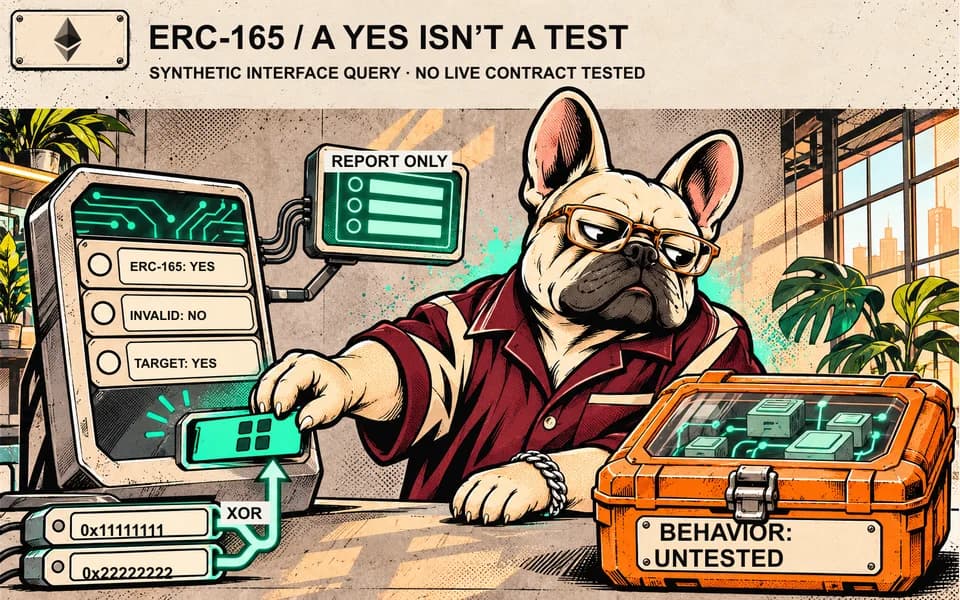
An ERC-5192 implementation must report support through ERC-165 for interface ID 0xb45a3c0e. That is a discovery mechanism, not an audit result. Our ERC-165 explainer separates an interface declaration from demonstrated behavior.
The word soulbound is also broader than a complete technical description. A product using that label needs an actual contract and rule set behind it. Do not assume that a label establishes ERC-5192 compliance, identity verification or permanent access to a service.
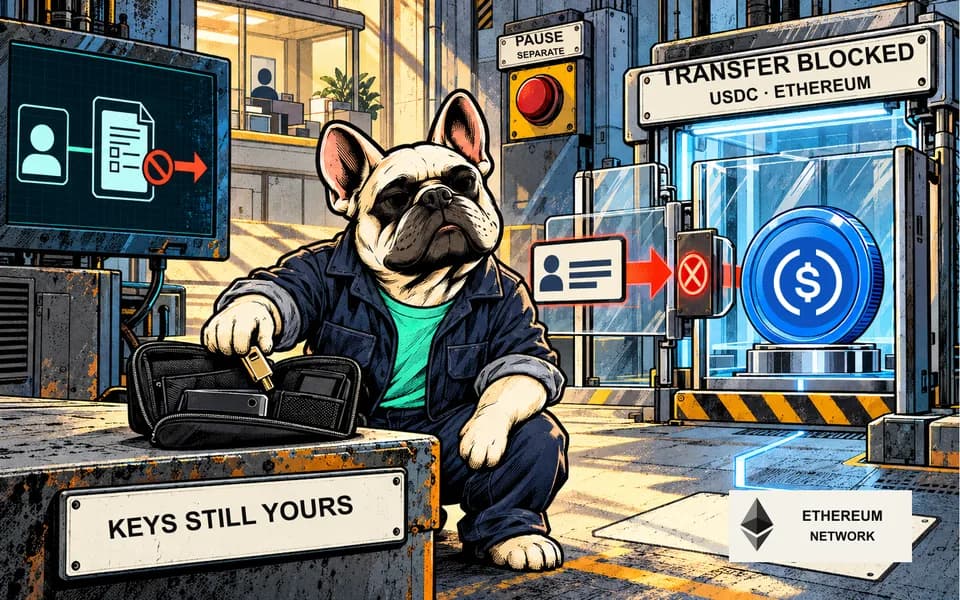
Keep this mechanism separate from stablecoin freeze and blocklist controls. An account blocklist, a token-wide pause and one NFT's lock status act on different records. None of those labels is interchangeable with the evidence behind an identity claim.
Read the claim and its evidence separately
For a token presented as an identity or qualification badge, ask:
- Which exact asset and current contract state are being described?
- What does the issuer claim about the holder, and which evidence supports that claim?
- Who can issue, change, invalidate or otherwise administer the token and its meaning?
- Which application recognizes it, and what checks does that application actually perform?
- What documented arrangements address account loss, stale claims and revocation?
These are questions to answer from current documentation and the actual system, not services promised by ERC-5192. There is no need to connect a wallet or submit personal documents to understand the interface itself.
A transfer restriction can be useful without being an identity system. Read ERC-5192's locked state as a specific token-behavior claim, then establish the issuer's evidence and the application's rules separately.
Sources
The complete current ERC-5192 specification was read on November 4, 2026, including the interface, motivation, rationale and security section. Its creation date is July 1, 2022; this is an explainer, not a new-launch announcement.
The document's short security section is not treated as a certification of any deployed contract. Issuer policy, identity checks, credential recognition, recovery and revocation are not established by this interface or by this article. No legal or jurisdiction-specific credential assessment is made.
The example and illustration are fictional. No live contract call, RPC request, wallet connection, signature, token transfer, personal-data submission, identity verification or security audit was performed.
- ERC-5192: Minimal Soulbound NFTs: the lock-status interface, transfer restriction, events, invalid-token query rule and ERC-165 identifier.
See something wrong? Brokzi logs material changes. Prepare a correction note.