
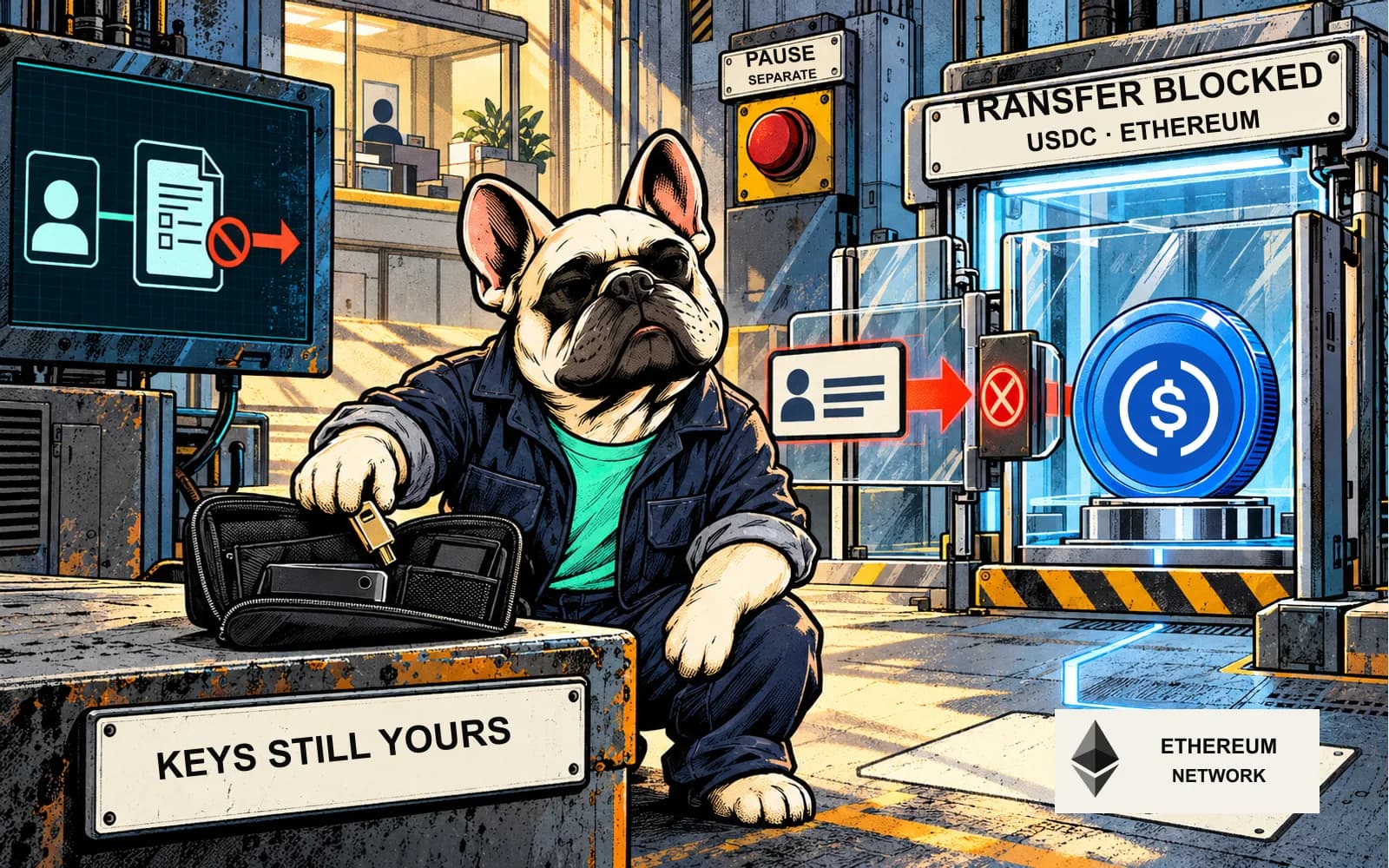
You still have the key. The token transfer can still fail.
For anyone trying to understand a stablecoin freeze, that is the first distinction: control of a wallet's signing key does not remove rules inside a token contract. This explainer uses Circle-issued USDC on Ethereum as its named reference, then reads Circle's published EVM contract design. It does not report a new freeze or determine whether a particular address is restricted.
Name the token before naming the control
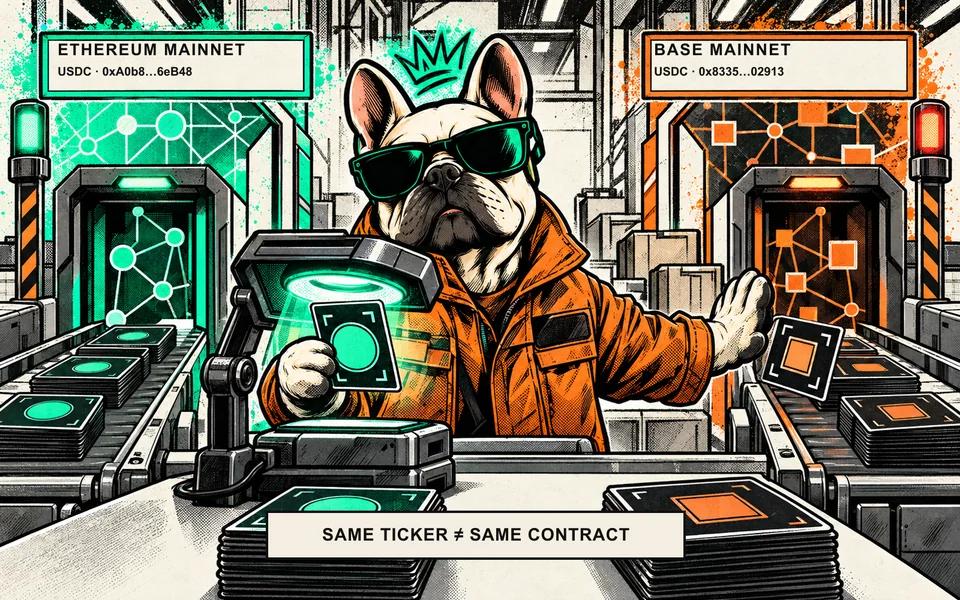
Circle's contract registry lists Ethereum mainnet USDC at 0xA0b86991c6218b36c1d19D4a2e9Eb0cE3606eB48. A familiar ticker on another network or a bridge-issued wrapper is not enough to identify that token.
For the code walkthrough, we pin Circle's repository to commit fc85788bc7c23cefe3df1a757133048bfddadeaa. Its README identifies FiatTokenV2_2 as the implementation design and a proxy as the forwarding contract. This is the source version reviewed here, not an independent assertion that every live USDC proxy points to identical bytecode today.
An upgradeable proxy can keep its address while its implementation changes. Read contract identity, implementation and observation time together. This article does not audit a deployment or supply an address-status lookup.
Blocklisting restricts addresses within the token
The Blacklistable contract gives the blacklister role functions to add and remove an address. It also exposes a status query and emits events. The owner can change the blacklister role.
In the inherited FiatTokenV1 transfer functions, an ordinary transfer checks both sender and recipient. A transfer using an allowance also checks the caller. In the V2.2 implementation, the address's restriction flag and token balance share storage, but the balance-reading function separates them. Setting the flag is not the same operation as subtracting or burning the holder's balance.
The consequence is narrower than "the entire wallet has been frozen." This token's contract can prevent its USDC moving to or from a restricted address. That does not give its administrator the wallet's private key or establish the status of unrelated assets. The wallet explainer separates signing control from the records a wallet displays.
A pause is a different switch
The Pausable contract gives a separate pauser role a token-wide pause mechanism. Transfers use the whenNotPaused condition. An address blocklist entry and a pause therefore answer different questions.
| Mechanism | Scope in this example | What it does not establish |
|---|---|---|
| Address blocklisting | Restricted addresses within the token's transfer rules | That every holder or every asset in a wallet is blocked |
| Token-wide pause | Functions guarded by the contract's pause condition | That a specific address was singled out |
| Provider account hold | Access under that provider's systems and terms | That the onchain token contract is paused |
| Direct redemption conditions | Eligibility and processing under the issuer's applicable terms | A promise that any wallet holder can immediately obtain bank dollars |
Circle's FiatTokenProxy supplies the upgradeable forwarding layer. In the documented design, proxy upgrade authority is separate from the token owner, blacklister and pauser roles. The presence of these capabilities does not prove that one of them was used in a particular incident.
A failed transfer need not erase the displayed balance
Use a fictional, isolated example of a direct transfer in the reviewed design. Holder A starts with 100 USDC and recipient B with 0 USDC. A proposes to send 25 USDC. Assume no other activity, adequate signing authority and no separate restriction except the one described.
If A is blocklisted, the transfer's check fails before the balance update. Under those assumptions, the USDC balances remain 100 and 0, not 75 and 25. The failed transfer does not deliver tokens simply because the wallet signed it.
These are invented whole-token balances, not a live address, a legal claim or a current incident. They describe the token amounts only; transaction execution costs in native ETH are a separate question. No wallet was connected and no transfer was attempted.
The limitation also works the other way: a balance being visible does not prove it can be transferred. Nor does one failure prove blocklisting. Pause state, allowance, balance, execution conditions and the exact error need their own investigation.
Approval is not a way around a transfer restriction
An approval and a transfer are separate actions. Circle's V2 code includes signature-based authorizations; V2.2 changes parts of the approval behavior while keeping checks on the relevant transfer routes.
In the reviewed V2.2 source, approve is pause-guarded but does not itself use the old address-blocklist modifiers. That does not mean a subsequent transfer can ignore the transfer function's restrictions. A successful allowance update is not proof that the token can move.
Our token-identity guide helps distinguish the asset and chain before interpreting an approval screen. This article does not recommend a workaround, alternate address or contract call to evade a restriction.
Redemption and a bank deposit are separate questions
Circle's USDC Terms, updated October 15, 2026, expressly apply to holders outside the European Economic Area. They direct EEA holders to separate documentation. Do not transplant this page's eligibility rules into every jurisdiction.
Those terms distinguish holders with Circle Mint accounts from other holders. Direct redemption requires the relevant account and eligibility conditions. The terms also discuss onchain blocklisting, legal orders and limits on deposit-insurance protection. They do not promise that a transfer restriction will be removed or that a loss will be reimbursed.
A USDC token is not a bank deposit merely because an app displays a dollar amount. Reserve backing, market price, transferability and direct redemption need separate evidence. The stablecoin mechanism guide covers that wider dependency map.
Read a restriction without inventing its cause
Keep a short record before drawing a conclusion:
- The network, issuer and exact token contract, including whether it is a wrapper.
- The action that failed, its transaction identifier if one exists, and the observation time.
- The relevant contract state and error, distinguished from the provider's account message.
- The implementation and administrative roles that the evidence actually identifies.
- The issuer or provider's current official notice and the terms applicable to the holder.
Do not infer criminal conduct from a contract flag alone or treat the existence of a blocklist function as a new enforcement event. A request for a seed phrase or an upfront "unlock fee" is not evidence of an authorized remedy. This page supplies no guaranteed unfreeze, appeal outcome, refund or sanctions advice.
Brokzi's Take
A stablecoin freeze is a question about a particular control at a particular layer. With USDC's published EVM design, signing keys can remain under the holder's control while token rules restrict a transfer. Identify the layer and evidence before deciding what the balance on the screen means.
Sources
Primary material checked October 26, 2026. Circle's registry and terms are issuer statements, not our audit. Contract explanations use the exact repository commit above and its V2.2 inheritance; no deployed-bytecode comparison, RPC status check, wallet action or legal assessment was performed. Etherscan access was unavailable during this review, so no live implementation or restriction-status claim is based on it. All balances and the artwork are fictional. Education, not financial or legal advice.
- Circle: USDC Terms, outside-EEA scope.
- Circle Docs: USDC mainnet contract registry.
- Circle EVM repository: pinned README and roles.
- Circle EVM source: Blacklistable.
- Circle EVM source: inherited FiatTokenV1 transfers.
- Circle EVM source: FiatTokenV2 authorizations.
- Circle EVM source: FiatTokenV2_2 overrides and state.
- Circle EVM source: Pausable.
- Circle EVM source: FiatTokenProxy.
See something wrong? Brokzi logs material changes. Prepare a correction note.