

A storage slot can contain a root and still be the wrong answer to your question. The missing detail is often the timestamp attached to it.
In the EIP-4788 design, an execution block's timestamp is the lookup key for that block's parent beacon block root. The contract uses a ring buffer, so different timestamps can map to the same index. A lookup checks the stored timestamp before returning the paired root. Matching the index alone is not enough.
The official EIP-4788 specification captured for this article on 23 November 2026 is marked Final. This is an explanation of that design, not a check of a particular network's activation, contract deployment or live lookup result.
Which root belongs to which timestamp?
Start with one execution block, E. Its header contains a timestamp and a parent_beacon_block_root field. EIP-4788 defines that root as the hash tree root of the parent beacon block for the given execution block.
The contract records the pair using E's execution timestamp as the key. That is not a claim that the key is the parent beacon block's own timestamp. It is also not the execution block's height or a beacon slot number.
| Value | Its role in this explanation |
|---|---|
| Execution block E's timestamp | The key used to store and retrieve the pair |
E's parent_beacon_block_root | The parent beacon block root recorded against that key |
| Execution block hash | A different value; not the root returned by this mechanism |
| Beacon slot number | Not a replacement for the execution timestamp key |
The word “parent” matters. Do not silently relabel the returned value as the current beacon head or the beacon state root. The specification deliberately chooses a beacon block root, and explains that choice separately from a state root.
For a related but different reading task, our guide to latest, safe and finalized block tags explains why the state or block view you select also matters.
Two paired storage areas, one record
EIP-4788 sets HISTORY_BUFFER_LENGTH to 8,191. For an execution timestamp T, the described storage relationship is:
- The timestamp goes at index T modulo 8,191.
- Its parent beacon block root goes at that index plus 8,191.
“Modulo” means the remainder after division. It keeps the index within a bounded range, allowing that range to be reused.
The two areas have different jobs. One says which timestamp this record belongs to; the other holds the root paired with it. A root read from the second area without the first area's identity check can be a root from another record.
These are the documented paired indices. The buffer length is not a statement that the whole design occupies only 8,191 storage cells, nor a guarantee of a fixed one-day history. This explainer does not turn the specification's approximate coverage discussion into a measured retention promise.
A fictional collision: same index, different record
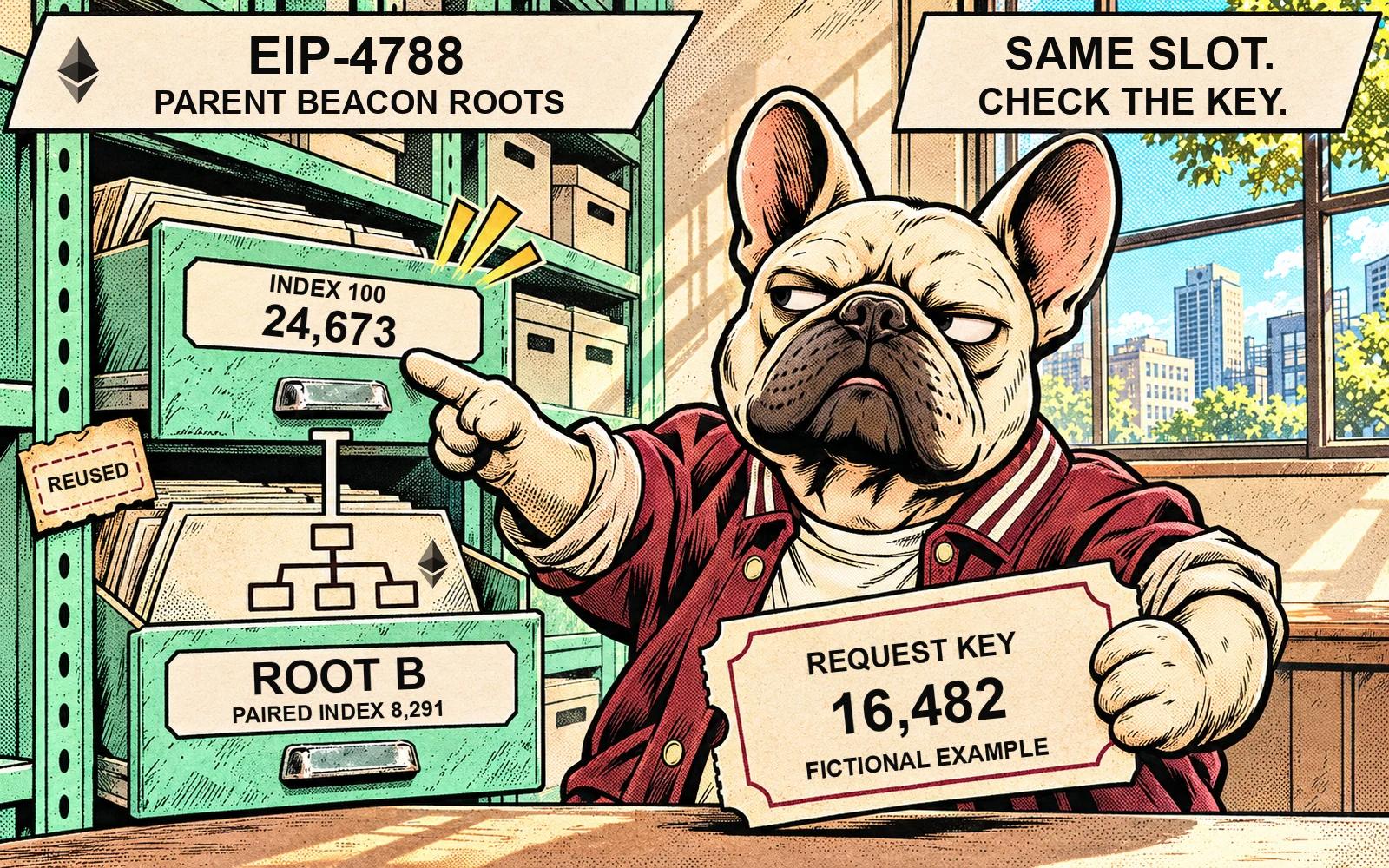
Consider two invented numeric timestamp keys, 16,482 and 24,673. They are arithmetic teaching values, not timestamps from real Ethereum blocks or a proposed valid block sequence. Roots A and B below are fictional labels, not actual hashes.
Both keys leave a remainder of 100 when divided by 8,191:
- 16,482 = 2 × 8,191 + 100.
- 24,673 = 3 × 8,191 + 100.
Their calculated timestamp index is therefore 100, and their paired root index is 100 + 8,191 = 8,291.
| Fictional buffer state | Timestamp stored at index 100 | Root stored at index 8,291 |
|---|---|---|
| After the first record | 16,482 | Root A |
| After that position is reused for the second record | 24,673 | Root B |
Now suppose the selected contract state contains the second row. A lookup for 16,482 still calculates index 100, but the stored timestamp is 24,673. Under the specified lookup, that mismatch causes a revert. Returning Root B as though it belonged to 16,482 would be the wrong answer.
A lookup for 24,673 in that same fictional state passes the timestamp comparison and returns the paired Root B, assuming the other input requirements are met. The index tells the contract where to look. The stored timestamp tells it whether it found the requested record.
That is the cover's visual joke: Brokzi has reached the right numbered drawer, but still has to check the record's label before taking what is inside.
What the lookup checks
The specification describes a timestamp input encoded as exactly 32 bytes in big-endian form. An input with the wrong length, a zero timestamp or a timestamp that does not match the stored value must cause the lookup to revert.
Those checks answer different questions:
- Is the input in the required form?
- Is the requested timestamp nonzero?
- Does this position currently contain the record for that exact timestamp?
Only after the identity check does the specified lookup return the paired root. Knowing a remainder or finding a value in the root area is not a substitute for those checks.
This is a reading guide, not a call recipe. We provide no contract address, encoded request, deployment instructions or live result.
A failed lookup is a narrow piece of evidence
A failure does not establish that the root never existed. In the described design, an input can fail a format or zero-value check, or the stored timestamp can differ from the requested one. A generic error does not tell you which condition caused it.
Keep the selected contract state in the explanation too. What is available in one state is a narrower question than what has ever existed or what another historical record might contain. The ring buffer is bounded storage, not a promise of a permanent archive.
This is distinct from blob data availability and retrieval: a stored consensus-layer root is not a copy of blob bytes. It is also distinct from transient storage's transaction lifetime. Ring-buffer reuse across records is not transaction-end cleanup.
What a returned root does—and does not—tell you
Within the specified mechanism, a successful lookup returns the parent beacon block root associated with the requested execution timestamp in that contract state.
It does not, by itself, verify an application-specific state proof, identify the current beacon head, establish withdrawal availability or show that a named bridge or restaking product is secure. Those are additional claims requiring their own evidence.
Before interpreting a reported lookup, establish the execution timestamp key, the selected contract and state view, and whether the exact stored-timestamp comparison succeeded. Then describe the returned value with its actual name: parent beacon block root.
We did not query a node, execute the source's examples, inspect deployed bytecode, verify a proof, connect a wallet or move funds. No particular network's current activation or later fork behavior is established here.
Sources
- EIP-4788: Beacon block root in the EVM — Final; created 10 February 2022. Complete official document captured 23 November 2026. The explanation uses its parent-root definition, paired timestamp/root indices, exact timestamp guard and bounded-buffer rationale. The arithmetic and labelled roots are fictional; deployment and system-operation examples were not executed.
See something wrong? Brokzi logs material changes. Prepare a correction note.