
A bloom match can tell a log search to keep looking. It cannot finish the search for you.
An Ethereum logs bloom is a compact filter built from log-emitting addresses and topics. Required bits being present makes a scope a candidate; it does not prove the requested log exists. Check the actual log's address, ordered topics and data in the intended receipt and chain context. A bloom match is not a payment or inclusion proof.
This explainer is for readers interpreting a logsBloom field or an explanation of log searching. We use invented log labels and a deliberately small toy diagram, without querying a node or supplying a real transaction.
What goes into an Ethereum logs bloom?
The checked Osaka bloom specification starts with 256 bytes, or 2,048 bits. For each log, it adds the emitting address and each topic. It does not add the log's non-indexed data field.
For each added item, the implementation takes three pairs of bytes from a Keccak-256 hash and uses their lowest 11 bits to select positions. Each selected position is set to 1. These positions can overlap, so an item does not always add three distinct new bits.
Setting a bit uses OR: a position already set stays set. The result does not retain a list of the original items, their order or which address appeared with which topic.
That is a named specification reference, not a claim that we measured the currently active mainnet fork or tested a client's implementation. The useful mechanism is the separation between a compact summary and the records it summarizes.
Keep the bloom's scope attached
The Execution API receipt schema gives a receipt separate logs and logsBloom fields. The log objects carry details that the bloom does not preserve.
The Ethereum JSON-RPC reference also describes a block's logs bloom. A block summary and a particular transaction's receipt summarize different scopes. A match in the broader scope cannot identify the desired transaction or event by itself.
Start by establishing which chain, block and receipt the displayed field belongs to. A copied bit string without that context is a poor basis for a conclusion. Our transaction-reading guide covers the surrounding record.
Two logs can supply the right pieces separately
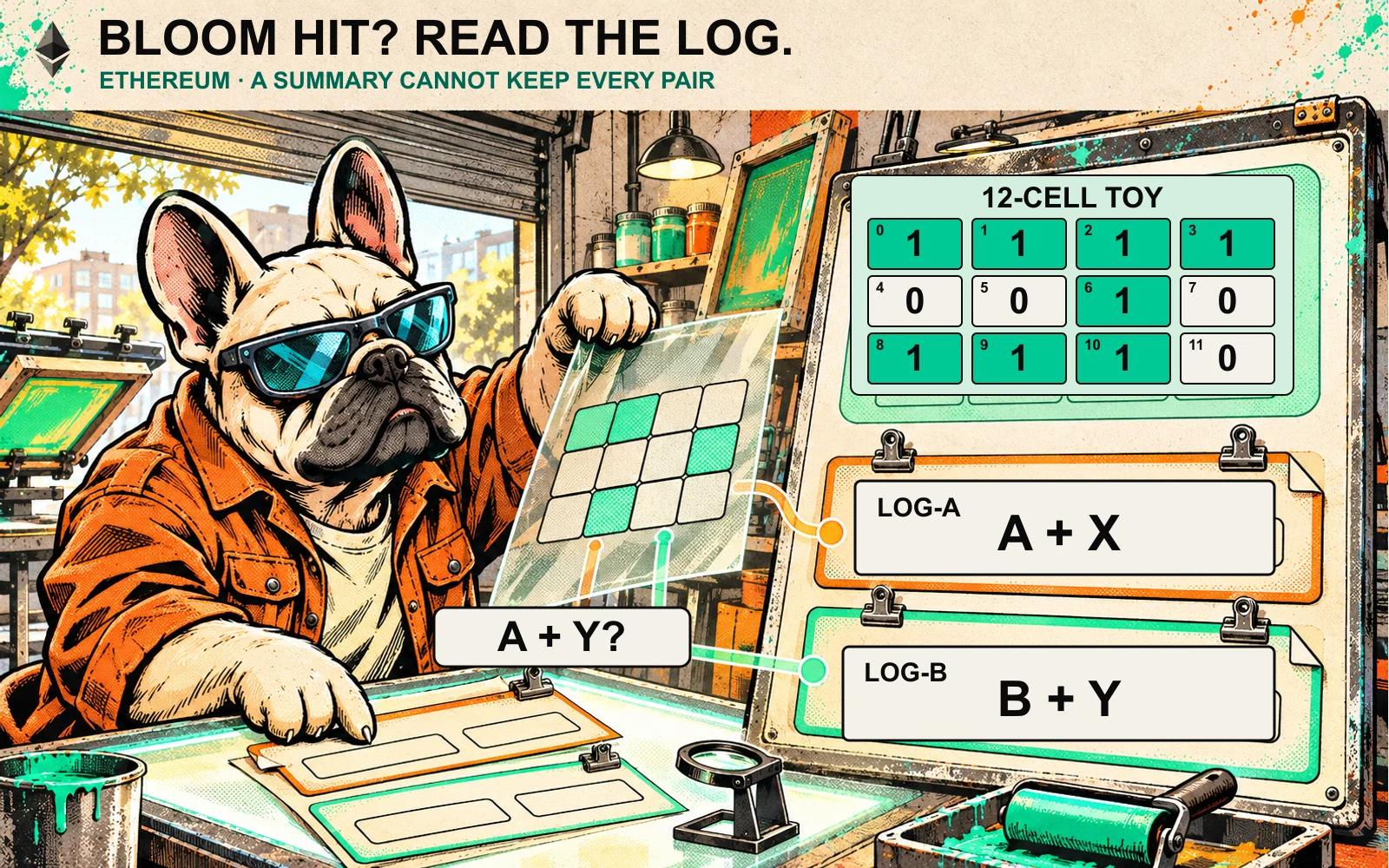
Imagine a fictional receipt containing exactly these two logs:
| Log | Emitting address label | Topic label |
|---|---|---|
| LOG-A | EMITTER-A | TOPIC-X |
| LOG-B | EMITTER-B | TOPIC-Y |
The names are placeholders, not addresses or topic hashes. Assume each log has only the one topic shown, with no omitted logs.
Now ask for a log from EMITTER-A containing TOPIC-Y. There is no such log in the declared record. LOG-A supplies the requested emitter, while LOG-B supplies the requested topic.
Both items are nevertheless added to the receipt's bloom. A test that considers only their individual bloom memberships cannot establish that they occurred together. This loss of association matters even without relying on a hash collision.
The same problem applies to topic position. The bloom construction adds each topic without preserving where it sat in the original topic array. Exact positional matching belongs to the actual log/filter stage.
This is a logical example of the information the summary discards. It is not a captured client query, a measured false-positive rate or a claim that a log API returns unfiltered bloom hits.
A toy OR diagram, with the size clearly changed
To make the union visible, use 12 toy boxes numbered 0–11. This is deliberately not Ethereum's 2,048-bit encoding. We choose the positions below by hand; they are not Keccak results or a bloom calculated from real address bytes.
| Fictional item | Chosen toy positions |
|---|---|
| EMITTER-A | 0, 3, 8 |
| TOPIC-X | 1, 3, 10 |
| EMITTER-B | 2, 6, 8 |
| TOPIC-Y | 1, 6, 9 |
After OR combines the four items, the set positions are 0, 1, 2, 3, 6, 8, 9 and 10. Reading boxes 0 through 11, the toy row is 111100101110.
Every chosen position for EMITTER-A and TOPIC-Y is present in that union. Checking those positions would not exclude the receipt. Returning to the two actual teaching rows, however, finds no EMITTER-A/TOPIC-Y log.
There is a second limitation: different items can select overlapping positions. All the required bits can therefore be set without the searched-for item having been added at all. The compact filter is useful for eliminating candidates, not reconstructing the original logs.
A negative check also needs its assumptions. A missing required bit can exclude an item from a correctly constructed, trustworthy bloom of the relevant scope. An unavailable RPC response, the wrong block's bloom or an incorrectly encoded search item does not establish that the event never happened.
Exact log results are a later stage
The Execution API filter methods define eth_getLogs as returning logs matching a specified filter. That method's result is not simply a list of blocks whose blooms looked promising.
The filter schema distinguishes a block-range filter from a block-hash filter and defines address and topic inputs. The JSON-RPC reference explains that topic matching is order-dependent. Those conditions contain information that a union of bloom bits does not retain.
This distinction is useful when reading a technical description: “the bloom matched” describes a candidate check, while “this log matches the filter” concerns an actual record under stated conditions. Neither phrase, on its own, proves the record was obtained from an authenticated chain history.
The checked transaction methods also allow a missing receipt result and define a pruned-history error. Provider availability and retained history matter. Do not translate an error, unsupported query or missing response into a universal “no event” conclusion.
Read the actual log in its receipt
For a matching-event question, inspect the record that can answer it:
- Keep the chain and block context. Retain the complete transaction and block identifiers and the observation time. Establish the source independently; a provider response is not automatically a cryptographic receipt-inclusion proof.
- Check the emitting address. The log's address identifies its emitter. It is not interchangeable with the outer transaction's sender or destination.
- Read the topic array in order. Match the intended conditions against the actual log. A bloom's collection of bits cannot recover topic positions or prove an address/topic combination.
- Read the data under the correct event layout. Non-indexed event data is absent from this bloom construction. A possible topic match says nothing about a particular quantity in that data.
- Separate the event from its meaning. A decoded name, receipt status or familiar ticker does not certify a token's identity, the intended economic result or a receiving service's credit.
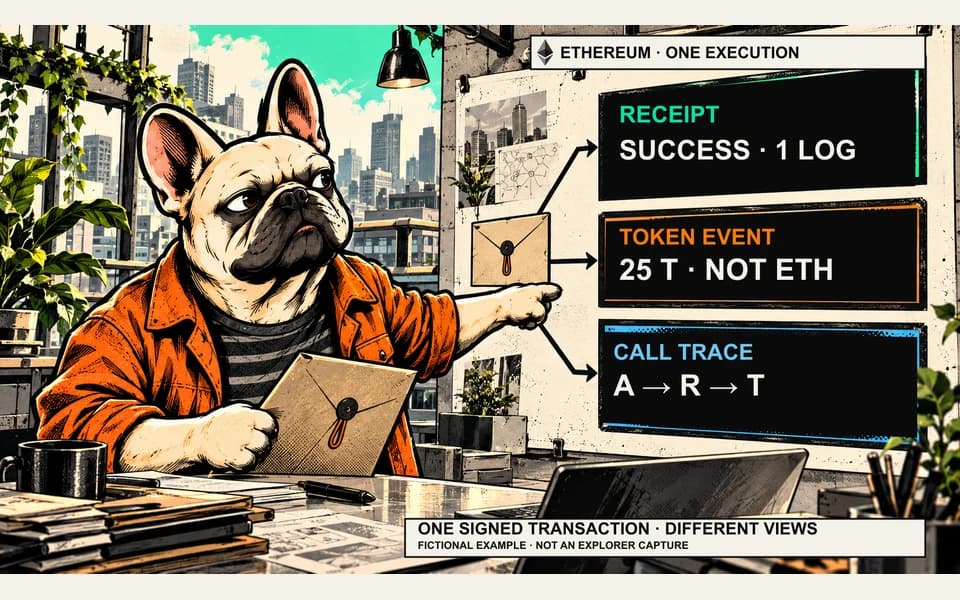
Our logs and internal-transactions explainer follows one action across receipt, log and trace views. It also explains why different views of one transfer should not be added together. For the asset's identity, keep the network and full token contract attached to the record.
Chain reorganizations and observation scope need attention too. The documented log response can mark a log as removed following a reorganization. A stored result needs its context; a bloom hit does not supply finality.
Use the bloom to understand why a scope remained a candidate. Use the actual records, their source and their interpretation to answer whether the requested event occurred.
Sources and scope
Complete official specification modules and relevant API contracts checked on 21 November 2026. The bloom construction is scoped to the published Osaka reference. Its source commit, release version and documentation build date were not established, and no claim is made about a measured active mainnet fork or every future implementation.
Execution API method and schema contents were captured from verified immutable Git blobs, with hashes retained in the editorial source record. These identify individual file contents, not a repository-wide commit, software release or tested provider. The linked branch pages can change later. The Ethereum.org reference contains historical examples and tutorials; none was executed or treated as a live observation.
LOG-A, LOG-B, the emitter/topic labels and the 12-box positions are fictional. No Ethereum bloom, real hash, address, log query, node, wallet, signature, transaction or receipt proof was generated or tested. No empirical false-positive rate is claimed. The comic is an explanatory illustration, not documentary evidence or a security verdict.
- Osaka specification: logs bloom — 256-byte construction, selected positions and added items.
- Execution API: transaction methods — receipt lookup, missing results and history errors.
- Execution API: filter methods — matching log results and query scope.
- Execution API: receipt and log schema — separate bloom and log fields, including record context.
- Execution API: filter schema — address, topic, block-range and block-hash inputs.
- Execution API: base types — the 256-byte field and other encoded types.
- Ethereum.org: JSON-RPC API — log/receipt fields, topic order and reorganization context.
See something wrong? Brokzi logs material changes. Prepare a correction note.