
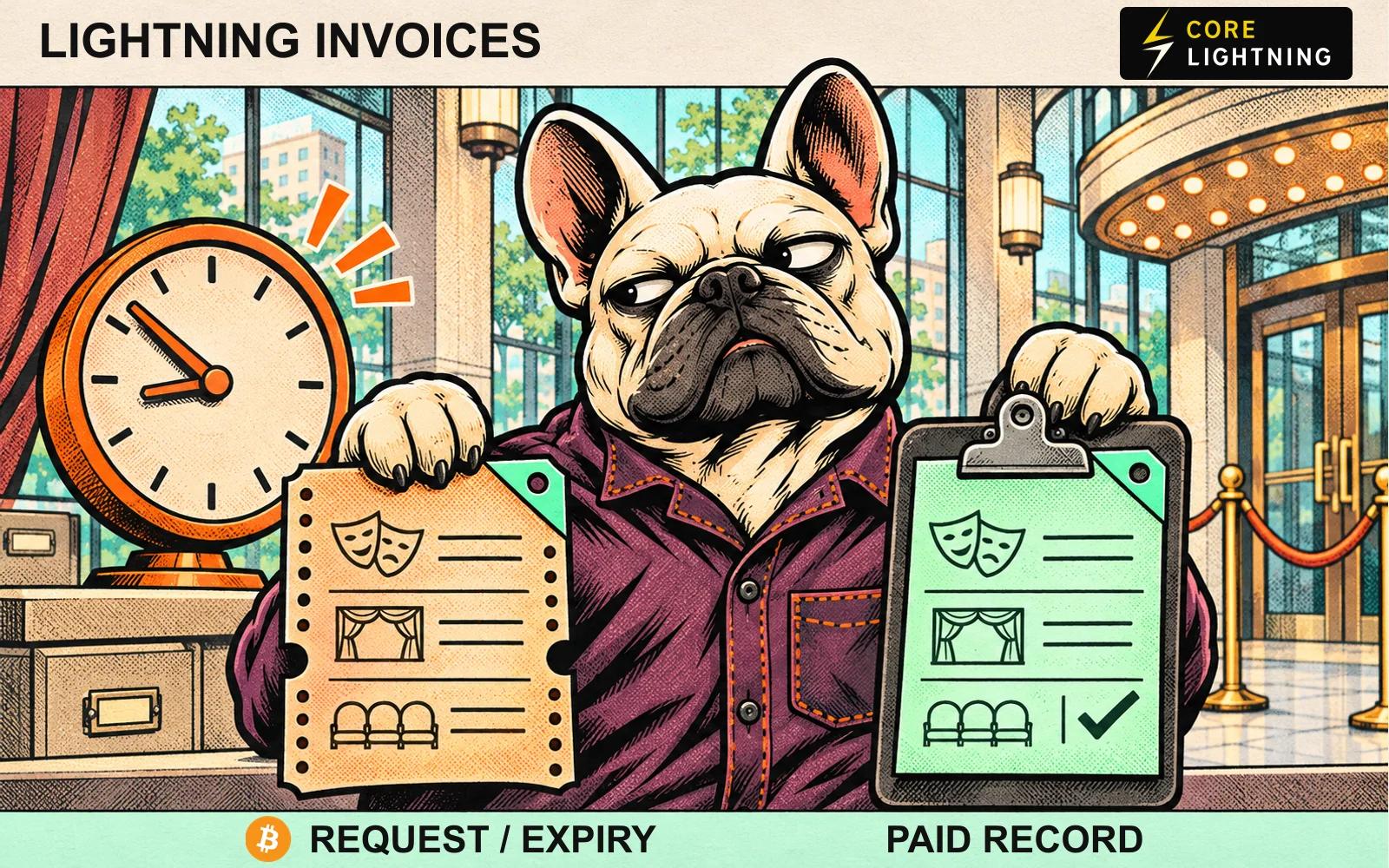
A Lightning invoice can look identical before and after payment. The signed request says what the recipient asked for. A payment record can show what they actually received and when. That distinction matters even if both display the same payment hash.
What a BOLT 11 Lightning invoice contains
Think of a theatre ticket request with a deadline. The request can be authentic and still sit unpaid. The table below shows selected decoded fields from a fictional example. It contains no complete invoice, payment address, QR code or real hash.
| Field | Fictional value | What it tells you |
|---|---|---|
| Network prefix | lnbc | Lightning on Bitcoin mainnet. lntb indicates Bitcoin testnet. |
| Optional amount | 12u | Twelve millionths of a bitcoin, or 1,200 satoshis. An omitted amount is unspecified rather than zero. |
| Timestamp | 8 Nov 2026, 14:10 UTC | When the request was issued, displayed here as a date and time. BOLT 11 encodes it as seconds since the Unix epoch. |
Expiry, tag x | 900 seconds | A 15-minute window ending at 14:25 UTC. If the expiry tag is absent, BOLT 11 defines a default of 3,600 seconds. |
Payment hash, tag p | DEMO-HASH-A | A placeholder for the required SHA-256 hash of a payment preimage. The placeholder itself is deliberately invalid. |
The network and optional amount are in the human-readable part of the encoded request. The timestamp, expiry tag and payment hash are in its data section. The invoice signature authenticates the request. It is already there before any payment, just like the hash. BOLT 11 specifies the encoding and signature.
What happens when a Lightning invoice expires?
The deadline is the timestamp plus the expiry duration. In the example, 14:10 UTC plus 900 seconds is 14:25 UTC. BOLT 11 says that after this deadline the payer should refrain from attempting payment and the recipient should refrain from accepting it.
Now compare two fictional outcomes at 14:30 UTC. In one, the request received nothing before the deadline. In the other, the recipient recorded payment at 14:17 UTC, eight minutes before expiry. Both copies of the original request still say 14:25 UTC. The deadline has passed in both cases, but it does not erase a completed payment. A clock can tell you when a request ran out of time. The payment record tells you whether it was fulfilled.
Where Core Lightning records payment status
Core Lightning’s payment guide describes invoice creation as issuing a BOLT 11 string. Its separate read-only invoice status reference documents the recipient node’s own records. Those records can be unpaid, expired or paid. A paid record includes the payment time (paid_at), amount received (amount_received_msat) and payment preimage.
In the example, the paid record could show 14:17 UTC and 1,200,000 millisatoshis, equal to 1,200 satoshis. The unpaid-at-expiry version would show expired with no paid time. These are Core Lightning’s documented states. BOLT 11 defines the signed invoice format. It does not require every Lightning app to present the same status labels.
Why the payment hash differs from a Bitcoin txid
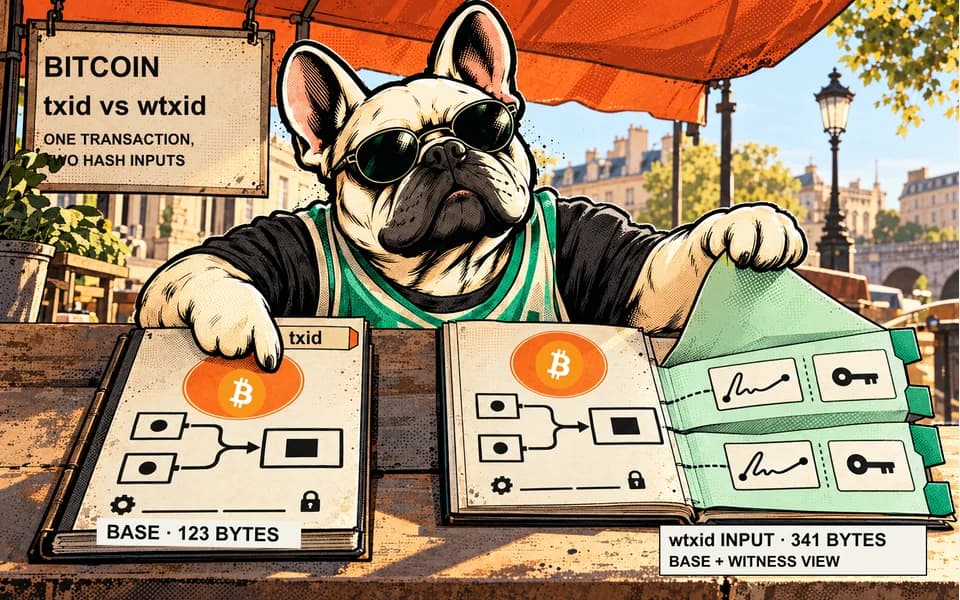
A Lightning payment hash is computed from the payment preimage, a secret value returned on successful Lightning payment. The preimage can be checked against the hash in the signed request. The hash alone cannot prove payment because it was included at issuance. A Bitcoin txid is the double SHA-256 hash of the serialized on-chain transaction without witness data, as specified in BIP 141. They can look alike when both are displayed in hex, but they describe different objects.
Core Lightning also documents an optional paid_outpoint with a txid and output number when an on-chain output paid the invoice. That is a separate field from payment_hash. For more on what a transaction identifier does and does not show, see Bitcoin txid vs wtxid.
Sources
- Lightning BOLT 11 specification — network and amount encoding, timestamp, expiry, signature and payment hash.
- Core Lightning: Sending and receiving payments — where the BOLT 11 request comes from.
- Core Lightning: Invoice status reference — status values, received amount, paid time, preimage and optional outpoint.
- Bitcoin BIP 141 — definition of the on-chain transaction ID.
See something wrong? Brokzi logs material changes. Prepare a correction note.