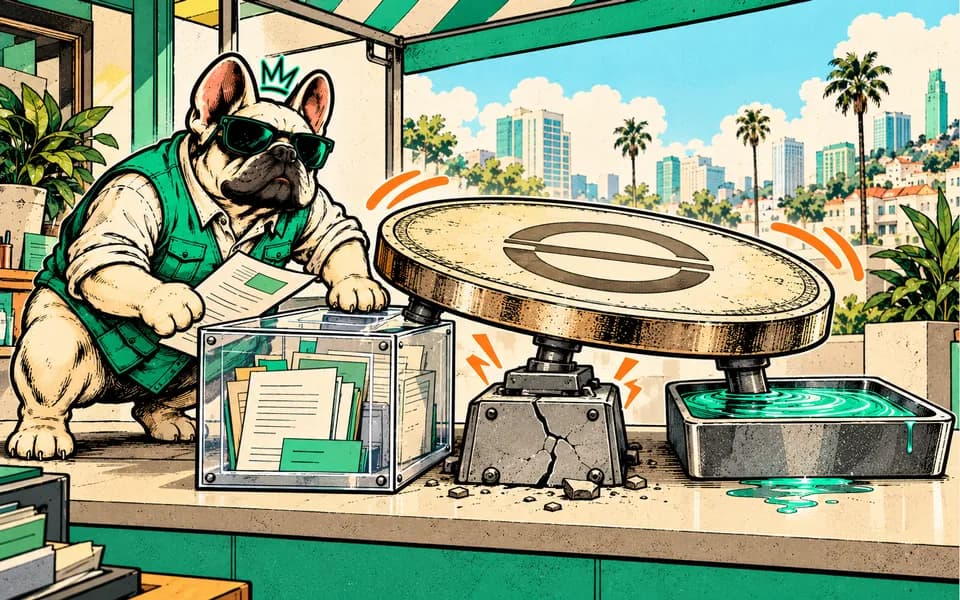
A reserve page shows assets. A customer wants to know whether they can get their money back. Those questions overlap, but the first does not settle the second.
For readers comparing custody disclosures, a proof-of-reserves report is a document to inspect, not a safety badge. This guide separates the evidence it may provide from the conclusions that need more information. It does not rank exchanges or verify anyone's reserves.
Start with the report, the entity and the date
Write down which legal entity, products and assets the document covers, who performed the work and when the snapshot was taken. Keep the snapshot date separate from the date somebody uploaded, checked or shared the page.
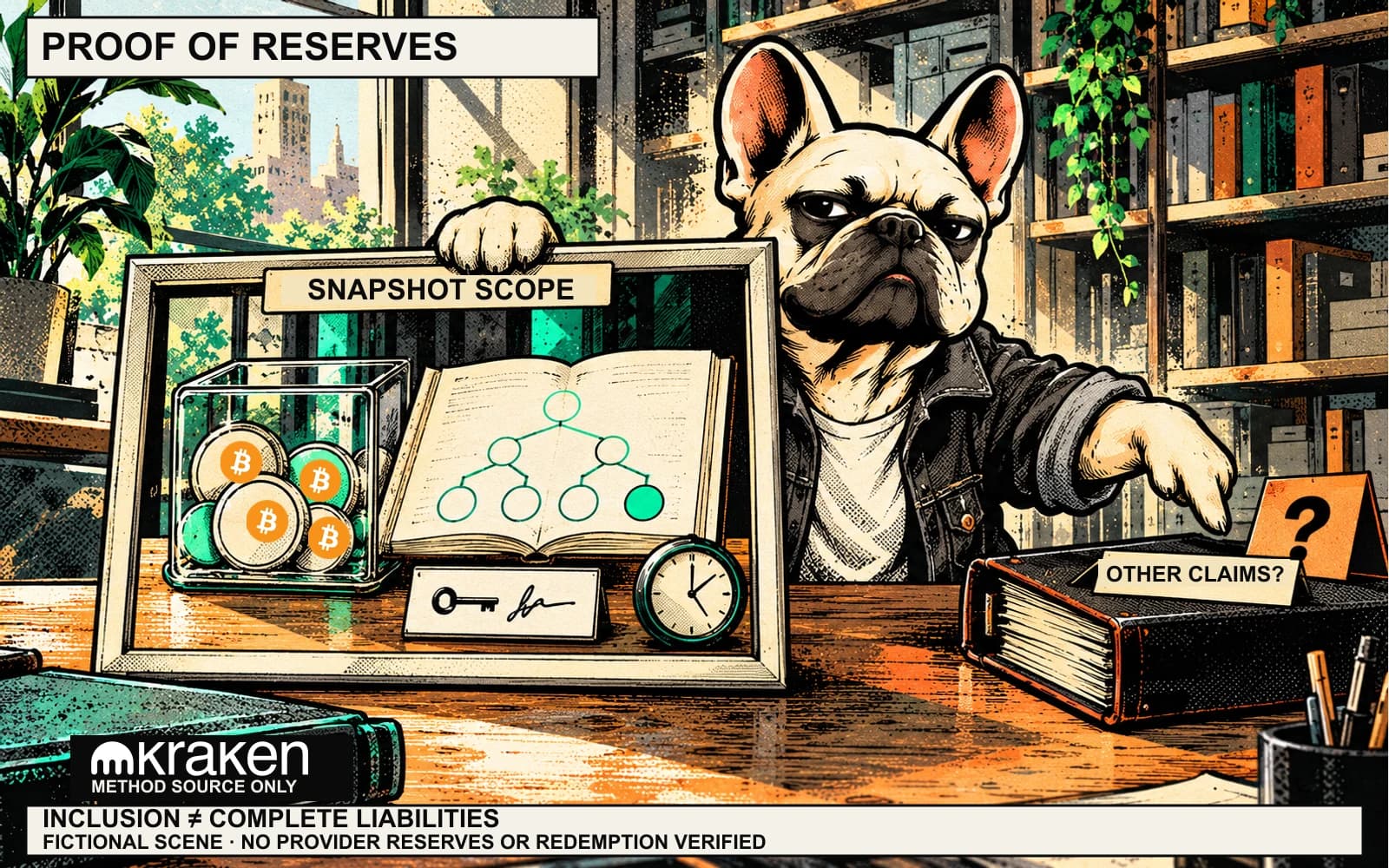
Kraken's current methodology page describes a snapshot, a Merkle-tree commitment to client balances and signatures associated with reserve addresses. It also describes product-specific balance treatment and exclusions. It is a useful named example of why the scope matters, not a template for every provider.
The page reviewed for this guide displays a June 30, 2026 snapshot. That is not an October 21 balance measurement by Brokzi. We have not inspected private account records or independently verified the linked accountant's report, its reserve ratios or the provider's financial condition.
Address control and balance inclusion answer different questions
A signature can provide evidence that somebody could authorize a message for an address under the procedure used. A public address balance tells you what is recorded there. Neither item by itself tells you every other claim against those assets.
A Merkle inclusion proof addresses a separate question: whether a particular record belongs to a dataset committed by a particular root. In Kraken's described process, customers can check their included balances against that commitment. The proof concerns the specified snapshot, not every later account movement.
Keep these checks separate when reading any report:
| Evidence presented | Question to ask next |
|---|---|
| Address and signed message | Which address, timestamp and signing procedure were checked? |
| Your balance and inclusion path | Which record, asset amount and snapshot root does this verify? |
| Total customer balances | How did the work address omitted accounts, products or claims? |
| Asset-to-balance comparison | Are the numerator and denominator measured on the same scope and date? |
Your record being present does not, by itself, establish that nobody else's record is missing. A successful inclusion check and a complete liabilities assessment are different tests.
A reserve ratio needs its denominator
Consider a fictional custodian, unrelated to Kraken or any named company. Assume a snapshot counts 110 BTC in the selected asset addresses and 100 BTC of included customer claims. The stated comparison would be:
110 BTC / 100 BTC × 100 = 110%
That arithmetic says what the two chosen totals imply. It does not establish whether the dataset covers all obligations, whether the assets are pledged or whether the custodian can meet withdrawals.
To see why missing scope matters, change the assumptions. Suppose the fictional business also owes another creditor 20 BTC. For this teaching example only, assume its entire available asset stock is the same 110 BTC, with no other assets or offsets. Total assumed obligations are now 100 + 20 = 120 BTC.
The new comparison is 110 / 120 × 100 ≈ 91.67%, rounded to two decimal places. The difference is 110 − 120 = −10 BTC. A positive-looking comparison against included customer claims did not answer the wider question under these different assumptions.
These are invented quantities, not current holdings, a borrowing allegation or a real balance-sheet assessment. The example changes the denominator; it does not establish a universal solvency test. Real reports need their actual definitions, valuation basis and legal context.
Snapshot evidence has a time boundary
An address-control check also has limits. Kraken's own shortcomings section says the procedure cannot prove exclusive possession of keys or detect hidden encumbrances, and cannot establish that funds were not borrowed for the review. It notes that assets or keys can become unavailable afterward.
The PCAOB Office of the Investor Advocate's March 2023 advisory likewise warns against treating point-in-time reserve work as a complete picture. Its concerns include liabilities, borrowed assets, later availability and internal controls. Those are general staff cautions, not findings about Kraken or any other provider discussed here.
A newer website timestamp does not repair an older snapshot. Record both, and ask what evidence addresses the intervening period.
Read what the accountant actually did
The word "audit" on a page does not tell you the engagement's standards or conclusion. The SEC staff's July 2023 bulletin distinguishes reserve reports from financial-statement audits conducted under SEC rules and PCAOB standards. It highlights incomplete financial statements and liabilities, varying requirements and differences in oversight.
Read the engagement type, procedures, exclusions and any stated assurance or opinion. A firm being registered does not make every service it performs a PCAOB-standard audit. The two US staff publications cited here are educational guidance, not new rules, European law or certification of a particular provider. Even a financial-statement audit is not a promise that a later withdrawal will succeed.
Keep redemption rights outside the reserve shortcut
Which entity owes you what, and under which terms? An address display does not supply that agreement. Nor does an inclusion path determine country eligibility, withdrawal processing or the asset you would receive.
Our wrapped-token explainer covers backing versus access to a conversion route; the stablecoin guide covers backing and redemption as separate questions. These are related mechanisms, not reasons to apply one product's terms to another. A wallet interface also should not be confused with control over a custodian's underlying addresses.
A short reading checklist
Before relying on a reserve claim, keep this record beside it:
- The exact entity, report provider and engagement type.
- The snapshot time and the covered assets, products and liabilities.
- What an individual inclusion check establishes, and what completeness work is described.
- Any limits concerning borrowed assets, encumbrances, keys and later events.
- The separate terms governing your claim and the proposed withdrawal or redemption route.
If a document does not answer one of those questions, leave the answer unknown. A proof-of-reserves label cannot fill in a missing liability or create a withdrawal promise.
Sources
Primary material checked October 21, 2026. This is a reading guide, not an audit, account test, legal opinion or recommendation to deposit funds. All BTC arithmetic is fictional. No wallet connection, signature, inclusion verification or redemption was performed.
- Kraken: Proof of Reserves: current public method, displayed snapshot date and shortcomings, not our verification of its report results.
- PCAOB Office of the Investor Advocate: reserve-report advisory, March 8, 2023. Staff views, not a Board rule or provider-specific finding.
- SEC staff: alternatives to financial-statement audits, July 27, 2023. US educational scope; not a statement of European law.
See something wrong? Brokzi logs material changes. Prepare a correction note.