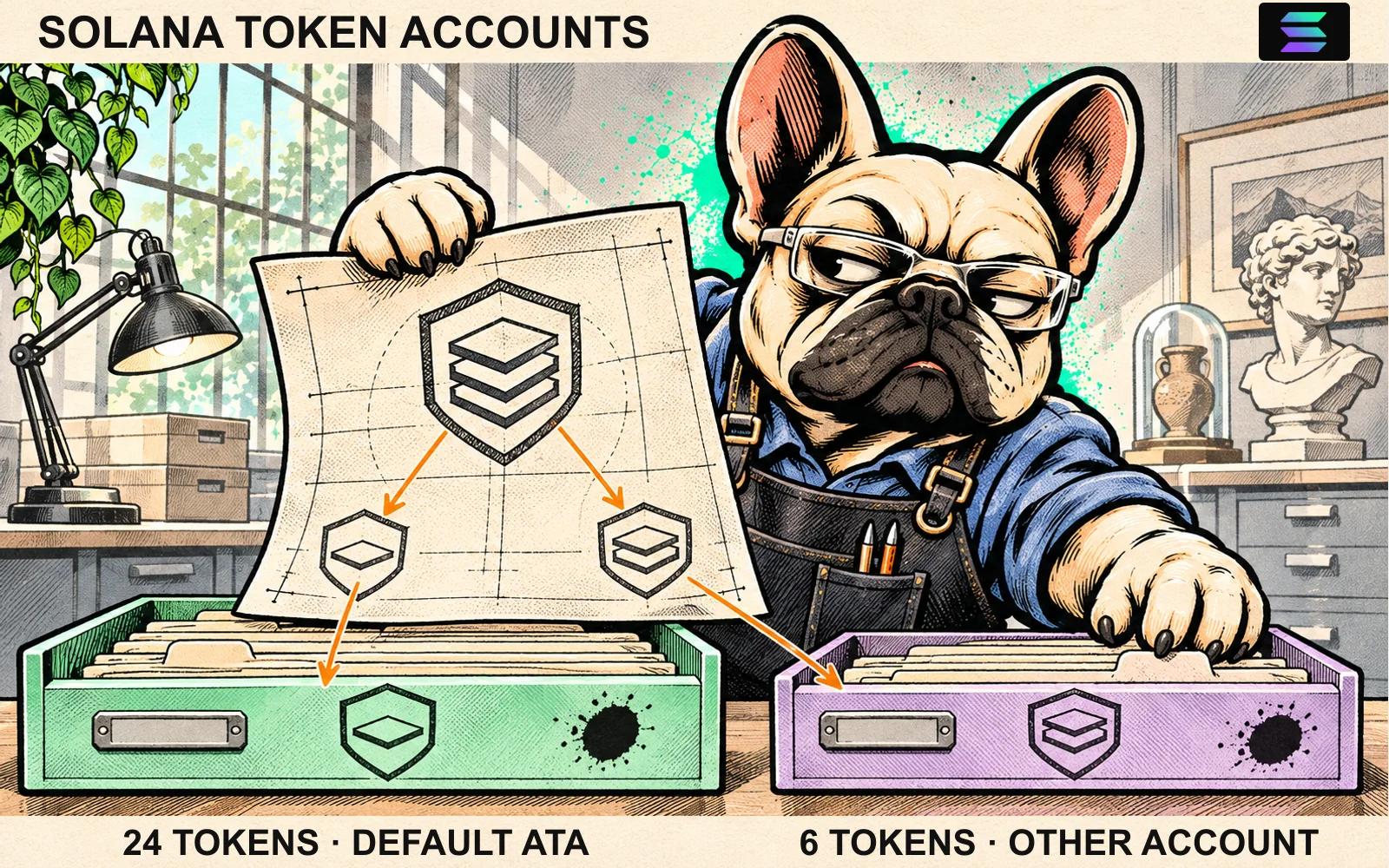
A wallet view can show 30 units of a Solana token even when its default token account holds 24. Both numbers can be right. The other six units may sit in a second token account for the same mint and owner. The mint identifies the asset. The token accounts record where the balances are.
Which address answers which question?
A Solana mint stores information shared by the whole asset, including supply and decimal precision. A token account instead records one balance, tied to exactly one mint. The wallet address can appear inside that record as its owner. It has its own address, separate from the mint and the balance records. Solana’s token overview describes each of these roles.
| Term | What it identifies | Fictional label |
|---|---|---|
| Mint account | The asset and its shared settings, such as supply and decimals | MINT-A |
| Wallet owner | The wallet named as the balance authority | OWNER-A |
| Token account | One balance record for one mint and one owner | SIDE-A |
| Associated token account (ATA) | The token account at the standard derived address | DEFAULT-A |
An ATA is a type of token account. Every label here is fictional and deliberately unusable as a Solana address. For the broader difference between a name and an on-chain identifier, see token symbols and contract addresses.
One mint and owner, two balances
Suppose MINT-A has two decimals and uses the original Token Program. The wallet OWNER-A appears as the owner in two separate records:
| Token account | Mint | Owner in token data | Stored amount | Display balance |
|---|---|---|---|---|
DEFAULT-A, the ATA | MINT-A | OWNER-A | 2,400 base units | 24.00 |
SIDE-A, an additional account | MINT-A | OWNER-A | 600 base units | 6.00 |
With two decimals, 100 base units make one whole token. The two records hold 3,000 base units, or 30.00 tokens, together. That total describes these two records only. It says nothing about the mint’s total supply. A view that reports only DEFAULT-A shows 24.00, while one that adds both shows 30.00.
Solana’s payments overview focuses on the standard account used in payment flows. One standard ATA for an owner, mint and token program can coexist with other token accounts. The default address does not describe the wallet’s entire inventory.
Why both records have two kinds of owner
Solana’s account metadata has an owner field naming the program that can change the account data. For both fictional balance records, that program is the original Token Program. The data managed by the program contains its own owner field. That field names OWNER-A, the authority over the tokens, subject to the program’s rules. A Token-2022 mint uses the Token-2022 program instead. The Associated Token Program provides the default address convention. The token program remains the program owner of the resulting account. Solana accounts and the token-account reference describe the two layers.
What determines the associated token account address?
The standard derivation uses three inputs in order: the wallet owner address, the token program ID and the mint address. The Associated Token Program ID supplies the program namespace for the derivation. The routine also finds a bump, a small value used to obtain a valid program-derived address. The published address derivation code shows those inputs.
Using Token-2022 instead of the original Token Program changes the derived address. It does not change which program owns MINT-A. The derived address also says nothing about whether an account has been initialised there or what its balance might be. That information belongs to the account record.
Sources
- Solana: Assets on Solana — mint data, token-account balances and multiple accounts for one mint.
- Solana: How payments work — the ATA convention and the token program input.
- Solana: Token account reference — data layout, authority and ATA semantics.
- Solana: Accounts — the owner field in account metadata.
- Associated Token Program address source — seed order and program namespace.
See something wrong? Brokzi logs material changes. Prepare a correction note.