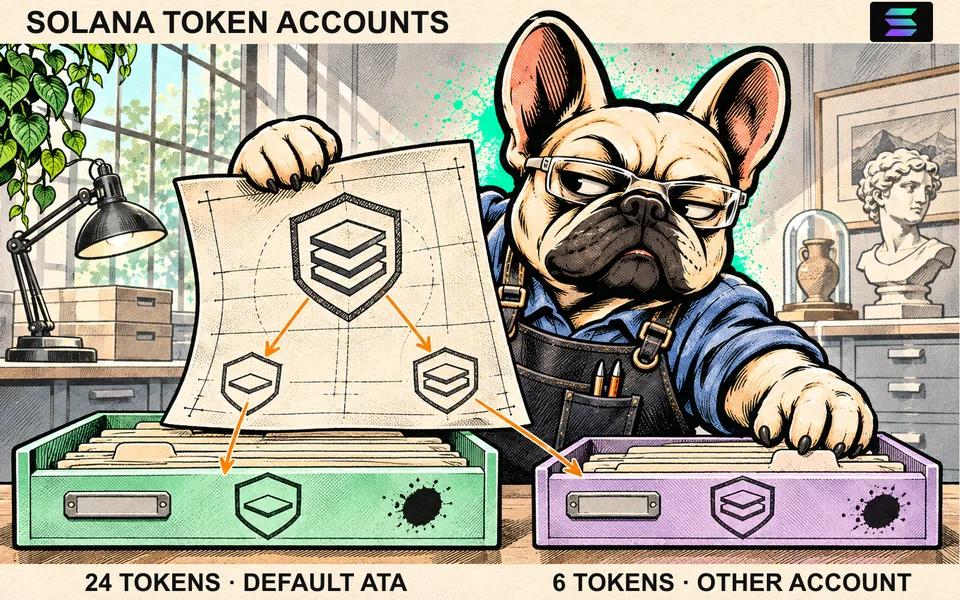
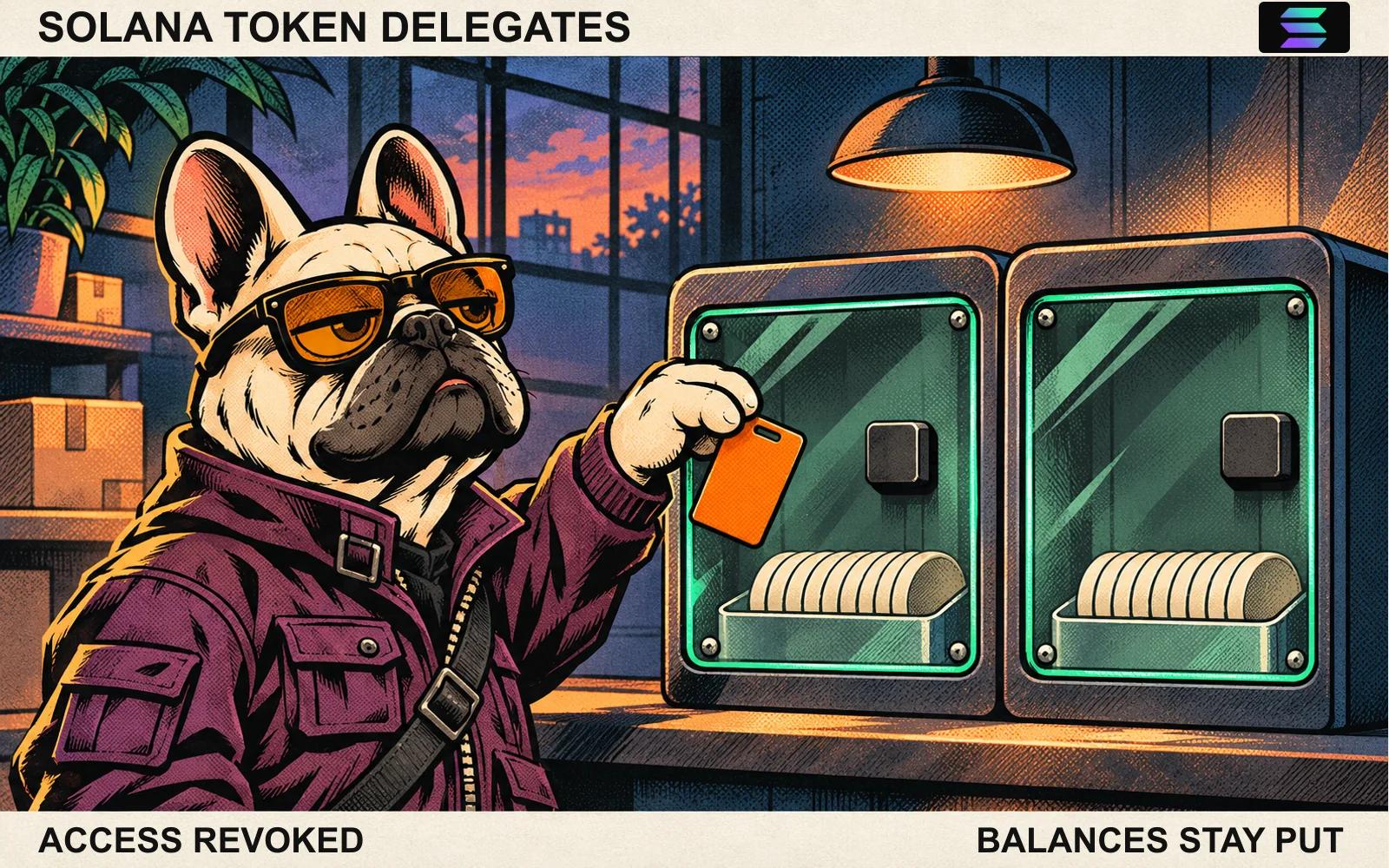
One wallet owns two accounts for the same Solana token. It approves a delegate on one of them. Which balance can the delegate touch? The answer is in the account that received the approval. An ordinary delegate’s allowance lives on that account.
What does a Solana token delegate get?
In the original Token Program, an approval lets the named delegate transfer or burn tokens from the source account within a cap. The account stores one current delegate and one remaining delegated_amount. The owner still controls the account. Approval sets permission without moving tokens or putting aside part of the balance. Solana’s approval documentation and the original Token Program processor show where those fields are written.
The owner authorises the approval. ApproveChecked also checks the expected mint and decimal precision. Those checks identify the asset and units for the instruction. The delegate and cap still go on the one source token account. A mint identifies the asset, while each account records its own balance and authorities. The Solana token-account explainer covers that distinction in more detail.
One owner and one mint, two allowances to check
Both accounts below belong to the same fictional owner and hold the same fictional mint. The first has 40 tokens and the second has 70. Every name is a placeholder. The table assumes each listed change succeeded and no transfers or burns occurred between rows.
| Change | Account A delegate and cap | Account B delegate and cap |
|---|---|---|
| Starting state | None, 0 | None, 0 |
| First approval on A | DEMO-ONE, 8 tokens | None, 0 |
| Second approval on A | DEMO-TWO, 3 tokens | None, 0 |
| Revoke on A | None, 0 | None, 0 |
The second approval replaces the first. After it succeeds, DEMO-TWO has a cap of 3 tokens on A. The old 8-token cap is gone. It does not become an extra 8 tokens for the new delegate, and it does not follow the owner to Account B. The balances stay at 40 and 70 throughout these permission changes.
An actual delegated transfer or burn is a different event. When the program processes one that consumes the allowance, it reduces the remaining cap by the amount used. For example, spending 2 tokens out of a 3-token allowance leaves a cap of 1 token. The original processor also checks available funds. The cap describes what the delegate can use, subject to the balance and other program rules.
What does revocation prove?
A successful Revoke in the original Token Program clears the delegate and writes zero to the delegated amount on the targeted account. Account B’s fields are separate. A screen that says “submitted” describes an attempt. A confirmed successful transaction and the account state provide evidence that the on-chain change occurred. Revocation changes authority going forward. It cannot undo an earlier transfer or burn. Solana’s revocation documentation describes the reset.
Token-2022’s Permanent Delegate is a different authority. When a mint has that extension, the authority sits on the mint and can apply to token accounts for that mint. Clearing an ordinary account delegate does not clear the mint’s permanent delegate. Solana’s Permanent Delegate documentation describes that scope.
Sources
- Solana: Approve Delegate — scope, replacement and mint and precision checks.
- Solana: Revoke Delegate — account fields cleared by revocation.
- Original SPL Token processor, program v9.0.0 — changes to the delegate, allowance and balances.
- Solana: Permanent Delegate — the separate mint extension.
See something wrong? Brokzi logs material changes. Prepare a correction note.