

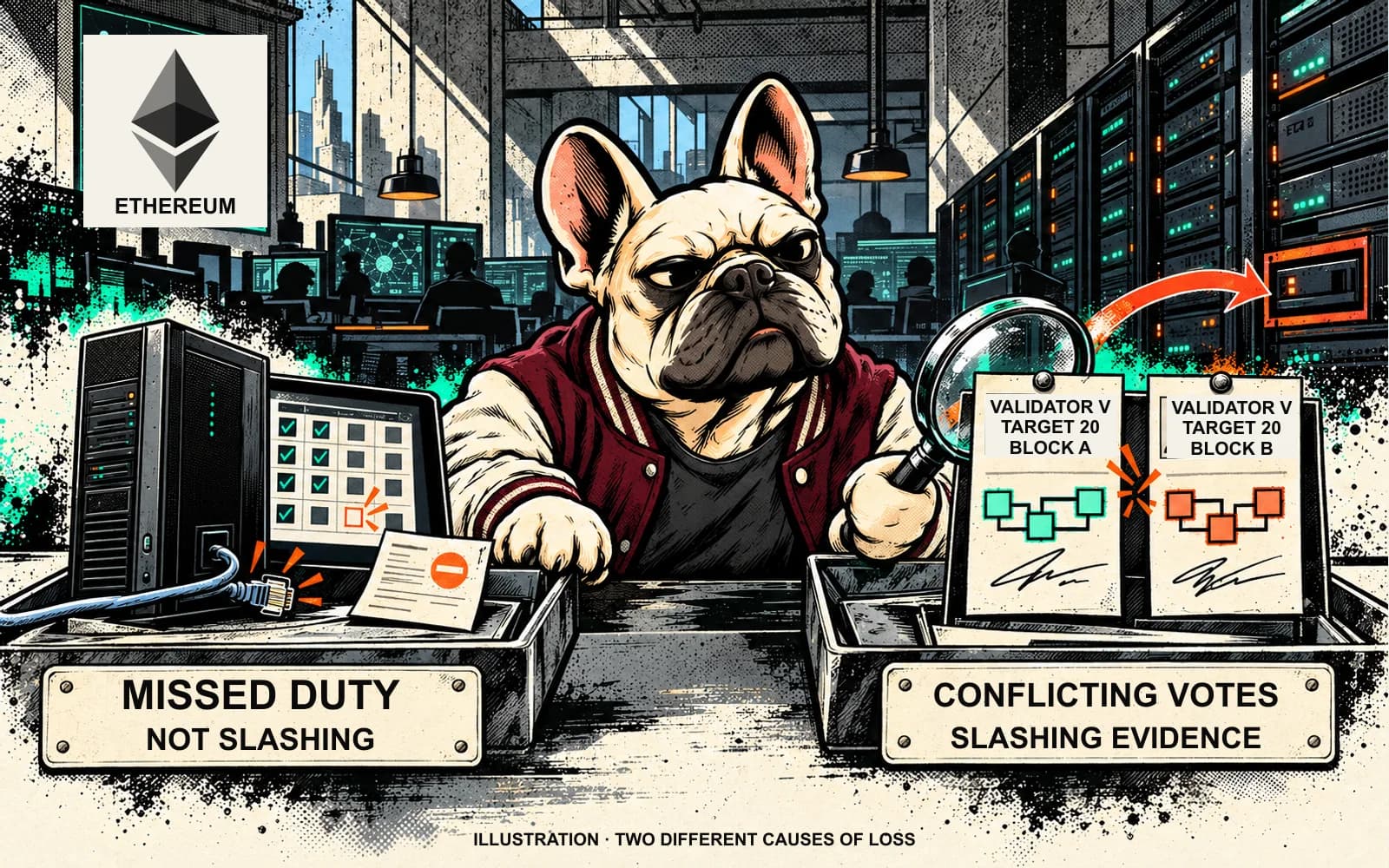
A validator misses a vote because its connection drops. Another signs two conflicting votes. Both can lose ETH, but calling both incidents "slashing" hides the difference that matters.
This guide is for readers interpreting Ethereum staking reports or the risks behind a staking service. It explains Ethereum consensus, not every proof-of-stake network or a particular provider's compensation policy. Ethereum's staking overview introduces the underlying validator role; our liquid staking explainer covers the separate token and exit routes.
Missed duties do not all have the same consequence
An attestation is a validator's signed vote about the chain. Ethereum rewards particular timely participation and penalizes some missing participation. In the pinned Altair participation rules, missing source or target participation can incur a balance penalty. Missing the head flag forfeits its reward without that flag's corresponding penalty. A missed block proposal also loses a reward opportunity rather than automatically becoming a slashable offence.
Those distinctions make "my rewards fell" an incomplete incident report. A smaller payment may reflect a missed reward, a deduction, service charges or other accounting. It is not, on its own, evidence that a validator was slashed.
| Situation | What changes | Is that alone slashing? |
|---|---|---|
| Missed attestation duties | Some rewards are lost; applicable penalties can reduce the balance | No |
| Missed block proposal | The proposer misses the reward opportunity | No |
| Extended failure of network finality | Inactivity-leak rules add losses linked to non-participation | No |
| Proven conflicting signatures | Slashing penalties and a forced validator exit apply | Yes, when the protocol's evidence checks pass |
This does not mean downtime is harmless. Duration, the duties missed and the network's state affect the loss. An uptime percentage alone does not calculate it.
What makes Ethereum staking slashing different
The consensus specification's evidence checks identify particular contradictions:
- A proposer signs different block headers for the same slot using the same validator identity.
- An attester makes a double vote: different attestation data with the same target epoch.
- An attester makes a surround vote: one vote's source-to-target epoch interval strictly encloses another's.
For a fictional example, votes from source epoch 10 to target 20 and from source 12 to target 18 satisfy 10 < 12 and 18 < 20. That is the surrounding relationship. Different votes with the same target epoch 20 instead meet the double-vote condition. These invented epoch numbers illustrate the checks, not an observed incident.
The rules verify signatures and the relevant validator identity. Two unrelated validators voting differently do not, by that fact alone, establish this evidence against either one. Nor is signing the identical message again automatically the same as signing conflicting data.
Slashing is a protocol outcome, not a finding about someone's intentions. A configuration mistake can produce contradictory signatures without an operator intending to attack Ethereum.
A slashing amount needs a version and a scope
For a reproducible reference, this article uses stable consensus-specs v1.6.1: the Electra penalty functions and the Fulu specification built on them. Development branches are not evidence that a proposed rule has activated on a network.
The pinned Electra slash_validator function calculates the initial penalty by integer-dividing effective balance by 4,096. If effective balance is exactly 32 ETH, represented as 32,000,000,000 Gwei, that initial term is:
32,000,000,000 Gwei ÷ 4,096 = 7,812,500 Gwei = 0.0078125 ETH
That is only the initial term under those specified rules, not the total cost of being slashed, a service fee or a forecast. The same function initiates an exit and marks the validator as slashed. The separate process_slashings calculation considers accumulated slashed balance relative to active balance; correlated slashings can increase the loss. Other applicable losses and withdrawal timing still matter.
A percentage copied from an older fork, a different effective balance or another chain is not a universal quote. Before comparing reported amounts, identify the network, applicable fork, balance basis and whether the number describes an initial deduction or the full outcome.
An inactivity leak is a network condition
The Ethereum rewards-and-penalties overview describes an inactivity leak as a response to prolonged failure to finalize. The additional loss is linked to participation and inactivity accounting. The trigger concerns the chain's finality, not just one operator's internet connection.
A validator can suffer inactivity-related losses without submitting slashable messages. Conversely, fixing a connection does not erase conflicting messages already signed. Keeping these mechanisms separate helps explain why two outages of equal duration need not have equal financial consequences.
Why a backup signer needs more than another server
Running the same signing identity in two places can turn an availability arrangement into a conflicting-signature risk. The EIP-3076 slashing-protection interchange document addresses transferring signing history between clients, including conservative rules where history is incomplete.
Signing history and coordinated control matter; possessing a second machine does not establish that the setup is safe. This article is not a migration procedure or an instruction to start, stop or upgrade a validator. Follow the relevant client's current operational documentation for a real setup.
Read a staking loss report before naming the cause
Use these questions to separate the event from its accounting:
- Which network and validator or pooled position does the report cover?
- Does it identify missed duties, lost rewards, an inactivity condition or an actual slashing record?
- What fork and effective balance underpin the calculation? Is the figure initial, cumulative, gross or after service charges?
- For a pool or service, which published terms determine how losses reach the holder and whether anyone promises compensation?
- Is the reported loss instead a lending liquidation or a token's market-price movement?
Those last outcomes have different causes. A lending health factor can cross its threshold without any validator being slashed. A staking token can trade at a different price without changing the consensus rule. Neither observation diagnoses a validator's signatures.
Does staying online guarantee no slashing?
No. Availability and consistent signing are different requirements. An online setup can produce conflicting signatures if its signing arrangement is wrong. Slashing protection is designed to constrain signing, but a product label or an uptime chart does not prove that a particular configuration or service eliminates losses.
Does this also cover restaking penalties?
Only the Ethereum consensus layer. Restaking can add commitments to another protocol or service, with its own enforcement and withdrawal conditions. Those require a separate, named-protocol review. An Ethereum slashing explanation does not certify the safety of additional commitments or promise that collateral can always be recovered.
Brokzi's Take
Ask what the validator signed, what it missed and what the network was doing before interpreting the balance change. "Offline" and "slashed" are not interchangeable diagnoses. A useful report names the mechanism and its accounting; a headline percentage without that context leaves the reader guessing.
Sources
Primary documentation checked October 25, 2026. The code reference is pinned to stable consensus-specs v1.6.1, not the latest development branch. The overview contains historical and updated examples; the explicit initial-penalty calculation above follows the pinned Electra code. No validator, provider loss, compensation policy or live network state was audited. No staking transaction, signature, migration or software update was performed. The epoch example and cover are fictional. Education, not financial advice.
- Ethereum.org: Staking: validator role and staking routes; live yield figures are not used.
- Ethereum.org: Proof-of-stake rewards and penalties: conceptual distinctions and inactivity-leak context, not a universal penalty calculator.
- Consensus-specs v1.6.1: Phase 0: conflicting-attestation predicate and signed proposer/attester evidence checks.
- Consensus-specs v1.6.1: Altair: participation flags, missing-duty and inactivity accounting.
- Consensus-specs v1.6.1: Electra: initial slashing term, forced exit and correlated slashing calculation.
- Consensus-specs v1.6.1: Fulu: inheritance from Electra and epoch-processing context.
- EIP-3076: Slashing Protection Interchange Format: signing-history portability and conservative signing conditions; a document, not certification of a running setup.
See something wrong? Brokzi logs material changes. Prepare a correction note.