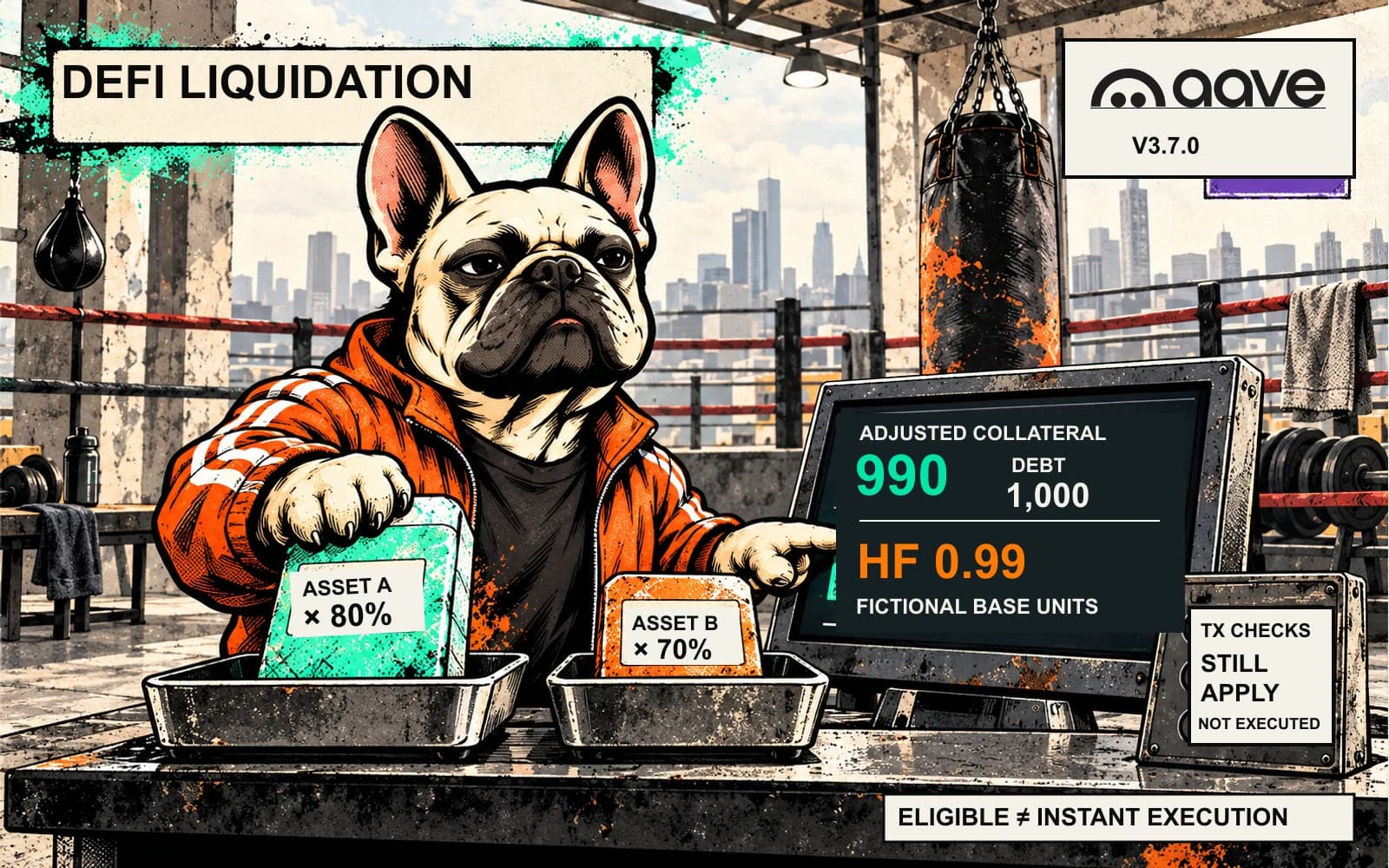
A borrowing screen can show a reassuring-looking number while the values behind it are moving. For readers learning DeFi liquidation, the useful question is what that number measures and which decisions it cannot make for you.
This article follows Aave V3's EVM implementation, release v3.7.0. The repository listed it as the latest V3 release when checked. That does not establish which implementation every market currently runs. Aave V4, Aptos deployments and Compound are outside this example.
What a health factor measures
Aave's borrowing explanation expresses health factor as collateral value multiplied by its weighted average liquidation threshold, divided by borrow value. For several collateral assets, the same relationship is clearer as:
Health factor = sum of (eligible collateral value × its effective liquidation threshold) / total debt value
Values must use the same base currency. In v3.7.0's GenericLogic, collateral flags, configured thresholds, token units, oracle prices and current balances feed this calculation. The contract uses integer scaling and rounding; the arithmetic below is a simplified teaching model.
Aave's V3 overview explains that outstanding debt accrues interest. Its value can also change with the borrowed asset's price. Watching only the collateral price misses part of the denominator.
Two collaterals need a weighted liquidation threshold
Invent two eligible collateral assets, A and B, and one debt position. Assume ordinary mode without E-mode, fixed balances, no additional interest during the example and values in fictional base-currency units. The 80% and 70% thresholds are invented, not current parameters for named tokens.
| Fictional collateral | Value in base units | Assumed liquidation threshold | Threshold-adjusted value |
|---|---|---|---|
| Asset A | 1,000 | 80% | 800 |
| Asset B | 500 | 70% | 350 |
| Total | 1,500 | Value-weighted, not a simple mean | 1,150 |
With debt valued at 1,000 base units, health factor is 1,150 / 1,000 = 1.15.
The weighted threshold is 1,150 / 1,500 ≈ 76.67%, rounded to two decimal places. Simply averaging 80% and 70% gives 75%, which ignores that A contributes twice as much value as B. Keep the unrounded weighted sum when calculating the example's health factor.
Now change only A's oracle-valued amount from 1,000 to 800 base units. B stays at 500, debt stays at 1,000 and both thresholds stay fixed. Adjusted collateral becomes 800 × 0.80 + 500 × 0.70 = 990. Health factor becomes 0.99.
Total collateral is still 1,300 against debt of 1,000. Nevertheless, the threshold-adjusted amount is below the debt value. Having more nominal collateral than debt is therefore not enough to stay above this liquidation boundary.
These calculations describe neither a real account nor an executable liquidation. They do not specify a liquidation bonus, amount seized, trading price or future loss.
LTV, liquidation threshold and bonus do different jobs
Loan-to-value, or LTV, concerns borrowing capacity. The liquidation threshold helps determine when a position becomes eligible for liquidation. The liquidation bonus affects the collateral exchanged when a liquidator repays debt. Substituting one for another changes the question being answered.
The V3 implementation takes the applicable bonus from reserve or E-mode settings and calculates collateral against the debt being repaid. Health factor alone does not tell you the resulting amount. Available collateral, repayment bounds, fees and rounding also matter.
E-mode can change the effective threshold for collateral included in its category. Our example deliberately excludes it. Read the actual market and user configuration rather than applying the example's percentages to a token with a familiar ticker.
Below 1 is a condition, not an execution clock
The v3.7.0 validation code requires health factor to be strictly below 1. Exactly 1 does not satisfy that comparison. A rounded screen displaying 1.00 cannot establish which side the full-precision value occupies.
Other checks remain. For the selected debt and collateral reserves, the implementation checks active and paused states and requires their liquidation grace periods to have expired. The collateral must be enabled for that borrower, the selected debt must exist, and borrower and liquidator cannot be the same address.
Passing the health-factor comparison does not execute a transaction automatically. A liquidator must submit a transaction that satisfies the remaining rules. The displayed number does not promise a delay in which a borrower can act, or guarantee the outcome of a repayment submitted afterward.
How much can be liquidated?
There is no universal answer of "always half." The selected release's liquidation logic considers the health factor and the selected collateral and debt values when setting repayment bounds. It also enforces minimum-leftover rules for partial liquidations. The amount available as collateral can further constrain the result.
Version matters here. The older Pool reference page's blanket 50% description conflicts with the more detailed current help page and selected code. This article follows the pinned implementation, not that shortcut. The v3.7.0 release notes also document liquidation-rounding changes. None of this verifies a particular deployed pool's settings or supplies a liquidation-bot strategy.
Which price is the calculation using?
Aave's oracle interface documentation describes prices returned for specified asset addresses in the market's base currency. Identify that configuration and its units before comparing a health factor with an exchange screen. An oracle valuation is not a promise that collateral can be sold at the same price.
Our price-oracle explainer separates reports, update timing and application checks. Do not assume that every V3 release has identical protections: v3.7.0 removed the price-oracle-sentinel integration, while the reserve liquidation-grace checks described above remain. The dependencies need reading at the version actually used.
Is a health factor above 1 safe?
It means the calculation is above this liquidation boundary at the observed state. It is not a universally safe health factor, a percentage chance of avoiding loss or a promise about the next block. Prices, accrued debt and applicable parameters can change. The metric also does not certify contract security or an asset's redemption rights.
For example, a liquid staking token's withdrawal process does not promise to finish before a lending position needs attention. A proof-of-reserves report answers different questions again; neither document substitutes for the lending protocol's calculation.
A read-first liquidation checklist
Before interpreting a displayed health factor, record:
- The network, pool, implementation version and observation time. A release tag alone is not a deployment check.
- Which balances are enabled as collateral, which debts exist and whether E-mode changes their effective parameters.
- The oracle-valued amounts, common base currency, token scales and value-weighted liquidation thresholds.
- The full-precision health-factor comparison, reserve states, grace periods and amount constraints.
- What remains unknown, including execution timing, sale proceeds and later parameter changes.
DeFi liquidation is a protocol operation with conditions and consequences. A health factor helps explain one part of it. Read the inputs and the applicable code before treating a colored number as a promise; upgradeable contracts can change the implementation behind the same address.
Sources
Primary documentation and release code checked October 22, 2026 (Asia/Tbilisi). This is educational coverage, not a contract audit, live position assessment or borrowing recommendation. All worked values and the illustration are fictional. No wallet connection, borrowing, repayment, signature or liquidation transaction was performed.
- Aave: Health factor and liquidations: public formula and liquidation explanation; no universal safe target.
- Aave: V3 overview: collateral, debt accounting and oracle-dependent values.
- Aave V3 Origin: v3.7.0 release: version boundary, rounding changes and sentinel removal. A repository release is not evidence of every market's deployed version.
- GenericLogic.sol at v3.7.0: weighted collateral, effective thresholds, balances, units and health-factor calculation.
- ValidationLogic.sol at v3.7.0: strict threshold, reserve states, grace periods, collateral flag and debt conditions.
- LiquidationLogic.sol at v3.7.0: debt repayment, collateral exchange, amount constraints, fees and rounding.
- Aave: Oracles: asset-price and price-source interfaces; actual deployment configuration was not queried.
See something wrong? Brokzi logs material changes. Prepare a correction note.