
Your wallet has two WalletConnect connections open. You disconnect one. Which app can still send requests, and what happens to the token approval you gave earlier? Those questions refer to three different records: a session, an allowance and a transaction.
Which WalletConnect session ends?
In WalletConnect Sign v2, a topic identifies a session's messaging channel. The session carries its agreed accounts, request methods and events. When a wallet or app disconnects a session, it targets that session's topic. The Sign v2 session events specification describes session_delete as an event after successful deletion. The RPC specification defines the peer message, wc_sessionDelete. The session data structure shows which fields belong to each topic.
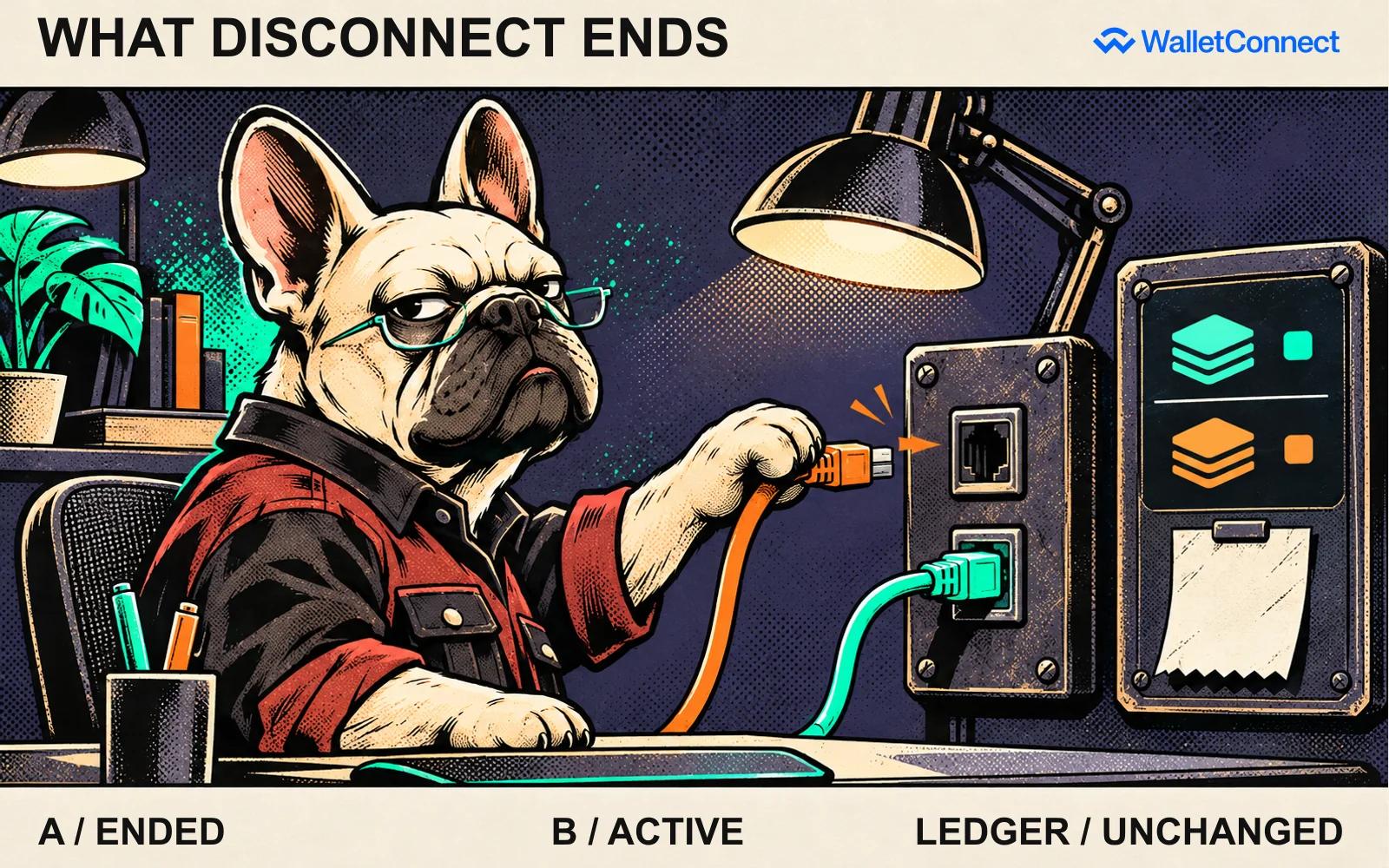
Imagine that the same Ethereum account has two open sessions. These topic names and app labels are fictional. Only the first session is successfully deleted.
| Session topic | Before | After |
|---|---|---|
DEMO-SESSION-A, a swap app | Can send the agreed transaction requests through this session. | The session ends. New requests can't use that session. |
DEMO-SESSION-B, a dashboard | Can request message signatures within its own agreed scope. | Stays connected. It keeps its own account and permitted request methods. |
A method listed in a session lets the app send that kind of request. The wallet still handles the request according to its own rules. The example assumes a successful deletion of A. Closing a tab or seeing a disconnected badge gives you less information than checking which session actually ended. Wallet interfaces differ in how they present connections.
What should you check onchain?
Suppose the swap app's spender already has an allowance of 12 units in a fictional ERC-20 token, and an unrelated transfer is already confirmed. If the only new event is deleting session A, the allowance still reads 12 and the transfer stays recorded. The session deletion message changes the connection between peers. It doesn't write to the token contract or reverse a transaction in a block.
For an allowance, inspect the token contract's current state for that owner and spender on the relevant network. ERC-20 defines the allowance as the amount the spender can still withdraw. For a confirmed transaction, check its recorded result separately. Ethereum tracks inclusion and finality onchain. For the broader distinction, see Brokzi's guide to token approvals and revocation.
Sources
See something wrong? Brokzi logs material changes. Prepare a correction note.