The Ethereum Foundation announced a new public-sector resource hub on November 3, 2026. It gives readers a place to examine proposed uses of Ethereum in public services, alongside examples the Foundation describes as existing implementations.
For anyone following Ethereum beyond trading, the useful question is what a public network would actually verify. A credential, the information inside it and a shared verification record can play different roles.
What happened
The Foundation's Ethereum for Public Infrastructure and Commons team introduced the website in a November 3 announcement. The hub includes introductory material, case studies and resources for institutions evaluating Ethereum.
Its audience includes government bodies and nonprofit organizations. The announcement concerns a resource website. It does not announce a change to Ethereum's protocol or a wallet update.
What is confirmed
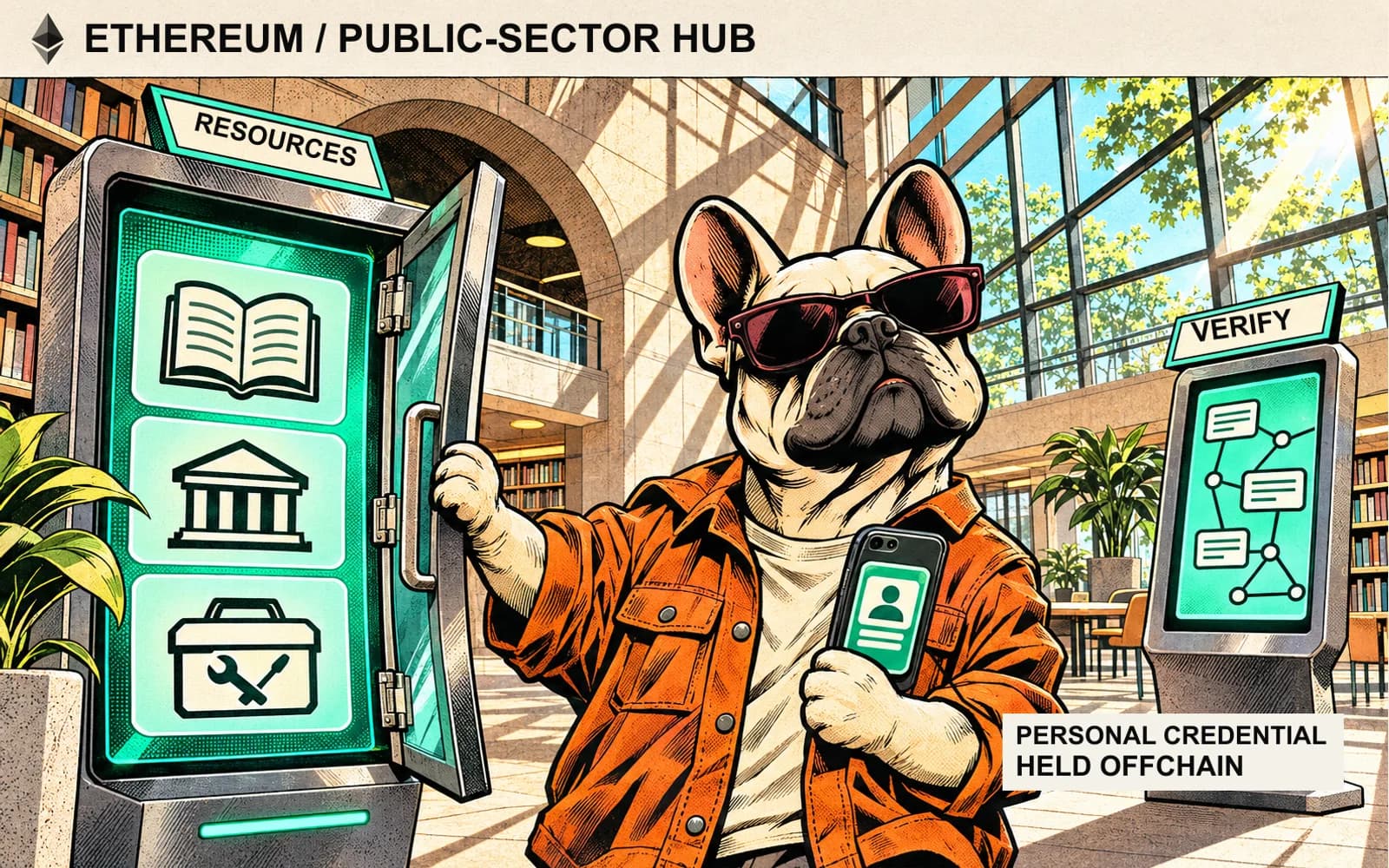
The blog uses Bhutan's National Digital Identity system to explain one design: people hold credentials in their NDI Wallets, while a registry on Ethereum helps services check authenticity. The credentials themselves are not published on Ethereum. Bhutanese institutions determine which issuers are trusted.
A separate humanitarian coordination project is explicitly a proof of concept. The announcement does not describe it as a newly deployed aid service.
The hub's navigation offers case studies, evaluation material and technical resources. Finding an example there establishes what the Foundation presents, rather than independently verifying its performance.
Why it matters for readers
When an announcement says a service uses blockchain, ask which part. Does the chain record a payment, support a verification registry, or perform another defined function? Then ask who issues the information and who decides whether to accept it.
Those questions help separate infrastructure from the institution's responsibilities. A shared record cannot, by itself, tell a reader whether the original issuer made a sound decision. Our transaction-reading guide explains a related limit: a blockchain record and a real-world identity claim are different evidence.
What remains unknown
The sources give the announcement date, but no exact time when the hub first became available. They do not establish a new deployment date for every featured case study or demonstrate the privacy of every implementation.
Brokzi has not tested a credential, connected a wallet or evaluated a public-service deployment. This report does not independently substantiate the hub's usage or funding counters.
Brokzi's Take
Use the hub as a reading list, then follow the implementation's own evidence. Before describing a service as operational, identify the operator, what data stays outside the chain, what is recorded on it and whether the work is a proposal, experiment or deployed service.
Our Ethereum explainer supplies the network basics. A useful application story should explain the particular job Ethereum does, as well as the decisions that remain with people and institutions.
Sources
Primary sources checked November 3, 2026. Announcement day is known; exact launch time is unknown. The illustration is a fictional explanatory scene, not a screenshot, official endorsement or documentary evidence.
See something wrong? Brokzi logs material changes. Prepare a correction note.