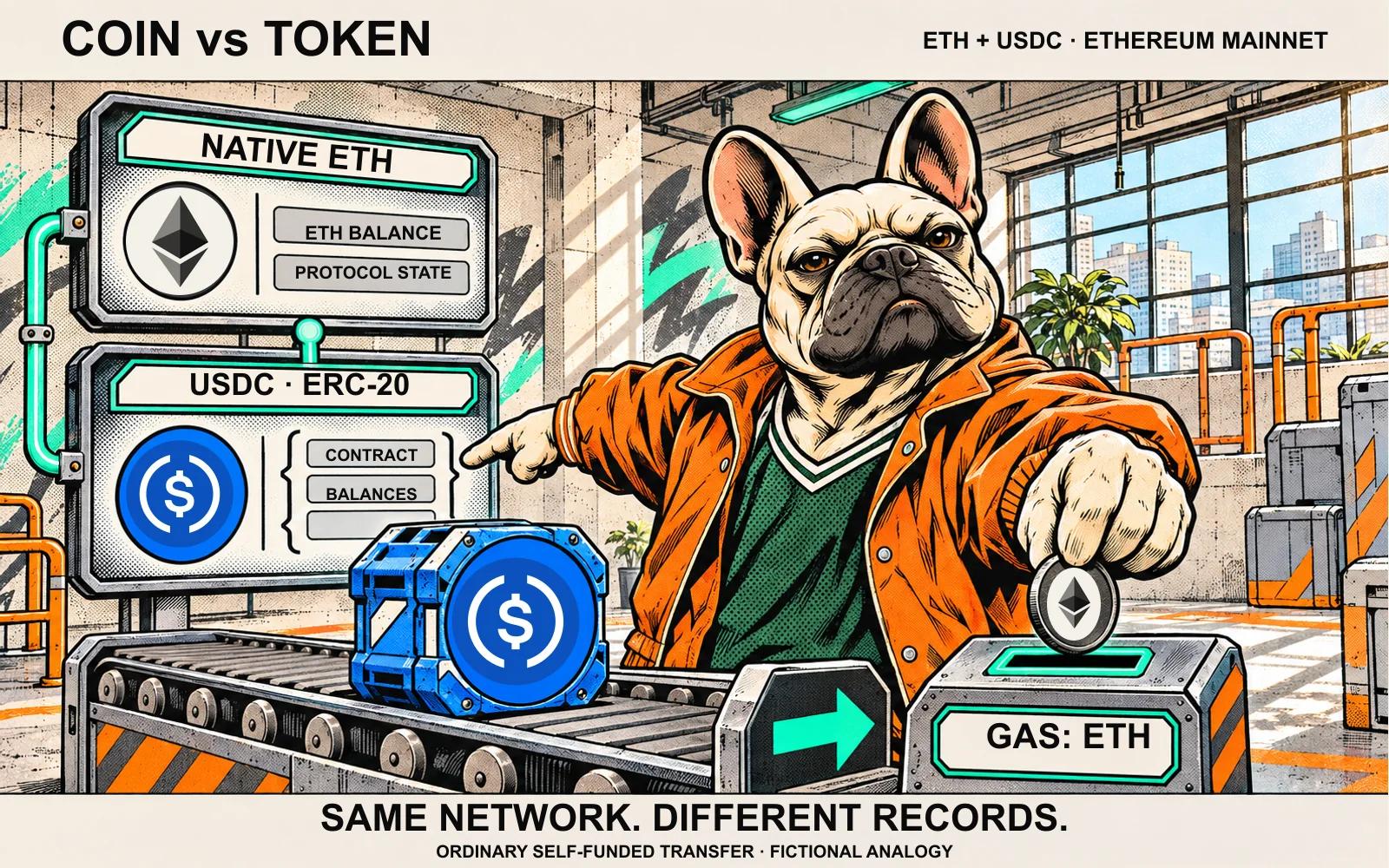
A wallet can show ETH and USDC side by side. Both have a balance and a Send button. Yet an ordinary USDC transfer on Ethereum Mainnet needs ETH for gas, even if the USDC balance is large enough to cover the amount being sent.
The coin vs token distinction explains that apparent contradiction. Start with two questions: which network records the asset, and which rules maintain its balance?
Coin vs token at a glance
Here, coin means a native network asset. Token means an asset implemented on that network through a separate mechanism. Our token example is an ERC-20 contract; other blockchains use different token systems. These are useful technical labels, not a ranking of quality or a legal classification.
| Example | Where the balance is recorded | Identifier to understand | Network fee in this example |
|---|---|---|---|
| BTC on Bitcoin | Spendable transaction outputs under Bitcoin's rules | Bitcoin network, receiving address and transaction outputs | BTC, commonly expressed in satoshis |
| ETH on Ethereum Mainnet | Native account balance in Ethereum's state | Ethereum Mainnet and account address; no ERC-20 contract for native ETH | ETH |
| USDC on Ethereum Mainnet | Token balances maintained by the USDC contract | Ethereum Mainnet, USDC contract and holder address | ETH for an ordinary self-funded transaction |
The last two rows share a network. Moving USDC does not send a transaction to a separate “USDC blockchain” in this example.
A native coin is part of the network's own accounting
Ethereum's ether documentation describes ETH as the asset used to pay for Ethereum computation. Its issuance follows the protocol's rules. An application developer cannot create additional native ETH by deploying an ERC-20 contract.
The Ethereum account model includes a native balance measured in wei, a denomination of ETH. That balance is distinct from the balances a token contract tracks for the same address. Your wallet brings those records into one interface; the matching visual treatment does not make them the same kind of record.
Bitcoin uses a different model. The Bitcoin developer guide describes inputs spending earlier outputs, with values measured in satoshis. A wallet's BTC balance represents spendable outputs. A normal Bitcoin payment does not call an ERC-20 transfer function, and its fee is the input value left over after the outputs.
For more background, see how Bitcoin transactions and blocks fit together.
A token contract adds another set of rules
The ERC-20 specification defines functions including balanceOf, transfer and totalSupply. A wallet can ask the token contract for an address's balance, then prepare a call to transfer some of those units. Ethereum executes that contract call under the network's rules.
Think of two records for one address: its native ETH balance, and its balance according to a particular token contract. Sending that token changes the relevant contract's accounting. It does not turn the units into ETH.
Ethereum's ERC-20 overview explains how a shared interface lets wallets and applications work with different fungible tokens. A common interface does not make every contract's permissions, backing or economic purpose identical. The standard describes operations, not a promise about an asset's value.
Nor does “token” mean ERC-20 everywhere. This explanation uses Ethereum to make the distinction concrete; do not apply its address format or contract functions to every chain.
ETH and USDC: one network, two balances, one gas asset
Circle's contract directory identifies USDC deployments across multiple blockchains. For this example, we mean Circle-listed USDC on Ethereum Mainnet. Circle's directory is the issuer's identification source, not Brokzi's assessment of backing or redemption eligibility.
Imagine an ordinary, self-funded Ethereum account holding USDC but no ETH. It prepares a direct USDC transfer:
- The asset being sent is USDC. The request calls the USDC contract to change token balances.
- The network doing the work is Ethereum Mainnet. The token transfer runs within an Ethereum transaction.
- The network fee is paid in ETH. Having enough USDC for the transfer amount does not provide the separate ETH balance needed for gas.
Ethereum's gas documentation distinguishes gas, which measures computational work, from ETH, which pays the fee. “Gas” is not another token you must locate. Native ETH transfers also incur fees; being a coin does not make sending free.
This is a conceptual example. It is not a live balance, fee estimate or transaction test. For the fee calculation itself, see how network fees work.
What about wallets that let you pay in tokens?
Some account systems add an intermediary. ERC-4337 defines a paymaster mechanism that can fund gas through an EntryPoint deposit. A service can arrange sponsorship or charge a user separately, subject to its rules.
That changes who supplies the network fee, rather than making every ERC-20 token the protocol's gas currency. Do not assume a wallet offers sponsorship, accepts your token or will keep doing so. Our UserOperation and paymaster explanation follows that additional layer.
The network belongs in the asset's identity
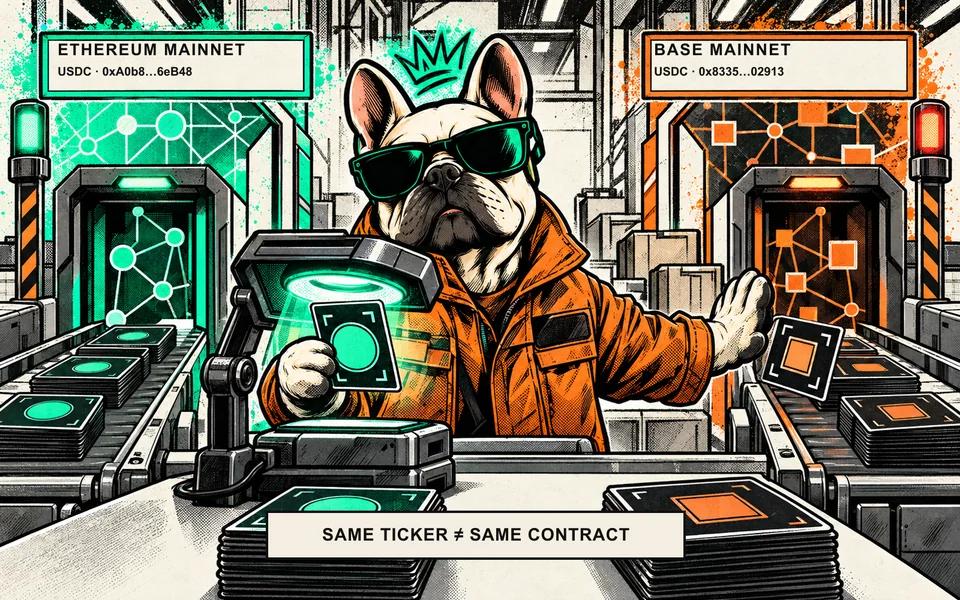
“USDC” alone is incomplete transfer information. Circle lists deployments on several networks, and those records do not merge just because a wallet shows the same ticker. Native assets need network context too: an ETH balance on another network is not automatically an available ETH balance on Ethereum Mainnet.
For an Ethereum token, separate the holder's address, the token contract and the network. The contract identifies the token deployment; the holder's address identifies whose balance is being queried. Native ETH has no ERC-20 token contract to look up.
Our symbol, contract-address and network guide covers the actual verification workflow. Use that when checking a transfer route; this comparison explains why the checks differ.
Does being a coin make an asset safer?
No. The label tells you where to start examining the mechanics. It does not establish security, decentralization, liquidity or investment merit. A native asset depends on its network's rules and operation. A contract token additionally requires understanding the relevant contract and any issuer arrangements.
When a wallet lists an unfamiliar asset, first establish its network and whether it is native or contract-based. Then identify the fee arrangement. That gives you a useful map of what the Send button will ask the network to do, before you consider the asset's separate risks.
Sources
See something wrong? Brokzi logs material changes. Prepare a correction note.