The market shows a healthy-looking supply balance. Your share is still there. That does not mean every supplied token is sitting in the contract waiting to be collected: some of it may be out on loan.
For readers investigating crypto lending utilization, the useful comparison is between borrowing, supply accounting and the tokens available now. This explainer uses Compound III's documented USDC market on Ethereum as its named context. Every balance and rate below is invented. We have not queried that market or tested a withdrawal.
Name the market before interpreting the percentage
Compound III's introduction identifies the original Ethereum deployment's base asset as USDC. The protocol distinguishes that base asset from assets supplied as collateral. A different market or network needs its own identification and parameters; a protocol-wide headline is not a balance sheet for one instance.
The docs also distinguish Compound III from Compound v2. We use the III documentation and a pinned reference implementation, not a formula borrowed from an older version. The token-and-network guide covers identifying a token beyond its ticker.
Utilization is a ratio, not a cash balance
The interest-rate documentation defines getUtilization() as total base-asset borrowing divided by total base-asset supply, scaled by 10^18. Eight-tenths of that scale represents 80%, not 80 USDC.
Compound's helper reference distinguishes aggregate supply, aggregate borrowing and one account's supplied balance. These are accounting amounts, including their relevant interest treatment. None is the same field as the base token's balance held by the contract.
The checked reference implementation returns zero utilization when its computed total supply is zero. That special case is another reason a lone percentage cannot establish withdrawable cash.
It also calculates base reserves from cash minus supply plus borrowing, with its accrual treatment. Therefore, subtracting a dashboard's borrowing number from an unrelated supply snapshot is not a reliable live cash measurement. The records need the same market, units and accounting time. Reserves and other movements matter.
A supplier's claim can exceed the cash available now
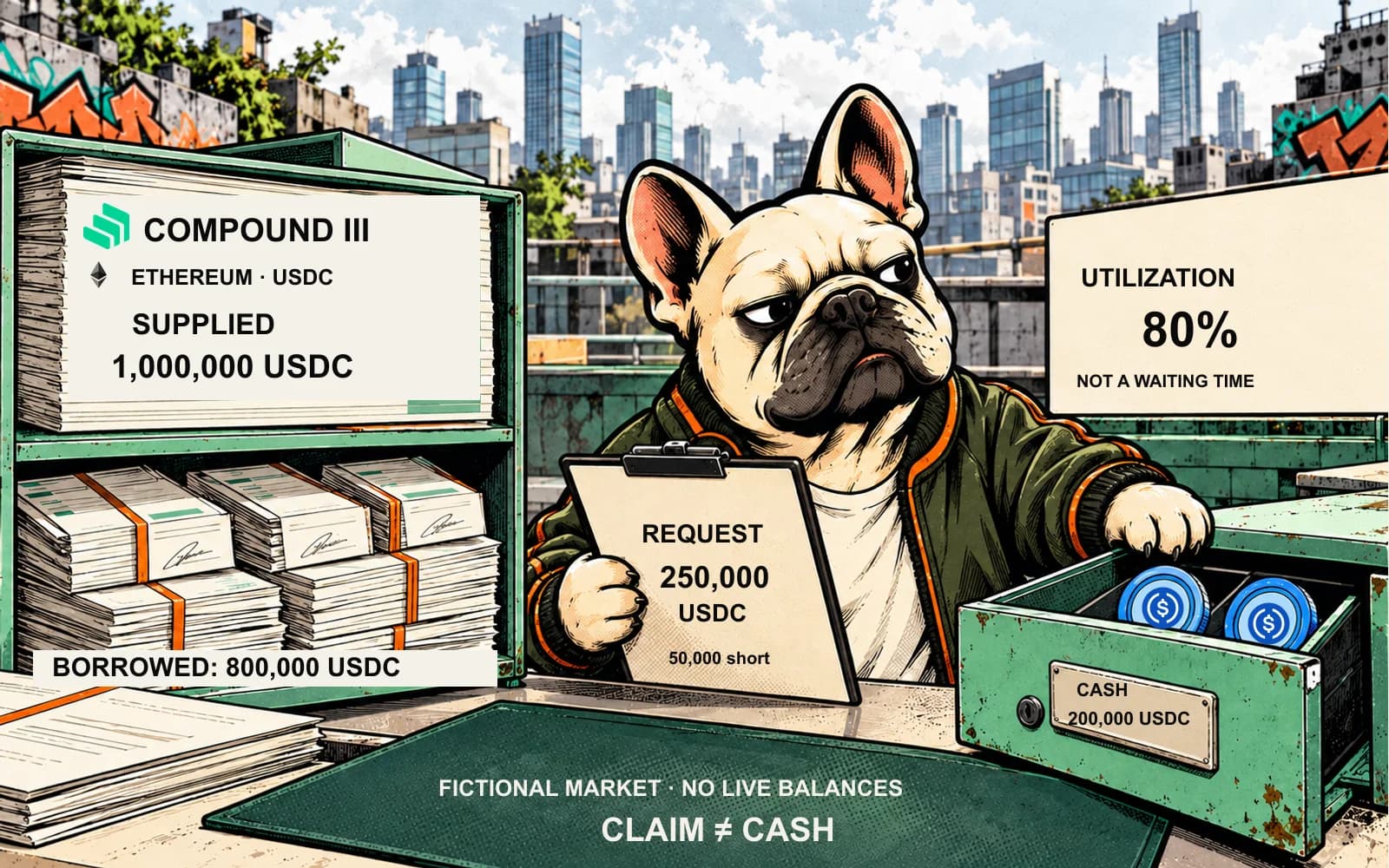
Assume a fictional snapshot with 1,000,000 USDC supplied, 800,000 USDC borrowed and 200,000 USDC cash. For this example only, assume zero reserves, no accrued-interest difference, no other movements and exact whole-token accounting.
Utilization is 800,000 / 1,000,000 = 80%. The cash is a separate 200,000 USDC assumption consistent with this simplified balance sheet. This is not a live balance, a liquidity forecast or a claim about USDC's dollar price.
Suppose one supplier has a 300,000 USDC positive claim and wants to withdraw 250,000 USDC. The claim covers the request, but the assumed cash does not: the shortfall is 50,000 USDC. The 80% label cannot make the missing tokens transferable.
Now consider a separate possible 100,000 USDC withdrawal from the starting snapshot. Assume all other conditions pass and no borrowing is created:
| Fictional state | Total supplied | Total borrowed | Cash | Utilization |
|---|---|---|---|---|
| Before the smaller withdrawal | 1,000,000 USDC | 800,000 USDC | 200,000 USDC | 80% |
| After a possible 100,000 USDC withdrawal | 900,000 USDC | 800,000 USDC | 100,000 USDC | About 88.89% |
Both cash and total supply fall by 100,000 USDC. Borrowing does not change. The second utilization is 800,000 / 900,000, rounded to two decimal places as a percentage. A withdrawal can therefore increase utilization without a new loan being issued.
This is a cash-only illustration. It does not certify that either request would execute on a real market or that one supplier gets priority over another.
The rate kink changes the price of borrowing
Compound III has separate supply and borrow rate models. The documented rates are per second; an annualized display also needs the scale and time conversion. The checked code uses a piecewise model with a kink. For the borrow side, written with consistent units:
U <= K: rate = base + low_slope * U
U > K:  rate = base + low_slope * K + high_slope * (U - K)
For an independent arithmetic illustration, invent a simple annualized curve with a 1% base, an 80% kink, a low slope of five percentage points per full unit of utilization, and a high slope of 100 percentage points per full unit. Here U = 0.8 means 80%.
| Invented utilization | Invented simple annualized borrow rate |
|---|---|
| 60% | 1% + 5% × 0.6 = 4% |
| 80% | 1% + 5% × 0.8 = 5% |
| 90% | 1% + 5% × 0.8 + 100% × 0.1 = 15% |
These are invented coefficients, not a current Compound quote or a yield recommendation. This simplified math omits fixed-point rounding, compounding and rewards. A borrow rate is also not a supplier's earned return. Do not copy one side's curve or kink into the other side's calculation.
The curve prices borrowing under its rules. It does not cause cash to reappear on a schedule. Higher displayed rates cannot prove that a borrower will repay before someone else's withdrawal.
Cash is only one condition for a withdrawal
Compound III's collateral-and-borrowing reference explains that withdraw can withdraw an asset or borrow the base asset. The same method name therefore does not identify the economic action. A request that creates borrowing has collateral and minimum-borrow conditions.
In the checked implementation, the withdrawal path checks pause state and permission. Its base-asset path updates the account, applies borrowing checks when needed and calls the token transfer. Sufficient cash does not bypass those other conditions or the token's transfer behavior.
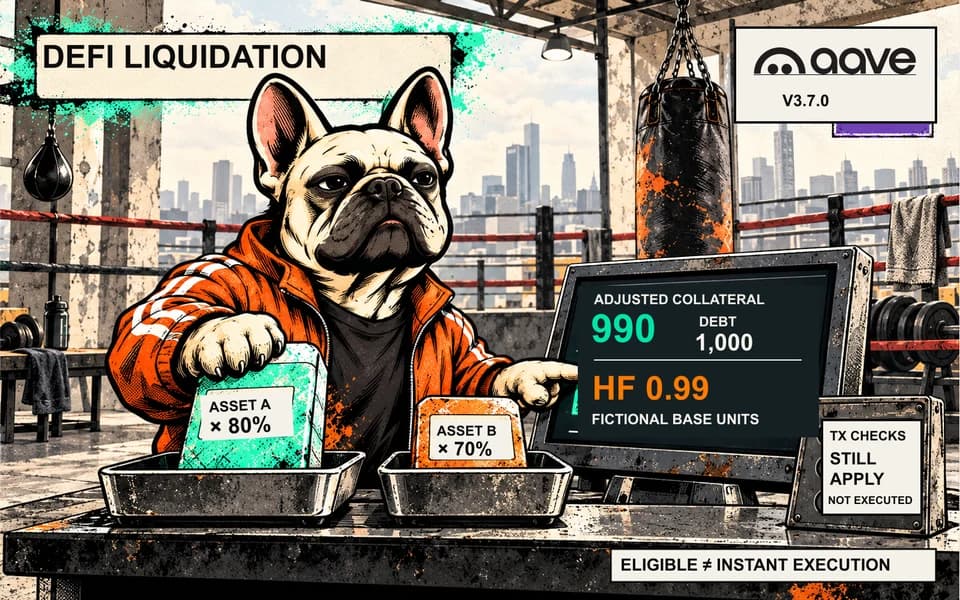
Withdrawing collateral that supports debt is a different task from redeeming a positive USDC supply claim. Our liquidation explainer covers a separate, explicitly Aave V3 example; its health-factor formula is not Compound's utilization formula.
Waiting is not a booked withdrawal slot
This model creates no withdrawal queue or promised payment date. An attempted call that fails has not reserved the next tokens repaid. Cash can change through repayments, new supply and other protocol movements; later borrowing or withdrawals can change it again.
The amount available at one snapshot does not establish the amount available when a later transaction executes. Nor does a percentage measure solvency, collateral quality, smart-contract safety or the likelihood of recovering funds. These are additional questions.
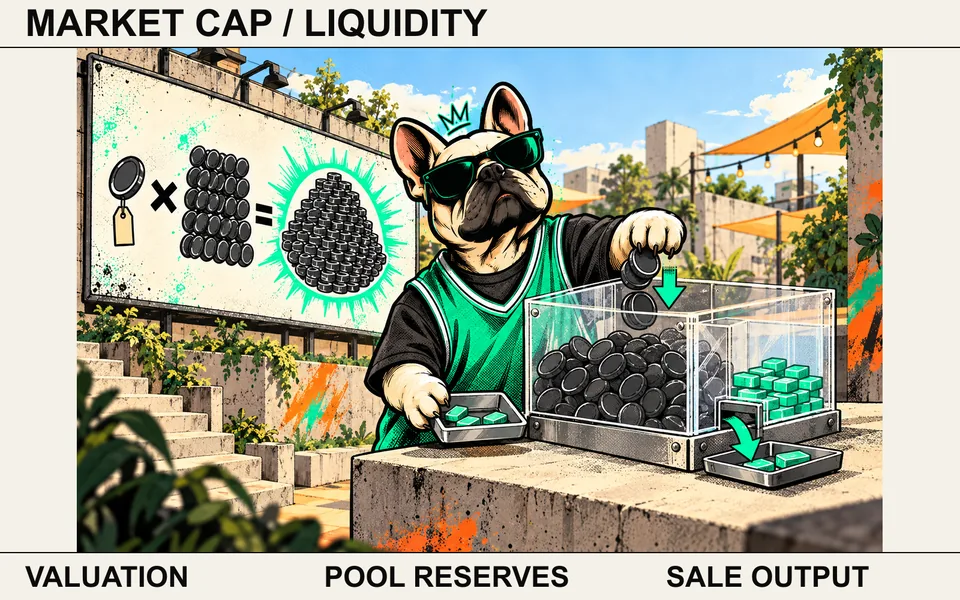
Keep the chain, market and base asset together with the snapshot time, supplied and borrowed amounts, cash, reserve treatment and the relevant account state. Then separate the current rate calculation from the amount a particular request could transfer. Our market-cap versus liquidity explainer makes a related distinction for trading; AMM exit liquidity and lending utilization are different mechanisms.
Sources
Primary documentation and the relevant reference-code functions checked October 28, 2026, Asia/Tbilisi. The official documentation now resolves to docs.compound.xyz. The code snapshot is revision f766f51583c23acc33b2a7824654ef2029a96804, file CometWithExtendedAssetList.sol; it is not verification of the implementation currently deployed behind any market's proxy. All balances, rates and the illustration are fictional. No live market parameter, RPC, wallet, approval, deposit, loan or withdrawal was tested. This is an explanation of mechanics, not a lending recommendation or contract audit.
- Compound III: introduction, base asset and deployment context.
- Compound III: utilization and separate interest-rate models.
- Compound III: collateral, supplied balances and withdrawal or borrowing conditions.
- Compound III: aggregate and account balance helpers.
- Compound repository: pinned reference implementation, rates, reserves and withdrawal paths.
See something wrong? Brokzi logs material changes. Prepare a correction note.