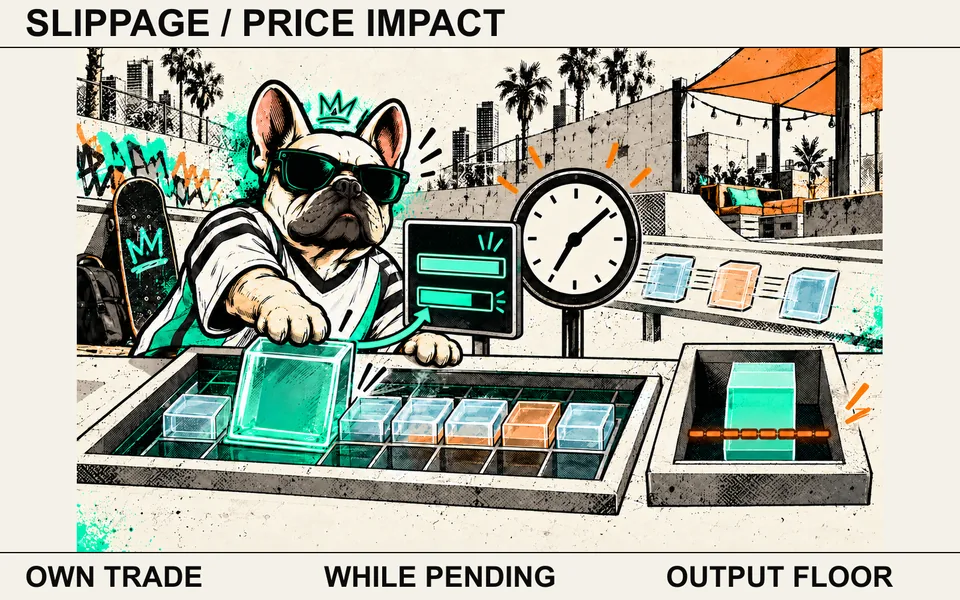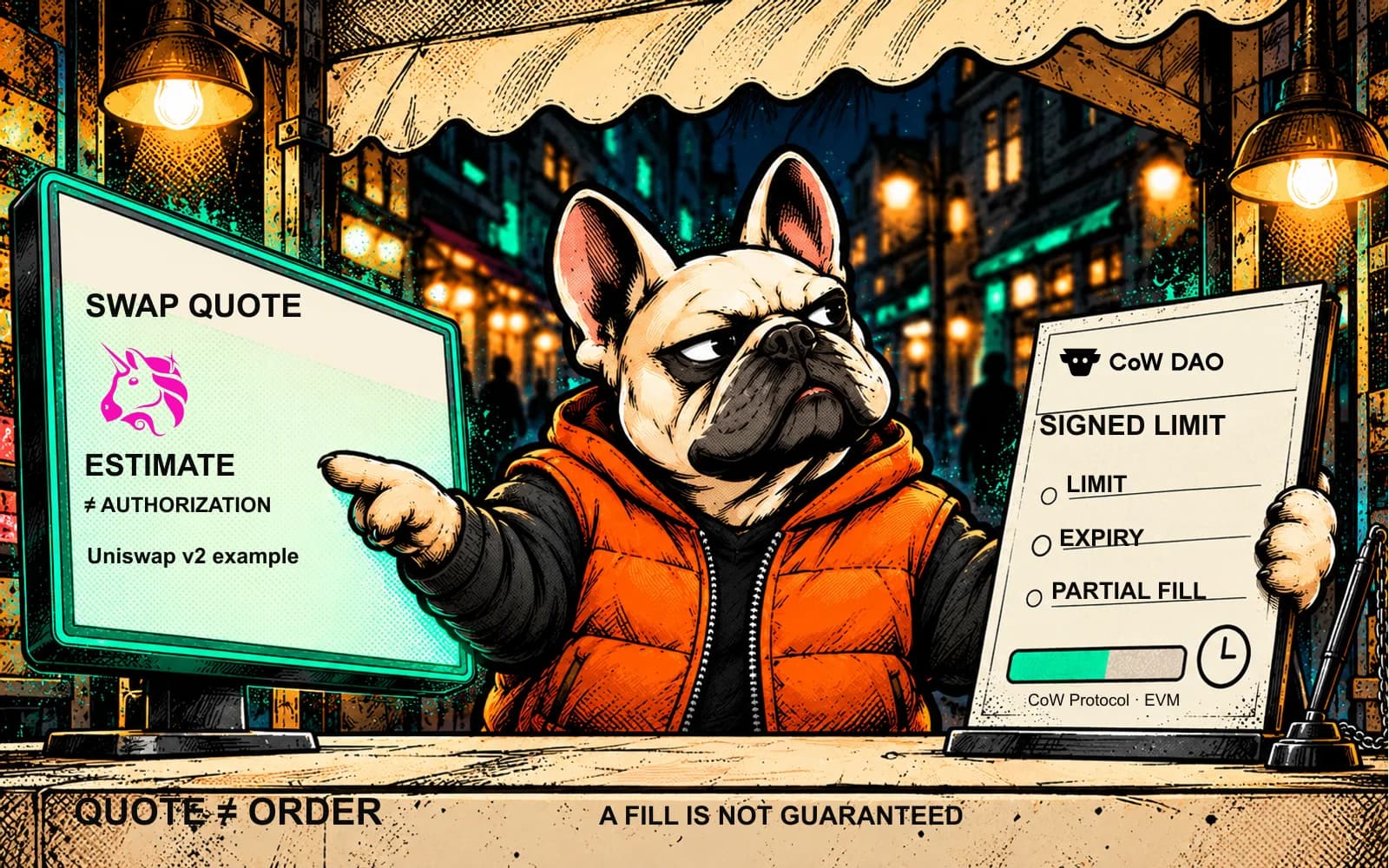
A screen says you could receive 205 tokens. Another lets you set a minimum of 200 and wait. Those numbers do not tell you whether you are looking at an estimate, a transaction to approve, or an order that remains executable after you leave the page.
For readers comparing limit order vs swap, start with authorization and timing. We use a Uniswap v2 router example and CoW Protocol's EVM order model. These are named mechanisms, not a recommendation to trade or a promise that every DEX uses the same rules.
A quote is information; an authorization permits action
A quote can describe a route, input amount, expected output and estimated costs. Merely reading it does not establish that a transaction was submitted or an order was signed. A refreshed quote is also not the same object as an already authorized request.
An authorized direct swap can include a price boundary. Uniswap v2's router guide distinguishes an exact-input trade's minimum output from an exact-output trade's maximum input. It also requires adequate funds and the relevant spending permission. A quote is not a substitute for those execution conditions.
The useful distinction is therefore not "swaps have no limits." It is what the actual request authorizes and when it can run. Our slippage and price-impact explainer covers the quote-versus-result arithmetic separately.
A standing limit order can remain executable
CoW's intent reference lists the tokens, amounts, buy-or-sell kind, partial-fill setting, receiver and validity among the order parameters. Those fields describe an outcome the user authorizes, rather than one compulsory path through a particular pool.
Its core architecture describes solvers competing to settle orders in batches, using direct matches or other onchain liquidity. An open order can therefore wait for a suitable settlement. It is not an execution guarantee or a reservation of liquidity at a chart's displayed price.
Do not infer the signing mechanism from the button label. CoW Swap's market-order tutorial also describes signing an order. In this protocol, clicking Swap does not necessarily mean the user broadcasts a traditional router transaction. Compare the actual route and order terms, not just "market" and "limit" labels.
| What you are reading | What it establishes | What it does not establish |
|---|---|---|
| A quote showing 205 B for 100 A | An indicated exchange under that quote's assumptions | Authorization, a fill or a reserved future price |
| An exact-input swap request with a minimum of 200 B | A minimum-output condition for that execution attempt | An order that automatically waits for a later favorable market |
| A signed standing sell order for 100 A with a 200 B limit | Authorization subject to its amount, price, validity and other terms | Guaranteed matching, timing or complete execution |
All amounts in this table are fictional. A and B are invented tokens, not project tickers or quoted opportunities. The direct-swap row is a router-style example, not a description of every CoW order or Uniswap version.
Read expiry and partial fill as separate conditions
CoW's settlement reference defines validTo as a Unix timestamp in seconds and partiallyFillable as the partial-fill versus fill-or-kill setting. An order's duration is a validity condition, not a countdown to a promised fill.
The checked settlement source rejects execution once the block timestamp is greater than validTo. It also checks the price relation and accumulated filled amount. This source snapshot explains the mechanism; it is not our verification of a deployed contract or a wallet's actual order.
Partial fillability changes how much may execute at once. It does not remove the limit condition. In CoW Swap's documented default, a limit order may fill gradually and a small remainder may never become economical to settle. A completed portion and an open remainder are different states.
A partial-fill example without a profit story
Assume an invented sell order for 100 A, requiring at least 200 B over a complete fill, and allowing partial execution. For this arithmetic illustration only, omit fees and assume exact whole-token amounts with no rounding difference. All other validity and funding conditions are assumed to hold.
The boundary is 2 B per A. A portion selling 40 A at that boundary corresponds to 80 B; 60 A remains available for a later fill under the order's terms.
| Illustrative state | A sold in that portion | B at the assumed boundary | A remaining |
|---|---|---|---|
| Before any fill | 0 A | 0 B | 100 A |
| First portion | 40 A | 80 B | 60 A |
| Separate possible final portion | 60 A | 120 B | 0 A |
If both portions occurred at that boundary, totals would be 100 A sold and 200 B received. The last row is a possible continuation, not an event that must happen. If the remainder expires unfilled, the earlier 40 A fill does not reverse itself.
This is ratio bookkeeping, not a live CoW fee calculation or a trade simulation. Actual orders use token base units, fees and implementation-specific rounding. A fill-or-kill order would not permit the same gradual sequence.
A price crossing is not proof of execution
CoW's limit-order tutorial explains that settlement economics can require a price better than the stated limit to cover network costs. Its displayed execution indication considers the order size, fees and market conditions. A chart touching a line cannot prove that those conditions were satisfied for the actual order.
Likewise, "free to place" is not "no costs anywhere." An approval or onchain cancellation is a different operation from submitting an offchain order. No fee percentage, gas charge or provider-wide free-trading claim is inferred here.
An order may remain unfilled even when its owner would prefer immediate execution. The opposite matters too: a valid standing order can remain executable when its owner has stopped watching the screen. Closing the tab is not evidence that it was cancelled.
Cancellation has an outcome, not just a button
CoW's tutorials distinguish an offchain cancellation request from an onchain invalidation transaction. The former depends on processing by the offchain service; the latter costs gas and needs to take effect onchain. Either can race a settlement that occurs first.
The checked implementation marks an invalidated order as no longer fillable. That does not unwind an earlier trade. A pending cancellation request should not be reported as a completed cancellation, and an expired remainder should not be described as a reversal of already settled portions.
For an actual order, its identity, confirmed fills and final status need reconciling. The settlement documentation warns that a historical fill-storage slot can be cleared after expiry; one counter alone is not a permanent complete trade history. This article performs no cancellation, lookup of a private order or transaction.
A signature and an allowance do different jobs
CoW's signing reference describes an order digest and a chain-and-settlement-contract domain. The signed parameters matter, including the receiver. They are not a harmless login message merely because no gas-payment dialog appears.
Token allowances concern a contract's spending permission; signing an order does not, by itself, prove that the needed balance and allowance exist. Nor does a valid signature certify the token or make an unsuitable price suitable for its owner.
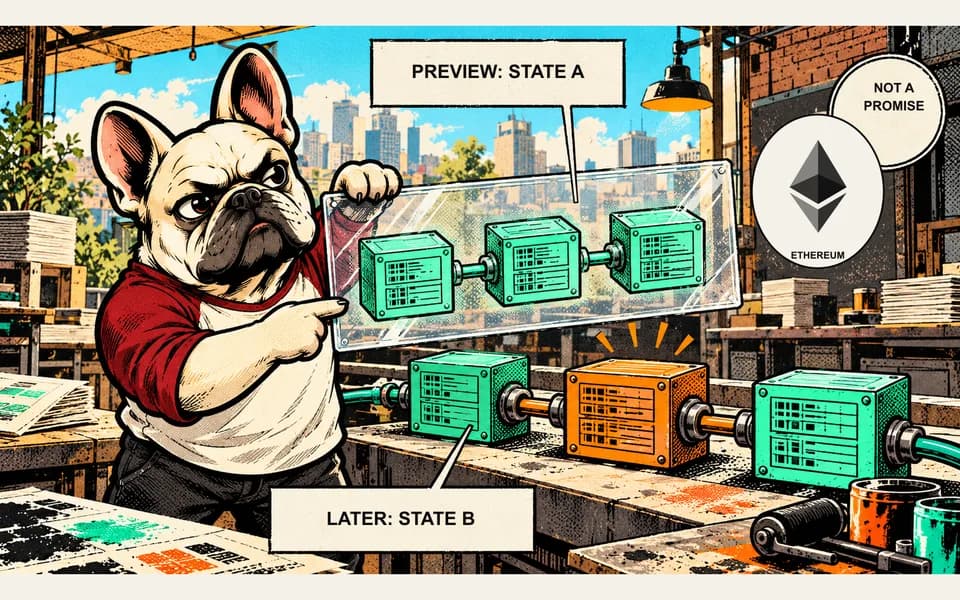
A transaction simulation is another kind of evidence again: a preview against assumptions, not a future fill reservation. Available liquidity cannot be inferred from market cap or a familiar logo.
A read-first order record
Keep the network and protocol, exact token identities, sell and buy amounts, price direction, receiver, expiry and partial-fill setting together. Separate the displayed quote from the signed terms. Then distinguish approval, submission, partial execution, cancellation requests and final outcomes.
A limit order versus a swap is easier to read when those stages stop sharing one green button. A quote proposes an exchange; the actual authorization sets conditions. Those conditions can limit an accepted result without making a fill inevitable.
Sources
Primary documents and source checked October 27, 2026, Asia/Tbilisi. The CoW example concerns its EVM ERC-20 order and standard settlement model, not its separate Solana integration. The Uniswap example is explicitly v2. All amounts and the comic are fictional. No wallet, signature, approval, order, cancellation, solver or trade was tested. This is education, not a trading recommendation or contract audit.
- Uniswap v2: router swap bounds and prerequisites.
- CoW Swap: limit orders, partial fills, execution conditions and cancellation.
- CoW Swap: its market-order workflow and cancellation modes.
- CoW Protocol: intent parameters.
- CoW Protocol: signing schemes and domain.
- CoW Protocol: core architecture and known limitations.
- CoW Protocol: settlement fields, checks and historical-storage limitation.
- CoW Protocol repository: GPv2Settlement source snapshot.
See something wrong? Brokzi logs material changes. Prepare a correction note.