
Your wallet accepts an Ethereum Name Service (ENS) name and fills in an address. The name passed the text check. The address still needs to match the person or service you intend to pay.
What does ENS name normalization do?
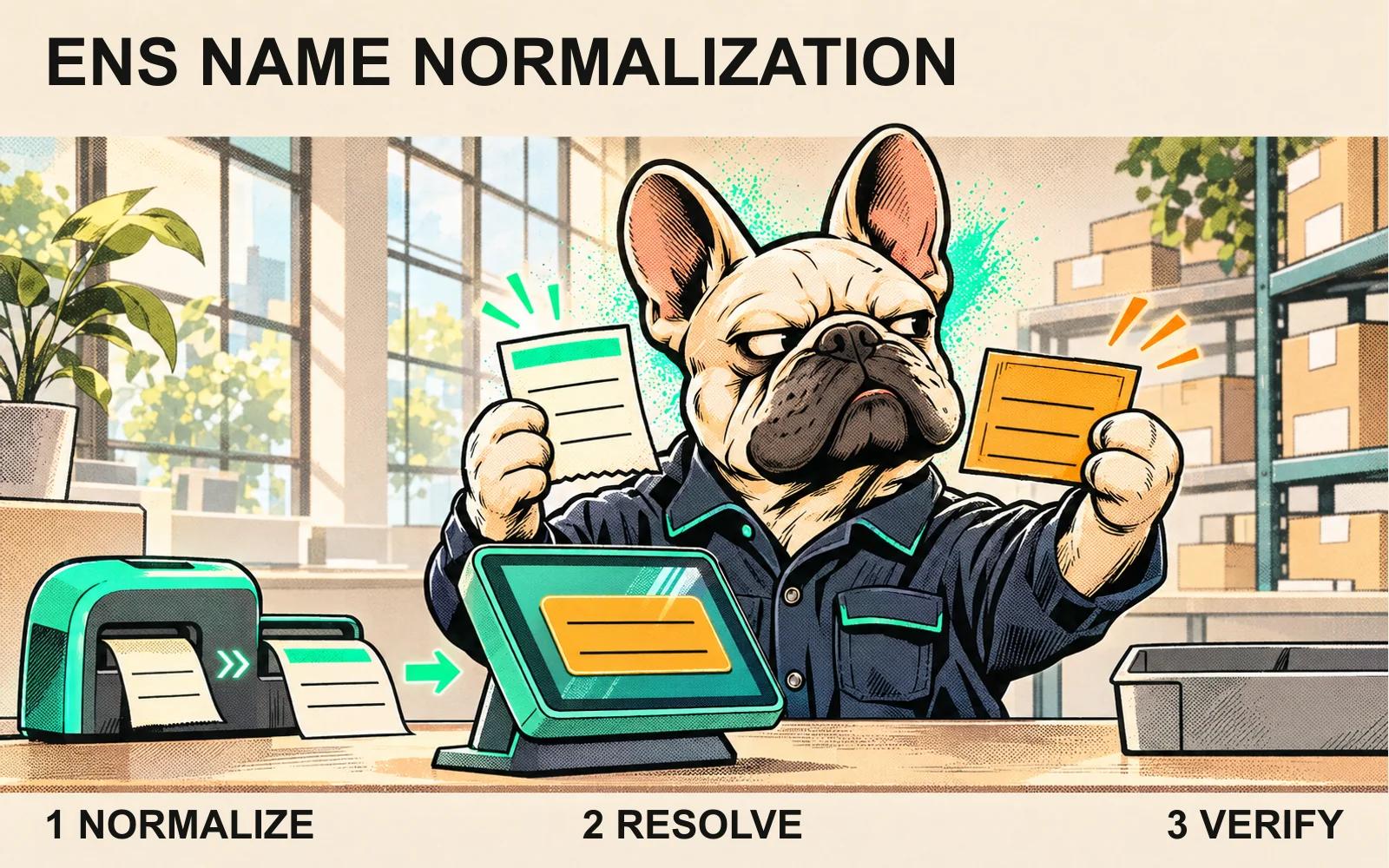
ENSIP-15 applies rules to each label, the part of a name between dots. It maps some characters to a standard form and rejects input that fails its rules. An app uses the normalized name to compute the lookup key, called a namehash. Two inputs that normalize to the same name lead to the same key. A text check alone never reads a resolver record. ENSIP-15 and ENSIP-1 define those steps separately.
| Input label | Normalizer result | What happened |
|---|---|---|
ⓐⓑⓒ (circled a, b and c) | abc | The mapped input passes. |
@ | Error | This character is disallowed. |
These are label examples from the validation tests linked by ENSIP-15. Both results were reproduced with the JavaScript reference implementation, version 1.11.1. Neither example was used for a live lookup.
What does the resolver return?
In the basic ENS flow, the app uses the namehash to find the resolver and asks it for the relevant record. The resolver contract handles the lookup. The destination comes from the address record it returns. A name can pass normalization and still have no address record for the requested network. ENSIP-1 describes the basic lookup and ENSIP-9 defines address records by coin type.
Say a fictional name passes normalization and a simulated resolver returns DEMO-ADDR-B. The recipient confirmed DEMO-ADDR-A through a contact channel you already trust. Those placeholders stand for different addresses. Pause there and confirm the destination again. Normalization and lookup can both succeed while the recipient check fails.
What should you verify before sending?
Compare the full address the wallet is about to use with the address the recipient confirmed independently for that network. Check the network and asset on the confirmation screen. If the app only shows the name or a shortened address, look for the full destination before you approve. If you still can’t see it, pause. How to read a blockchain transaction explains where the destination appears.
ENSIP-15 reduces some look-alike tricks. Its security notes explain that fonts and rendering can still make different names look similar. Familiar text or matching address ends are weak evidence. See how address poisoning exploits matching prefixes and suffixes.
Sources
- ENSIP-15: Name Normalization — input rules, validation and visual ambiguity.
- ENSIP-1: ENS — namehash, registry and resolver responsibilities.
- ENSIP-9: Multichain Address Resolution — address records and missing coin-type records.
- ENSIP-15 validation vectors, pinned to version 1.11.1 — the mapped and rejected inputs above.
See something wrong? Brokzi logs material changes. Prepare a correction note.