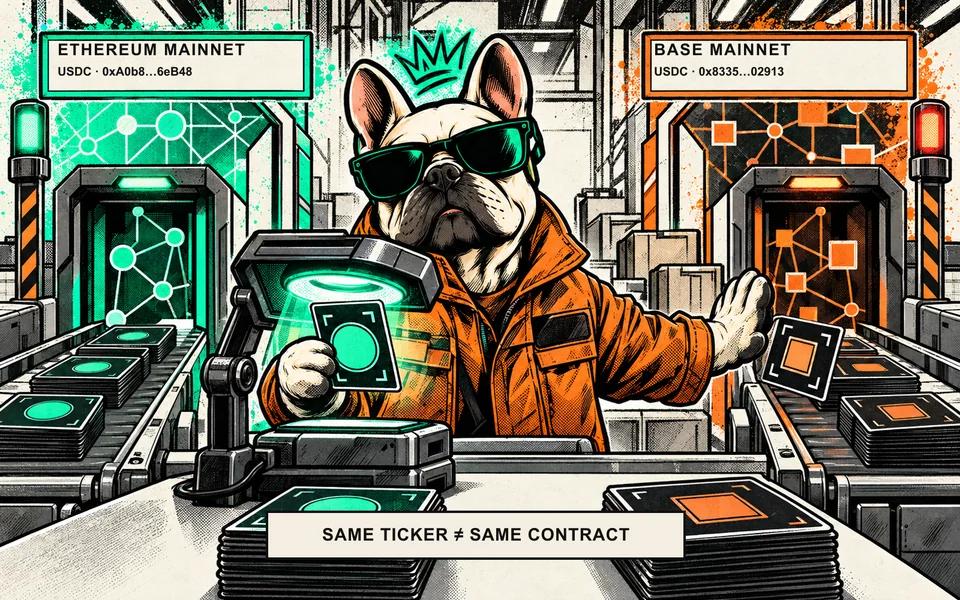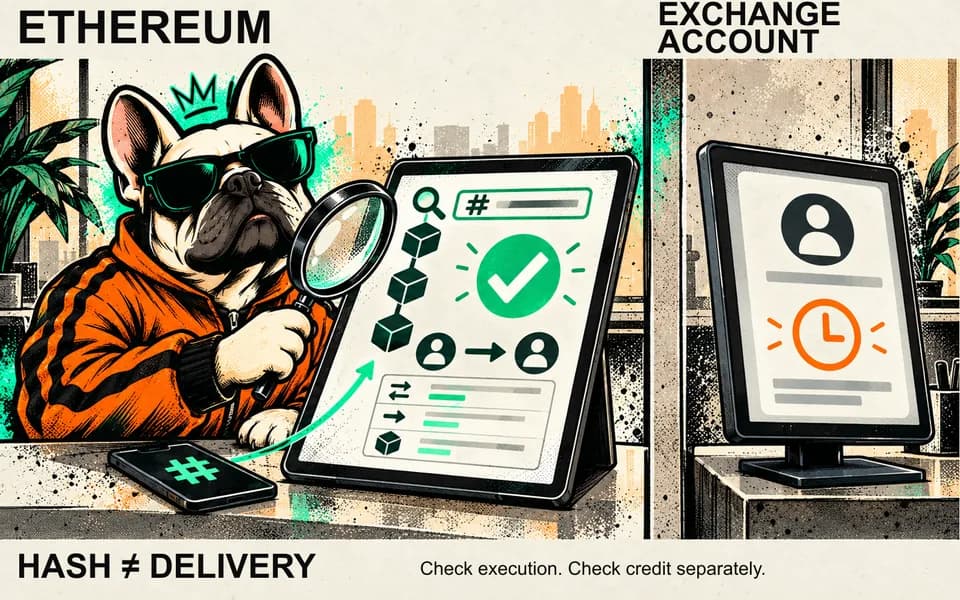
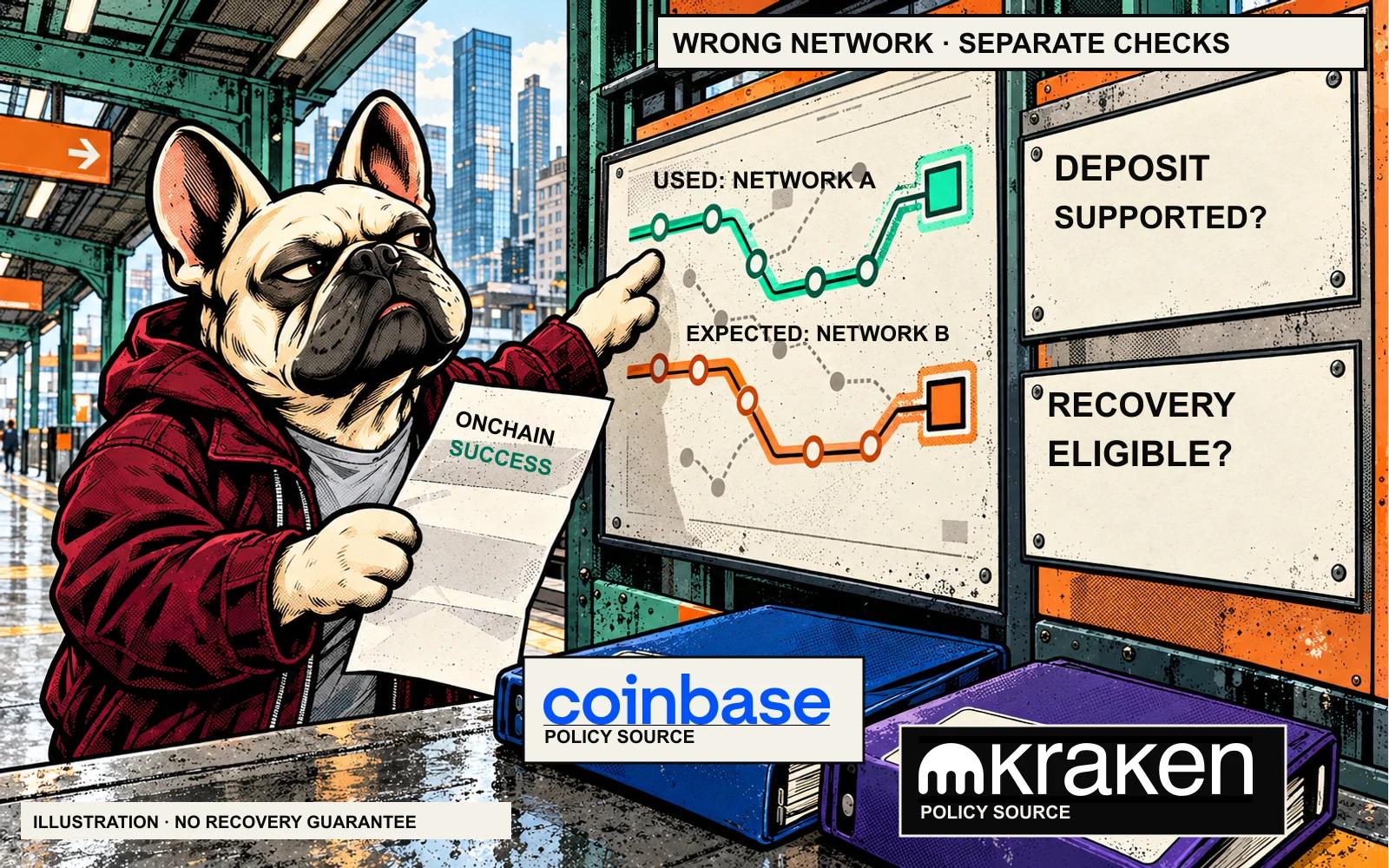
The explorer shows success. Your exchange account shows no deposit. Before treating that as a delay, check whether the transfer used a network the receiving service accepts for that asset.
This guide concerns an already-submitted transfer to a custodial service. It helps you distinguish a network mismatch from other deposit problems and prepare a useful record for official support. It does not execute a recovery or supply a route that bypasses the recipient's rules.
First, identify which record you have
Keep the sending record's actual network and full transaction ID together. Check the asset movement and destination, not just a token ticker or a green status badge. Our transaction-reading guide explains why top-level execution success can differ from the token movement you expected.
An exchange then applies its own supported deposit routes and account processing. A familiar address format does not establish support on every chain. Nor does finding an address on an explorer show that a service has the infrastructure or permission to recover a particular deposit.
Use this distinction to avoid solving the wrong problem:
| Observation | What still needs checking |
|---|---|
| Record found on the actual sending network | Execution result, asset movement and destination |
| Transfer completed on a different network | Whether that receiving product supports this asset on that route |
| Supported route, but account not credited | Deposit conditions, processing state and any required customer routing |
| Unsupported route | The provider's recovery eligibility, not a generic confirmation target |
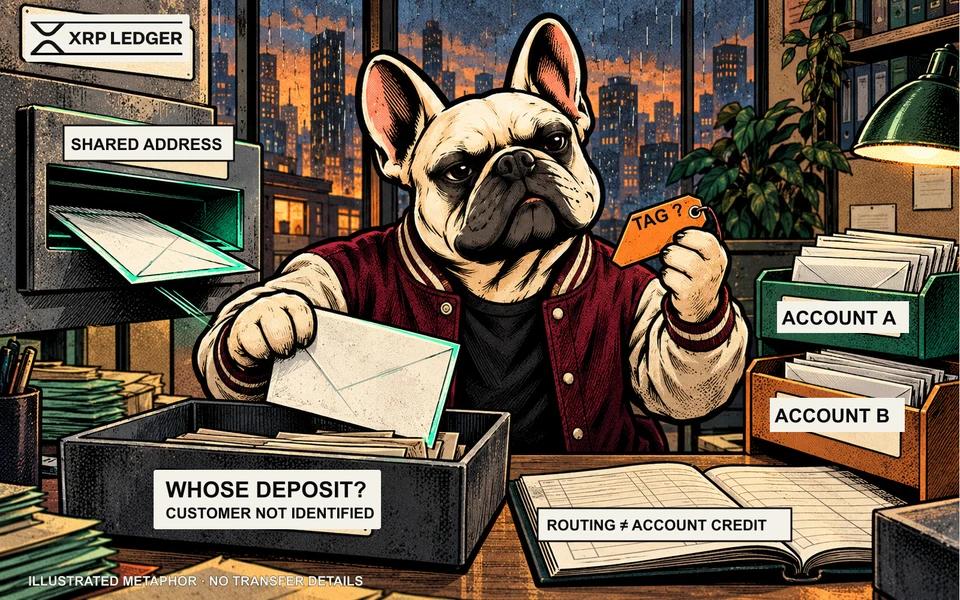
A missing memo is another problem. The memo and destination-tag guide covers that separate customer-routing value. Adding a memo elsewhere does not change the network used by the original transfer.
What Coinbase's recovery policy actually offers
Coinbase's unsupported-crypto recovery page limits recovery to certain assets and networks sent to a Coinbase address. An ineligible asset or network produces an error. A successful public transaction is therefore insufficient to establish eligibility.
The documented result is a return to a self-custodial wallet, not automatic credit to a Coinbase trading balance. Its checks include the transaction ID, Coinbase destination and actual network. The page describes a recovery fee for values over $100, plus network fees; it does not promise a completion deadline.
This is a reading of Coinbase's consumer help, checked October 17, 2026. It is not a current eligibility decision for your transaction, a promise about every Coinbase product or a claim of availability in every country. This guide does not walk through wallet connection, signatures, fee funding or a recovery transaction.
Kraken: a support review is not a refund guarantee
Kraken's deposit-recovery policy, updated September 21, 2026, distinguishes unsupported tokens, unsupported networks, missing routing information and other uncredited deposits. It explicitly says some misrouted deposits cannot be recovered because of technical constraints.
Its support checklist asks for the transaction ID, asset and amount, deposit address, and transaction date and time. Further documentation may be requested. Recovery time varies with complexity; fees can apply and should be communicated before proceeding.
The published fee table separates error types, but also says fees can change with complexity and some cases remain unrecoverable. A listed recovery category is not an agreement to recover every transaction in that category. Do not use a fee row as a refund receipt.
Three different outcomes, not one universal recovery button
| Documented route | Scope | What it does not promise |
|---|---|---|
| Coinbase asset recovery | Certain eligible assets and networks; return to self-custody | Every unsupported deposit can be retrieved |
| Coinbase historical automatic credit | Specific previously unsupported deposits covered by its later-support notice | A future listing will rescue a current mismatch |
| Kraken support-assisted recovery | Case review under its deposit-recovery policy | A fixed fee, deadline or guaranteed refund |
Coinbase's separate automatic-credit notice concerns specified earlier deposits after network support was added. It says qualifying customers receive credit without action. That limited historical notice is not a universal waiting strategy for unsupported networks.
Its multiple-network help also warns about incorrect-network losses. Read a dedicated recovery policy as a conditional service, not permission to ignore a deposit warning. Use the exact account and product's current instructions, not an old tutorial's chain list.
Prepare evidence before contacting official support
Make a private note containing:
- The receiving service and product, plus the asset and network you intended to use.
- The network actually used, full transaction ID and explorer link obtained through an independently checked source.
- The relevant destination and token contract, if applicable, with amount and timestamp.
- The recipient's current deposit instructions and any displayed deposit status or error.
- Any existing support case reference, so a follow-up describes the same transfer.
Our token-and-network checklist helps identify the asset. Bitcoin confirmations explains a separate chain-depth question; Bitcoin's counts are not a recovery rule for another network.
Share requested details only through the provider's verified support channel. Do not post account records publicly or give recovery words and private keys to someone offering to "synchronize" a deposit. Another payment does not change the first transfer's network. This guide requires no new transfer, wallet connection or signature.
The useful next question is whether this exact transfer qualifies under this exact service's rules. An explorer cannot answer that on the exchange's behalf.
Sources
Primary help pages checked October 17, 2026. No wallet, account, transfer, support case or recovery was tested. Provider policies describe conditional services, not universal guarantees. No deposit address, operational hash, universal fee, recovery time or chain whitelist is supplied.
- Coinbase: Recover unsupported crypto.
- Kraken: Crypto assets deposit recovery, updated September 21, 2026.
- Coinbase: Assets on multiple networks.
- Coinbase: Automatic return for unsupported network transactions, a scoped historical-credit notice.
See something wrong? Brokzi logs material changes. Prepare a correction note.