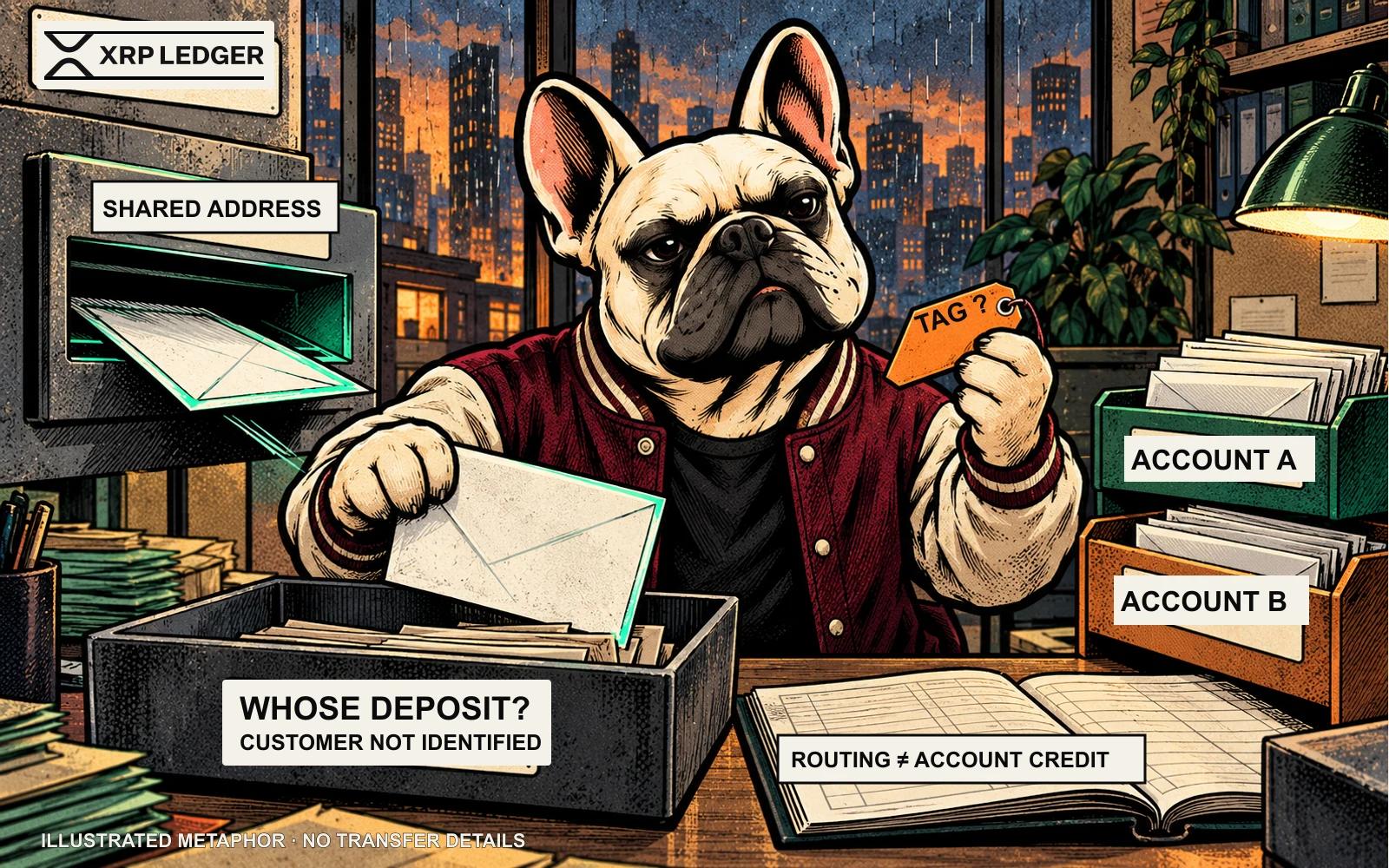
Your payment reached the right address, but your exchange balance has not moved. A missing crypto memo or destination tag is one possible cause: the exchange may lack the routing information it needs to credit your account.
This guide explains crypto memos and destination tags through XRP and a specific Kraken XLM example. It does not assume every wallet or network uses the same fields, and it is not a recommendation to use an exchange or send funds.
One receiving address can serve many customers
An exchange can receive payments for several customers at a shared blockchain address, while recording their individual balances in its own system. The receiving address identifies the onchain destination; an extra routing value can identify the intended customer.
The XRP Ledger documentation describes destination tags as information for off-ledger processing. A tag does not create a separate ledger account for each exchange customer. Its meaning comes from the receiving business's records.
Think of a building address and an internal delivery label. A parcel can reach the building without identifying its intended recipient. The analogy explains routing; it does not promise delivery or recovery.
Address, network, tag and transaction ID do different jobs
| Detail | What it identifies | What it does not establish |
|---|---|---|
| Asset and network | What is being sent and which ledger processes it | Whether a particular service accepts that route |
| Deposit address | The receiving blockchain account or destination | Which customer a shared address belongs to internally |
| Destination tag or memo | Routing information required by that deposit method | Asset identity, a network choice or proof of account credit |
| Transaction ID | The particular submitted transaction | A correct tag or a credited exchange balance |
These checks complement the network and token-identity checklist. A correct tag cannot repair a wrong network, and the correct network and address do not replace a required customer-routing value.
XRP: use the destination's tag, not a guess
Kraken's XRP instructions, updated August 8, 2025 and checked for this guide, say its XRP deposits use a shared address and a mandatory customer-specific destination tag. That is a Kraken deposit rule, not a claim that every XRP recipient requires one.
Use the current value shown in your own receiving instructions, not a number from a tutorial, another customer's screenshot or a previous payment to a different service. This article supplies no real deposit address or example tag.
Source and destination tags are also different fields. XRP Ledger documentation describes the source tag as information about the payment's origin and the destination tag as information for its recipient. Copying a source tag into a destination field is not a reliable way to identify your account.
A field can be present and still be wrong
The Require Destination Tag setting can make the XRP Ledger reject a payment that omits a tag. It cannot check whether the supplied value identifies the right customer in an exchange's database.
A syntactically accepted payment therefore does not prove the customer mapping is correct. Do not assume that a wallet accepting the field, or an explorer showing success, means the exchange has accepted the deposit for your account.
XLM: the muxed-address exception matters
Kraken's XLM deposit page, updated July 1, 2026, distinguishes two routes. Its supported muxed addresses begin with M and do not need a separate memo. For its non-muxed route, the page instructs customers to include their generated numerical memo.
Do not turn that into "XLM never needs a memo" or "all XLM transfers need one." The address format and the receiving service's supported method matter. If your sending platform cannot handle the address or required extra field, stop and check the official instructions rather than removing information to make the form submit.
This is Kraken's documented exception. It is not a compatibility test of every Stellar wallet, exchange or address format.
A short check before a deposit
Kraken's general deposit instructions, updated August 19, 2026, tell customers to select a supported network, copy any additional required information and read the individual asset's warnings. They also warn users to check that a QR-based XRP, XLM or STX transfer includes the tag or memo where required.
Use these questions before deciding whether the sending screen is complete:
- Does the receiving service support this exact asset over this network for your account?
- Are the address and any required routing value taken from the same current deposit instructions?
- Does the sending method preserve that value in the field the recipient requires, including when using a QR code?
- Have you checked the final transfer details, minimum deposit rules and other recipient conditions?
This is a reading checklist, not an instruction to submit a transaction. A required field that your software cannot represent is a reason to stop, not to invent a workaround.
Already sent it without the right tag or memo?
Keep the transaction ID, actual network, asset, destination, amount and the routing value that was included or omitted. Compare the sending record with the receiving service's deposit page, then use its official support route. Provide only the transaction details it requests through that verified channel.
Kraken's XRP and non-muxed XLM guidance warns that missing routing information can delay credit and may make a deposit unrecoverable. There is no universal recovery fee, response time or refund guarantee to infer from those pages. Do not send another payment to try to repair the first, or disclose recovery words to an unsolicited recovery service.
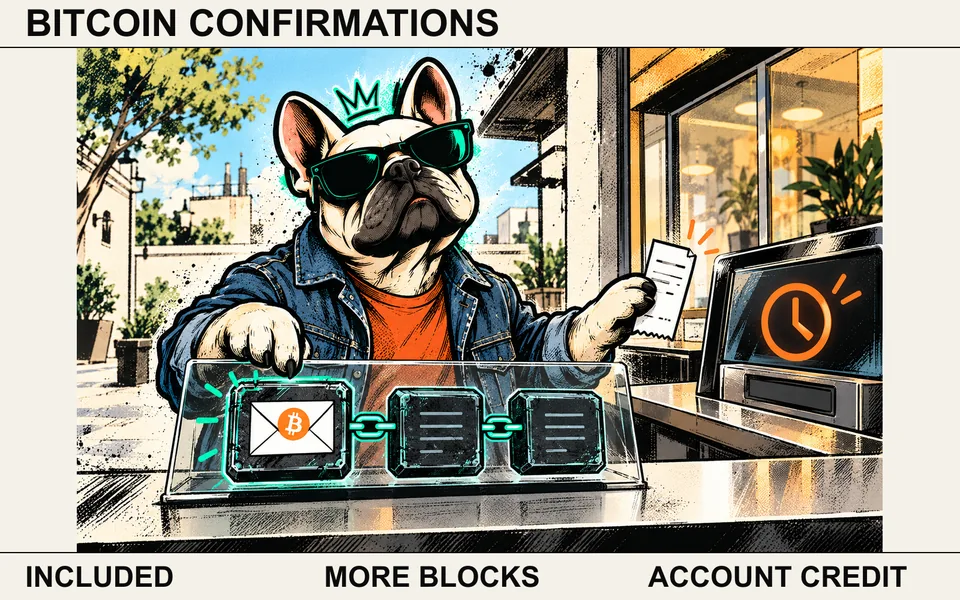
Reading a transaction record and checking account credit are separate investigations. Our Bitcoin confirmation guide explains that separation for Bitcoin; it does not supply XRP or Stellar confirmation rules. Recovery phrases and private keys explains why those secrets are not a customer-routing label.
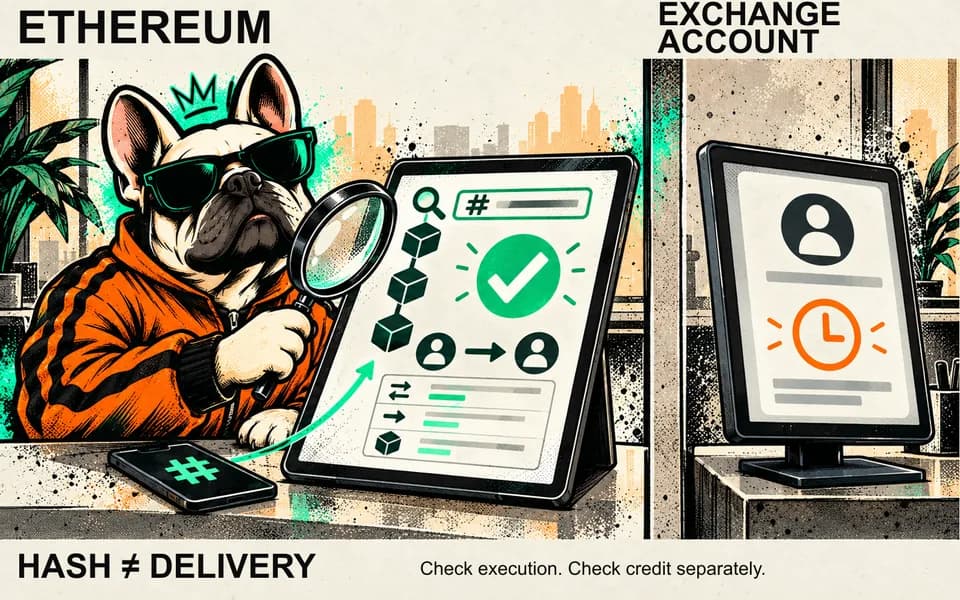
When checking a missing deposit, compare both the destination and the required customer-routing information. A successful payment and a credited exchange account are different things.
Sources
Primary documentation checked October 16, 2026. Provider rules are attributed to Kraken, not generalized to every wallet, product, region or network. This guide did not connect a wallet, submit a payment, contact support or test a recovery. Its diagram uses non-operational labels rather than real deposit addresses or tags.
- XRP Ledger: Source and destination tags, for shared destinations and off-ledger routing.
- Kraken: Destination tag for XRP deposits, updated August 8, 2025; required tag and missing-tag risks.
- XRP Ledger: Require destination tags, for the difference between field presence and customer-mapping validity.
- Kraken: Memo for Stellar Lumens deposits, updated July 1, 2026; muxed-address exception and non-muxed memo requirement.
- Kraken: How to deposit cryptocurrencies, updated August 19, 2026; network, extra-field and QR checks.
See something wrong? Brokzi logs material changes. Prepare a correction note.