
An Ethereum address appears in lowercase on one screen and with capital letters on another. That alone does not mean the destination changed. But a checksum warning deserves a closer look, rather than a quick edit to make the warning disappear.
Ethereum hexadecimal addresses represent 20 bytes. Changing only the case of a hexadecimal letter does not change those bytes. ERC-55 uses a particular pattern of uppercase and lowercase letters to add a checksum to the written address. That pattern can help detect typing mistakes; it does not establish who controls the address or which network you intended.
This explainer is for readers comparing address displays and trying to understand a warning. It describes the ordinary ERC-55 encoding, not the validation policy of a particular wallet, exchange or network-specific extension.
The address and its written form are different layers
An address's 20 bytes are normally written as 40 hexadecimal characters after 0x. Each character represents four bits. The letters a through f have the same hexadecimal values as A through F; decimal digits have no uppercase version.
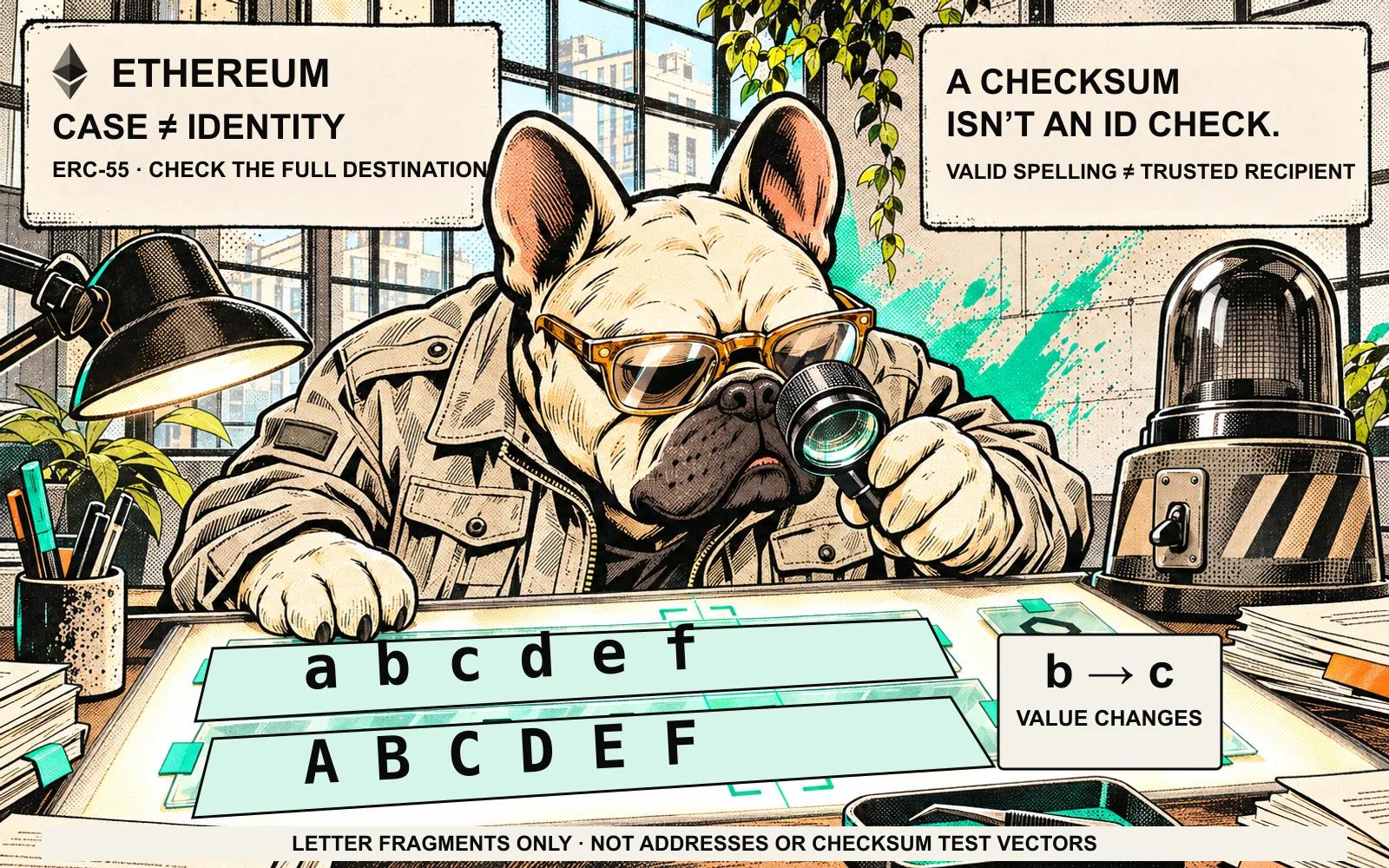
For a tiny illustration, the fragment ab and the fragment AB both encode the byte value 171. The fragment ac encodes 172 instead. These are two-character fragments, not complete addresses or valid checksum examples. The point is that a case change preserves a hexadecimal value, whereas changing a digit or changing one letter to another can change it.
That gives us two separate questions:
- Payload: do the full strings describe the same 20-byte value?
- Encoding: does the capitalization follow the checksum convention being checked?
An application can distinguish those questions internally. As a reader, do not turn that distinction into an instruction to strip capitalization from a destination and submit it anyway. Doing so can discard the very error signal you are investigating.
How the Ethereum address checksum uses capitalization
The ERC-55 specification describes the encoding. First, take the address's lowercase hexadecimal characters, without the 0x prefix. Hash that text representation with Keccak-256. This matters: the input is the lowercase hexadecimal text, rather than the underlying 20 raw address bytes.
At each address position containing a letter, inspect the corresponding hexadecimal character of the hash. A value of 8 or higher makes the address letter uppercase; a lower value leaves it lowercase. Positions containing decimal digits stay unchanged.
The result still has 40 address characters. Its letter case now carries check information. This is deterministic for a given address under this encoding; it is not a style choice, a password or an extra private key.
You do not need to calculate hashes by hand to understand a warning. The useful distinction is between an address's value and the check information carried by its spelling. This article does not run the specification's sample programs or recommend a new address-conversion service.
What changed between the two screens?
Imagine two saved address displays and an independently obtained reference for the intended recipient. These are hypothetical comparison cases, not observations of a real account.
| Observation | What it can mean | What remains to establish |
|---|---|---|
| Only uppercase and lowercase letters differ | The hexadecimal payload may be identical, while the written checksum information differs | The complete payload, the expected encoding and the source of each display |
One hexadecimal value differs, such as b becoming c | The payload differs at that position | Which complete address is intended; a plausible-looking string is insufficient |
| An ERC-55 check passes | The capitalization is consistent with this encoding | Recipient identity, intended network and whether the source itself is trustworthy |
| An app reports a checksum warning | Its validation found a problem under its rules | The actual rule and the original destination; the warning alone does not diagnose the cause |
Do not compare only the beginning and end. A shortened display can conceal a changed middle character. The address-poisoning explainer covers how a convincing look-alike can enter a transaction history or address-selection flow.
Is an all-lowercase address automatically wrong?
No. Capitalization alone is insufficient to make that judgement. ERC-55's own test cases include address strings whose checksum result is entirely lowercase and others whose letters are entirely uppercase.
That is different from taking an arbitrary mixed-case address and forcing every letter to lowercase. Many hexadecimal parsers can read lowercase input, but parsing a value and verifying a checksum are different operations. Wallets and services can impose their own input policies; this specification does not establish what an unnamed application accepts today.
A mixed-looking string is not necessarily a valid checksum, either. Randomly capitalizing a few letters does not create the correct encoding. The exact relationship to the hash matters.
A valid checksum is not a trusted recipient
Anyone can produce the correct ERC-55 representation of an address they control. A fraudulent destination can therefore have perfectly valid capitalization. The checksum does not authenticate a person, a project, a contract or the message that supplied the address.
It also does not identify a chain. Ordinary ERC-55 derives its case pattern from the address text, without a chain-ID input. The same written value does not prove equivalent accounts, assets, contract code or deposit support on two networks. Brokzi's network and contract-address guide explains why an asset needs more context than a familiar address or ticker.
Nor does the checksum tell you whether an address is a personal account or a contract, whether a contract accepts a particular asset, or whether a deposit requires an extra memo. Those are separate properties. A memo or destination tag can be required by a receiving service even when the address itself is correct.
The practical limit is straightforward: a checksum is useful error detection, not a safety certificate. This article makes no numerical claim about protection against deliberate address selection or fraud.
A reading checklist for a checksum warning
- Keep the original evidence. Preserve the complete destination and the warning's wording. A screenshot that truncates the address cannot support a full comparison.
- Identify the context. Record the network, asset, receiving service and where the address came from. A checksum cannot supply missing deposit instructions.
- Obtain an independent reference. Return to the intended recipient's established channel or the receiving service's own deposit instructions. A second copy from the same suspicious message is not independent confirmation.
- Separate value from spelling. Determine whether a full hexadecimal value differs or only letter case differs, and which checksum convention the application expects. Do not guess from the first and last characters.
- Leave unresolved discrepancies unresolved. Do not lowercase, recase or otherwise edit the destination merely to silence a warning. Establish the intended complete destination before proceeding elsewhere.
This is a comparison checklist, not a request to connect a wallet, sign a message or send a test payment. It requires no seed phrase or private key.
Sources and scope
The complete final ERC-55 specification, including its implementation discussion and test vectors, was checked on 22 November 2026. Created in January 2016, it is the primary source for the checksum convention described here. It is not a current product compatibility list or a measurement of live wallet behavior.
The short fragments and comparison table are educational examples. No real address was validated, no hash program was executed, and no wallet, RPC service or transfer was used. Network-specific checksum extensions and non-hexadecimal address formats are outside this article's scope. This is technical education, not financial advice.
- ERC-55: Mixed-case checksum address encoding — the encoding procedure, rationale, implementation examples and official test cases.
See something wrong? Brokzi logs material changes. Prepare a correction note.