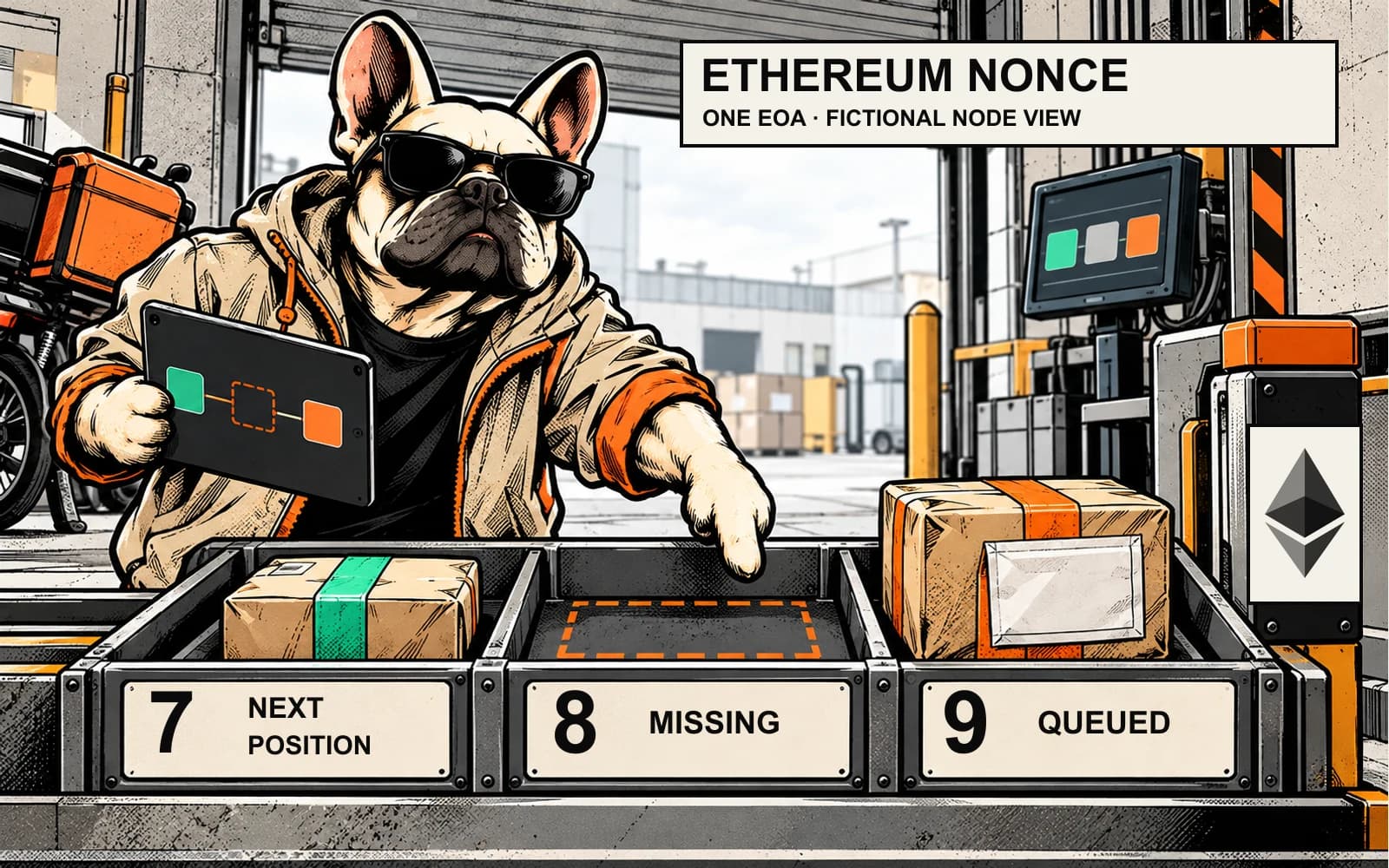
Transaction 9 is ready. Transaction 8 is nowhere in view. Ethereum does not let this account skip the missing position because the later request looks more urgent.
That is the useful starting point for an Ethereum nonce: an account-level ordering rule. This explainer is for readers trying to understand the numbers in transaction details, rather than looking for another Send button to press. For an already stuck payment, use our pending Ethereum transaction guide.
What an Ethereum transaction nonce identifies
Ethereum's transaction documentation lists the nonce as the sender's sequential counter, alongside the recipient, value and fee fields. It is not a global transaction number. Two different accounts can each send a transaction with nonce 7; they do not compete for one shared slot.
Keep the network with the account record. The same address on another chain has separate state. A transaction hash identifies the particular signed transaction; its nonce identifies a sequence position for its sender. Neither the hash nor the number proves the intended token transfer succeeded.
The example below concerns an ordinary externally owned account, or EOA, with no delegated code and no EIP-7702 authorization activity. That boundary matters: account delegation and smart-wallet operations complicate the shortcut that a nonce is simply a count of outgoing payments.
A nonce gap, one position at a time
Here is a fictional account, A. At the chosen chain state, its nonce is 7, so 7 is the next ordinary outgoing transaction position. A hypothetical node knows a valid transaction at 7 and another at 9, but none at 8. Assume sufficient funds, suitable fees and no other validity problem; the missing position is the only obstacle being illustrated.
| Observation in this fictional sequence | Account nonce in the chosen chain state | What comes next |
|---|---|---|
| Neither request has been included | 7 | Transaction 7 is the next candidate; 9 cannot skip ahead |
| Transaction 7 is included | 8 | Position 8 is now next; transaction 9 still cannot fill it |
| A valid transaction at 8 is included | 9 | Transaction 9 can now satisfy the nonce condition |
| Transaction 9 is included | 10 | The next ordinary outgoing position is 10 |
The values 7, 8, 9 and 10 are invented counters, not block numbers, fees or an observed wallet. The Ethereum execution specification's Prague implementation checks the sender's nonce against the transaction and increments the sender counter before execution. Meeting the nonce condition alone does not guarantee inclusion.
The missing 8 need not have been broadcast anywhere. It might exist only as a locally prepared request, or this node might not know it. A gap in one observation is not evidence that a transaction was stolen. It explains why counting the requests currently visible on a screen is a poor way to infer the next usable position.
Why latest and pending can disagree
The JSON-RPC reference documents eth_getTransactionCount, which takes an address and a block-state selector. latest asks about the latest block state; pending asks about pending state. They answer different questions. latest is not another spelling of finalized.
In our invented example, a node that can apply transaction 7 to its pending state could report 8 there while the latest block state still reports 7. The later transaction at 9 does not turn that gap into a completed sequence through 9. These are illustrative state values, not captured RPC responses or promised behavior from every provider.
The reference represents numerical RPC quantities in hexadecimal. A displayed 0x8 is decimal 8, while 0xa is decimal 10. Do not read the latter as ten pending transactions. It is a counter value, and it needs its address, chain, state selector and observation time.
Geth's txpool documentation distinguishes pending and queued groups, organized by sender and nonce. Those are a particular client's pool observations. They are not one network-wide waiting list or a guarantee that a retained transaction will enter a block. An explorer and a wallet can also observe different nodes or different moments.
Two requests at nonce 8 are alternatives
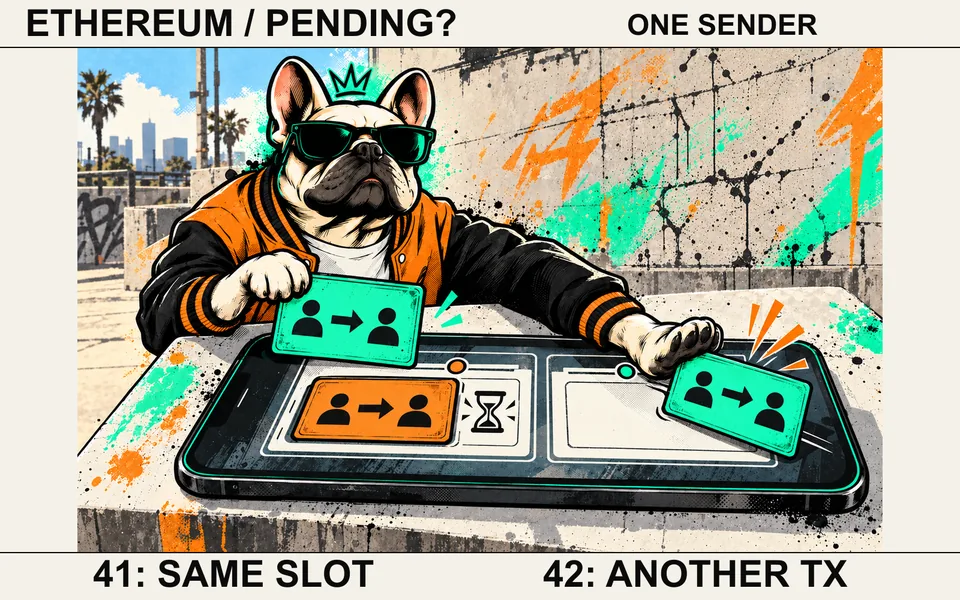
Suppose account A has signed two different ordinary transactions at nonce 8. They may have different recipients, actions, fee settings and hashes. They are not two consecutive transactions. They are alternatives for the same sender position in a given chain history.
Geth explicitly notes that its pool inspection can show multiple transactions associated with the same account and nonce. What a node accepts as a replacement depends on its policy and the transaction's conditions. Do not infer a universal fee-bump percentage from the existence of a second hash.
By contrast, signing one request at 8 and another at 9 creates different sequence positions. If both eventually execute, the later action does not erase the earlier one. Our pending-transaction guide covers replacement diagnosis; this article does not recommend changing a nonce or submitting a cancellation.
A larger gas limit also does not rename a transaction's position. Sequence and execution-fee constraints remain separate.
Permit nonces belong to a different record
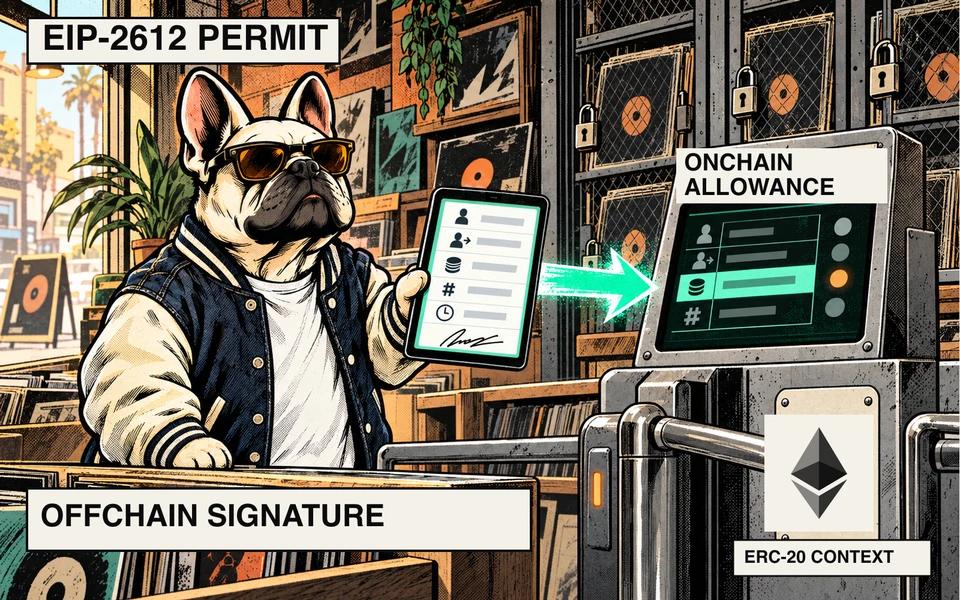
In ERC-2612, the token contract's nonces(owner) participates in validating a signed permit. An accepted permit changes an allowance and increments that token's owner counter. Signing alone does not perform that onchain update.
The permit's nonce is not automatically the owner's Ethereum transaction nonce. Another address can submit the permit, so the transaction sender and the token owner need not even be the same account. Changing an account transaction number does not, by itself, prove a particular outstanding permit unusable.
The permit explainer covers that signature's domain, deadline and allowance effects. Keep its replay-protection record separate from this article's outgoing transaction sequence.
Delegation and smart wallets need their own rules
EIP-7702 allows EOAs to delegate execution to code. Its authorization processing checks the authorizing account's nonce and increments it for a valid authorization. That can happen inside a transaction sent by another account. Delegated execution can introduce further nonce changes, so an account's nonce is not a reliable lifetime count of successful outward payments.
A smart wallet can also maintain application-level operation counters. Do not apply the simple 7-to-10 example to every field labelled nonce in an account-abstraction interface. Identify whether you are reading the outer transaction, an authorization or the wallet's own operation scheme. Our smart-contract wallet explainer separates the account, signer and execution layers.
A useful record before troubleshooting
Keep these details together when comparing a wallet with an explorer:
- The exact chain, sender address and transaction hash.
- The transaction's nonce, plus any different hash using that same sender position.
- The account-state observation, including whether it is latest, pending or finalized and when it was read.
- Any unresolved earlier position, while leaving unknown transactions unknown.
- Whether the account uses delegation or a wallet-specific operation counter.
You can inspect public records without sharing recovery words or signing a rescue request. If the observations disagree, establish what each service is showing before sending anything else.
An Ethereum nonce orders one account's ordinary outgoing transactions. It does not order the entire network, reserve block space or certify a successful payment. Find the right counter before trying to fix the queue.
Sources
Primary documentation checked October 21, 2026. The account, table, pending-state values and cover are fictional teaching examples. No wallet connection, signing, cancellation, replacement, RPC call or transaction was performed. This is a protocol explanation, not a client test, recovery procedure or investment recommendation.
- Ethereum.org: Transactions: sender nonce and transaction fields.
- Ethereum.org: JSON-RPC API: account-state queries, block selectors and hexadecimal quantities.
- Geth: txpool namespace: client-specific pending/queued groups and same-nonce alternatives; documentation last edited August 16, 2023, checked again for this guide.
- Ethereum execution specifications: Prague fork: sender-nonce validation and increment; a named specification version, not a full specification of all later forks or client pool policies.
- EIP-7702: authorization processing and delegated-account boundaries.
- ERC-2612: token-owner permit counter, accepted permit effects and caller independence.
See something wrong? Brokzi logs material changes. Prepare a correction note.