
“Access list” sounds like a list of who is allowed in. In an Ethereum transaction, the name points to a different job: gas accounting for declared accounts and storage keys.
An Ethereum access list predeclares items for warm-access accounting. It does not grant a spender permission, restrict execution to those items or prove they were actually used. Its upfront gas charge also does not guarantee a cheaper final transaction. This explainer is for readers interpreting transaction details, without connecting a wallet or preparing a real transaction.
What an Ethereum access list declares
EIP-2930 introduced transaction type 1 with an accessList field. Each entry contains an account address and a list of storage keys for that account. An entry may contain no storage keys. The specification defines the account as 20 bytes and each key as 32 bytes.
A storage key identifies a location in a particular account's storage. It is not the value stored there, a private key or a permission to spend the account's funds. The same key label under two different accounts describes two different account-and-key pairs. Establishing what a real slot means would require the relevant implementation and state; this article does neither.
The list gives gas accounting information in advance. It is not necessarily a complete prediction of execution. EIP-2930 expressly allows accesses outside the list.
Type 1 is the feature's origin, not the only transaction family that can carry such a list. The named Osaka transaction model also includes access lists in fee-market, blob and set-code transaction records. Those records have other fields and rules; an access-list badge cannot explain the entire request.
Declared, warm and actually used are three different views
EIP-2929 defines logical sets of accessed accounts and account/storage-key pairs. These sets support different gas treatment for cold and warm accesses in the transaction context. An access list supplies items to that accounting before the main execution.
Keep three records separate:
| Record | What it describes | What it does not establish |
|---|---|---|
| Serialized access list | The entries supplied in the transaction | Every item the transaction will use, or that a listed item will be used |
| Initial warm sets | Items initially treated as warm under the applicable rules | A complete execution trace or a spending permission |
| Actual execution accesses | What the executed path accesses, with its scope and state context | That those items all appeared in the supplied list |
There can be extra declarations, and execution can access unlisted items. Fork rules also supply warming outside the transaction's own list. For example, the Osaka processing reference adds the block's fee-recipient account to its initial set separately from the supplied entries.
“Warm” is a logical gas-accounting category. It is not evidence that a particular computer physically cached the data, that a wallet approved an address, or that a storage value has been checked. EIP-2929 also defines scope rollback for accesses added during reverted execution. Do not treat every item ever encountered in a failed inner call as a permanent addition to a simple global trace.
The list is not an allowlist of spenders
Putting an account in an access list does not perform an ERC-20 approval. Leaving an account out does not prohibit a call to it. The list's specified effect concerns access accounting, while an application's authorization rules decide what an execution may do.
That distinction does not make the whole transaction safe to sign. EIP-2930's signed payload includes the access list alongside fields such as destination, value and data. Those other fields can describe consequential actions. Calling something “just an access-list transaction” is not a substitute for understanding the complete request.
Use the connection, signing and approval comparison for those permission layers. An ERC-4337 operation and an EIP-7702 authorization are also separate mechanisms. Do not import their rules into this field, or read gas prewarming as a grant or removal of account authority.
Duplicate entries are charged before sets deduplicate
Under EIP-2930's original accounting, the access-list component is 2,400 gas per account occurrence plus 1,900 gas per storage-key occurrence. The checked Osaka constants use the same values. These are gas units for this component, not ETH prices or a complete transaction bill.
The charging loop counts serialized entries. The logical sets used for warming, however, contain unique accounts and unique account/key pairs. Duplicate declarations are allowed, but do not create extra unique warm items.
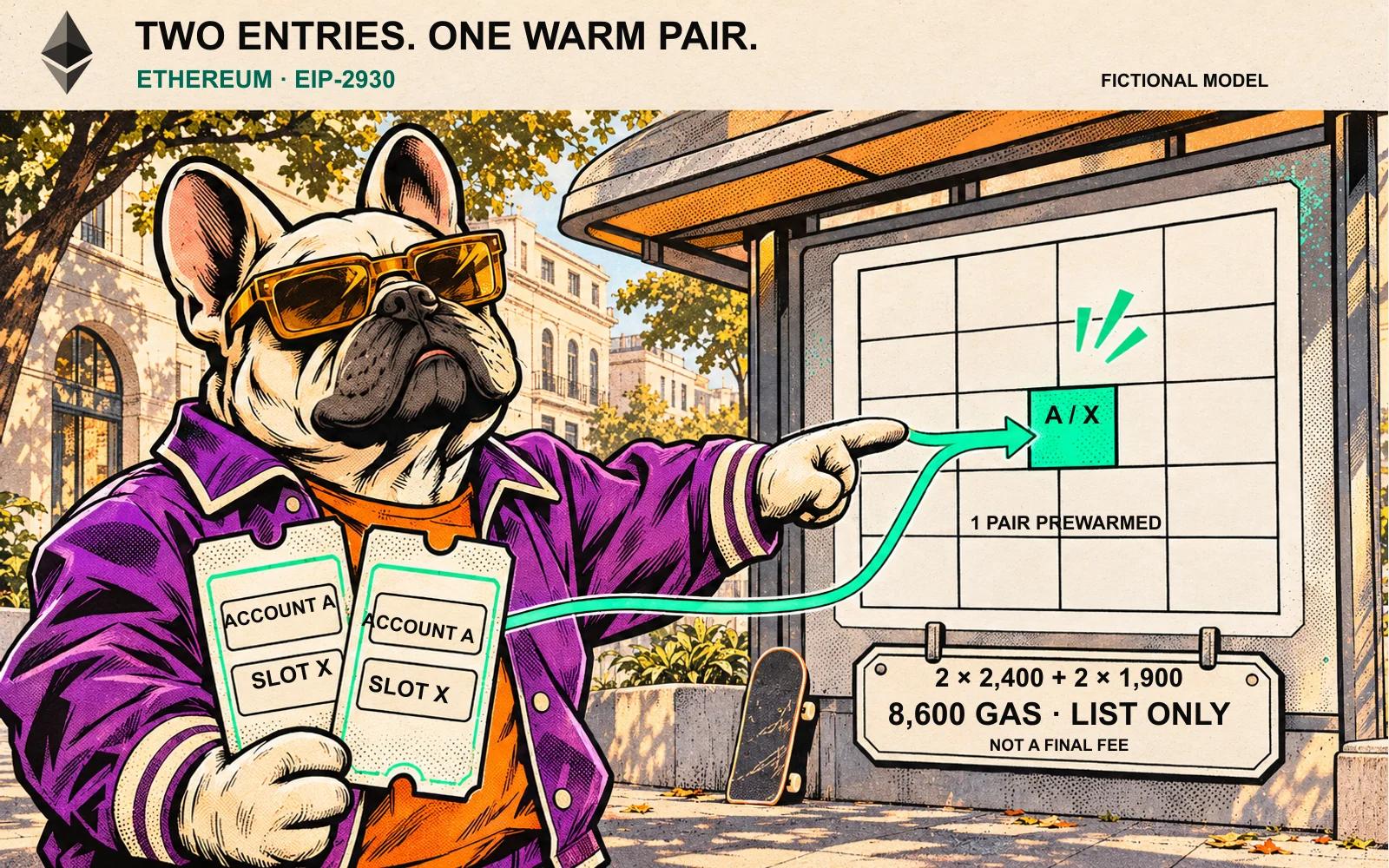
Here is an abstract teaching record. ACCOUNT A and SLOT X are deliberately invalid labels, not addresses, hexadecimal keys or a transaction payload.
| Serialized entry | Account label | Storage-key labels |
|---|---|---|
| First entry | ACCOUNT A | SLOT X |
| Second entry | ACCOUNT A | SLOT X |
There are two account occurrences and two storage-key occurrences. The list component is therefore:
2 × 2,400 + 2 × 1,900 = 4,800 + 3,800 = 8,600 gas.
The supplied list contributes only one unique account and one unique account/key pair to warming. Deduplicating the accounting sets does not retroactively remove the repeated entry charges.
Nothing in this record tells us whether execution actually touches SLOT X. Its list charge does not wait for a later opcode to use it. Nor have we defined calldata, an execution path, a gas price or any remaining transaction fields, so 8,600 gas is not a final fee estimate.
This example is a reading exercise. It is not advice to edit, construct or sign a transaction, and no account or storage was queried.
Why prewarming does not promise a lower final fee
A warm access component can be cheaper than a cold one under the specified rules. But the access list has its own upfront cost. Unneeded entries can add intrinsic cost without supplying a useful new warm item. Items already warm for another reason need separate consideration too.
Even the familiar 100-gas warm-access figure is not the total price of every opcode. EIP-2929 has opcode-specific rules; calls can have other costs, and storage writes have their own accounting. A complete calculation cannot replace all that with “each listed thing costs 100.”
The final charge has further layers. EIP-7623 introduces a calldata-dependent floor. In the checked Osaka model:
calculate_intrinsic_costkeeps regular intrinsic cost, including list entries, separate from the calldata floor.- Validation requires the transaction's gas allowance to cover the larger of those two amounts.
- Transaction settlement compares accounted gas after refunds with the calldata floor.
These are features of that named reference model, not a claim that we measured today's mainnet or every EVM chain. They explain why an isolated access-cost difference cannot establish an all-in saving. Execution, refunds, applicable floor rules and the paid unit price still matter.
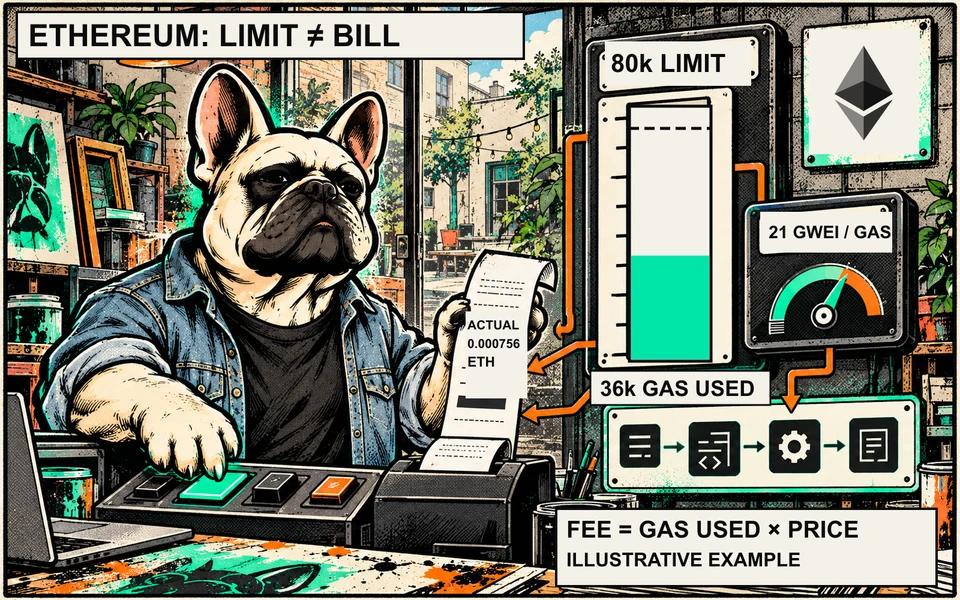
Our gas limit versus gas price explainer owns the receipt-reading task. The list component is neither the transaction gas limit nor the price per gas. This article does not produce a counterfactual fee quote or recommend an “optimised” list.
Which rules do these numbers belong to?
The 2,400/1,900 entry charges come from the original EIP-2930 model introduced with the Berlin-era changes. EIP-2930 and EIP-2929 both specify fork block 12,244,000. The Osaka execution-specification pages captured on 20 November 2026 provide a separately named reference that retains those component constants and includes later accounting such as the calldata floor.
We have not established which fork a live network was running, pinned the documentation build to a repository commit, or tested any client. Do not turn this reference into a universal current invoice for Ethereum, another EVM network, a Layer 2 or a wallet service.
Also distinguish this transaction-level field from block-level access lists mentioned in dated Glamsterdam upgrade reporting. A similar name does not make a block-production mechanism the same record as a sender's EIP-2930-style list. This article makes no new Glamsterdam activation claim.
A read-only access-list checklist
When reading transaction details, keep these questions together:
- Which record is this? Identify the network, transaction family and applicable fork context. A generic “access” label is not enough.
- What was declared? Read each account with its associated storage keys. Count occurrences separately from unique pairs if checking the entry component.
- What actually happened? A list alone does not supply an execution trace. Leave actual usage unknown when no suitable execution evidence is available.
- What was authorised? Read the complete payload and the application's rules separately. Inclusion in the list is not an approval; omission is not a ban.
- What was charged? Separate the list component from final accounted gas, the paid unit price and any additional network or service charges.
An access list is useful information about declared warming and prepayment. Read it as that record, rather than asking it to certify permission, execution or a cheaper bill. No wallet connection, signature or recovery material is needed to understand these distinctions.
Sources and scope
Complete official documents checked on 20 November 2026. EIP-2930 and EIP-2929 are Final Core EIPs created on 29 August and 1 September 2020; EIP-7623 is a Final Core EIP created on 13 February 2024. These are specification creation dates, not new event or activation dates.
The execution references are the published Osaka modules captured on the check date. Their release version, source commit and documentation build date were not established. No claim is made that this is the currently active mainnet fork. For the named Osaka settlement, the explicit implementation and EIP-7623's printed maximum formula are used; an ambiguous prose sentence about below-floor gas usage is not treated as an operating rule.
The labels, arithmetic and comic are fictional teaching material. No wallet, real address, storage value, RPC, signature, transaction, simulation, fee estimate or funds test was used. This is a documentation-based explanation, not signing instructions, an application audit or financial advice.
- EIP-2930: Optional access lists — transaction format, entry charges, duplicates, unlisted access and signing scope.
- EIP-2929: Gas cost increases for state access opcodes — logical access sets, cold/warm accounting and scope rules.
- EIP-7623: Increase calldata cost — calldata floor and its distinction from an access-list component.
- Execution specifications: Osaka transactions — transaction families, list representation, intrinsic cost and validation.
- Execution specifications: Osaka transaction processing — list initialization, fee checks and final settlement.
- Execution specifications: Osaka gas constants — component constants and other gas-cost categories.
See something wrong? Brokzi logs material changes. Prepare a correction note.