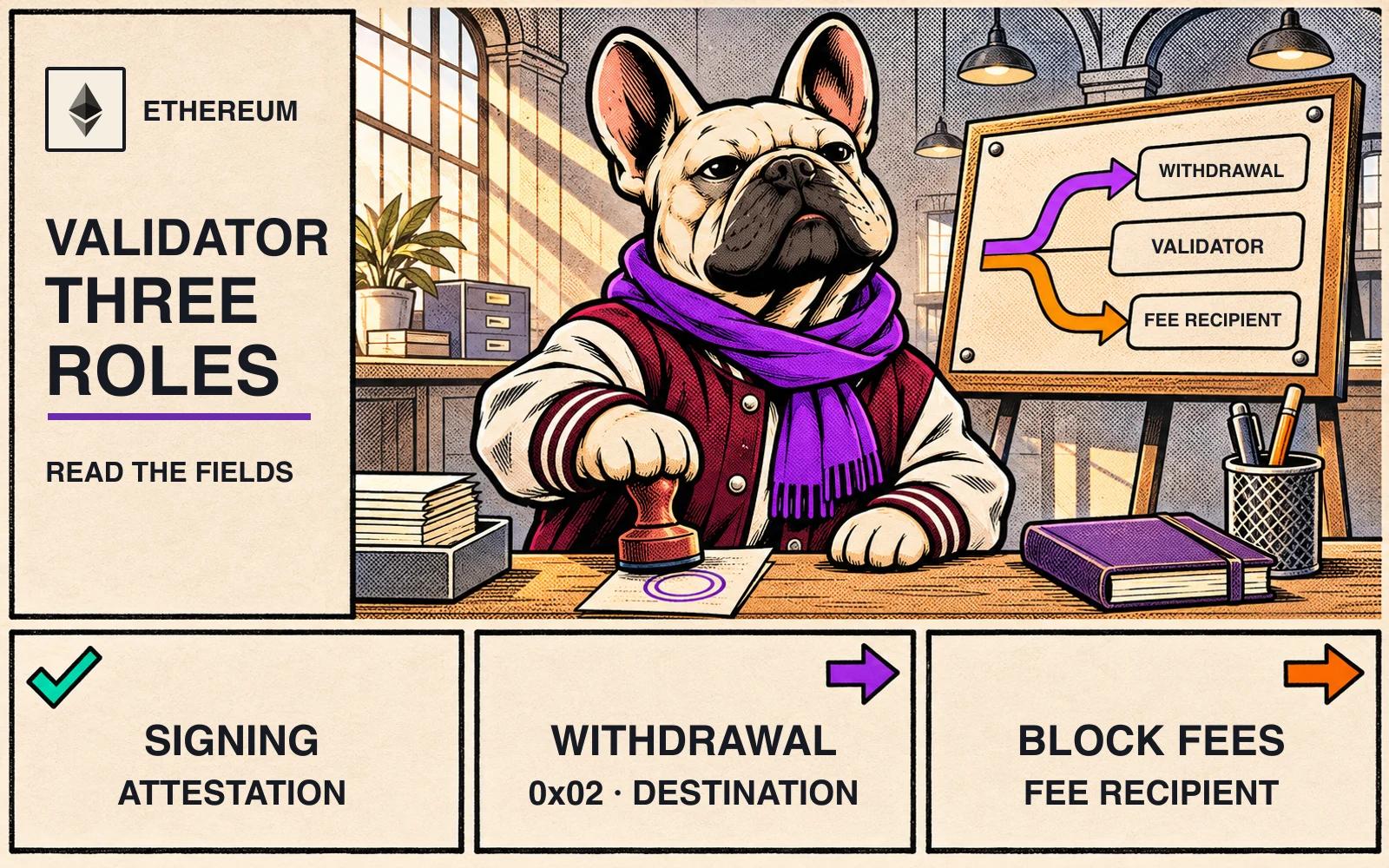
An Ethereum validator can sign an attestation while its staking withdrawals are directed to a separate account. To read a validator record, check three things: the validator’s public signing identity, its withdrawal credential type and destination, and the fee recipient for any block you’re looking at. Each belongs to a different part of the record.
What does the validator signing key do?
Ethereum uses a validator’s public signing key to identify the validator and verify its signatures. The signing key authorises consensus duties such as proposing a block and attesting, which is voting on the chain. The Ethereum proof-of-stake keys guide and the consensus validator specification describe that signing role separately from the withdrawal credential.
A signed attestation is evidence about a consensus duty. To identify a withdrawal destination, read the validator’s withdrawal credentials.
What the 0x00, 0x01 and 0x02 prefixes tell you
A validator’s withdrawal credential is a 32-byte field. Its first byte identifies the credential type. The table shows what the Ethereum withdrawal credentials guide and the Electra consensus specification say about the documented types.
| Prefix | Credential type | What you can read from it |
|---|---|---|
0x00 | Legacy BLS withdrawal credential | No execution-layer withdrawal address is set in the credential. |
0x01 | Execution-address withdrawal credential | The credential includes an execution-layer withdrawal destination and uses the non-compounding type. |
0x02 | Compounding withdrawal credential | The credential includes an execution-layer withdrawal destination and uses compounding rules. |
The prefix identifies the credential type. For 0x01 or 0x02, the full credential specifies the destination. The prefix alone leaves the amount and timing of a future withdrawal open.
One fictional validator, three fields
Imagine DEMO-VALIDATOR attested in one slot and proposed a block in another. The validator record shows a 0x02 credential pointing to DEMO-WITHDRAWAL. The proposed block’s execution payload records DEMO-FEE-RECIPIENT. Every name here is a label, with no real key, address or block behind it.
The attestation uses the validator’s signing identity. The withdrawal credential identifies the compounding type and its destination. The block’s fee_recipient is a separate execution field identifying the recipient of that block’s transaction tips. Ethereum burns the base fee. See the Ethereum block structure reference and Ethereum’s gas and fee reference.
Start with the record that answers your question. Read the attestation alongside the validator’s public identity for duties, the full withdrawal credential for the designated staking withdrawal destination, and the execution payload for the block fee recipient. The staking penalties explainer covers what different signing outcomes can mean for a validator. The liquid staking explainer covers a separate question about redeeming a token.
Sources
See something wrong? Brokzi logs material changes. Prepare a correction note.