

The balance may still be tied to the same ETH. The list of conditions attached to it gets longer.
This explainer follows EigenLayer on Ethereum mainnet, using its published core-contract documentation pinned to v1.13.0. The repository's deployment table lists that protocol version for Ethereum mainnet; we have not independently verified every deployed implementation against the table. Other networks, vaults and restaking providers can have different rules.
The question is what the position commits to, who can enforce those commitments and what must happen before the holder can exit. This is not a recommendation to deposit or delegate.
Restaking adds another enforcement layer
Ethereum staking concerns validators participating in Ethereum consensus. Ordinary penalties and consensus slashing remain part of that underlying exposure. Our slashing-versus-downtime explanation separates those mechanisms.
EigenLayer adds another system. Its protocol overview and deployment registry distinguish restakers, operators and Autonomous Verifiable Services (AVSs). Operators run service software; assets delegated to them can support additional security commitments. An AVS is a service built on this arrangement, not another name for Ethereum consensus.
A service's rewards are not a second Ethereum protocol reward guaranteed to every holder. Availability, distribution rules, costs and exposure need their own assessment. Adding an enforcement layer does not turn the underlying stake into a risk-free savings balance.
Native ETH and liquid tokens enter differently
The native route links validator balances and withdrawal credentials to an EigenPod, a contract associated with a pod owner. EigenPod documentation explains how proofs account for ETH on the beacon chain and in the pod. Those accounting shares are not a second asset that can be withdrawn independently of the ETH behind them.
The liquid-token route deposits supported ERC-20 tokens into strategies through the StrategyManager. Its documentation distinguishes deposit shares from the underlying tokens. A liquid staking token also retains the dependencies of its original issuer or staking protocol.
| Route | What EigenLayer accounts for | What an exit still needs |
|---|---|---|
| Native restaking | Proved validator/pod ETH and associated shares | Applicable beacon-chain steps, pod accounting and EigenLayer withdrawal conditions |
| Liquid-token restaking | Tokens held in a strategy and its share accounting | EigenLayer withdrawal completion and the strategy's token conversion |
| Later exit from an LST itself | The original token protocol's claim or market sale | That separate protocol's rules or the available market price |
Withdrawing an LST from EigenLayer does not automatically redeem it for ETH. Selling a liquid token is another transaction with another counterparty or pool. Our liquid staking guide explains why transferability, wrapper conversion and redemption are different observations.
Delegation is not the end of the risk map
The DelegationManager documentation describes delegation of a staker's available position to an operator. In this core route, delegation is all-or-nothing and a staker is delegated to one operator at a time. That operator may participate in several service arrangements.
The AllocationManager tracks allocations to an Operator Set, identified by a service address and a set ID. A set groups operators around particular tasks and reward/slashing rules. The operator's registration, strategy and active allocation affect what is slashable. Pending deallocation and deregistration do not necessarily end exposure immediately.
The allocation documentation calls the allocated capacity Unique Stake. Its magnitude accounting caps what can be allocated across sets for a strategy. This is not a promise that each service gets a separate copy of all the assets, or that the holder is insulated from every other risk.
To picture the distinction, imagine an operator dividing a fictional 100 units of allocatable capacity: 20 to Set A, 30 to Set B and 50 unallocated. The allocations sum to 100, not 200. This simple partition illustrates the capacity limit, not a live balance, an exact payout model or a claim that the unallocated portion has no underlying asset risk. Actual withdrawable amounts use the protocol's share-scaling and slashing calculations.
Who decides whether a service commitment was broken?
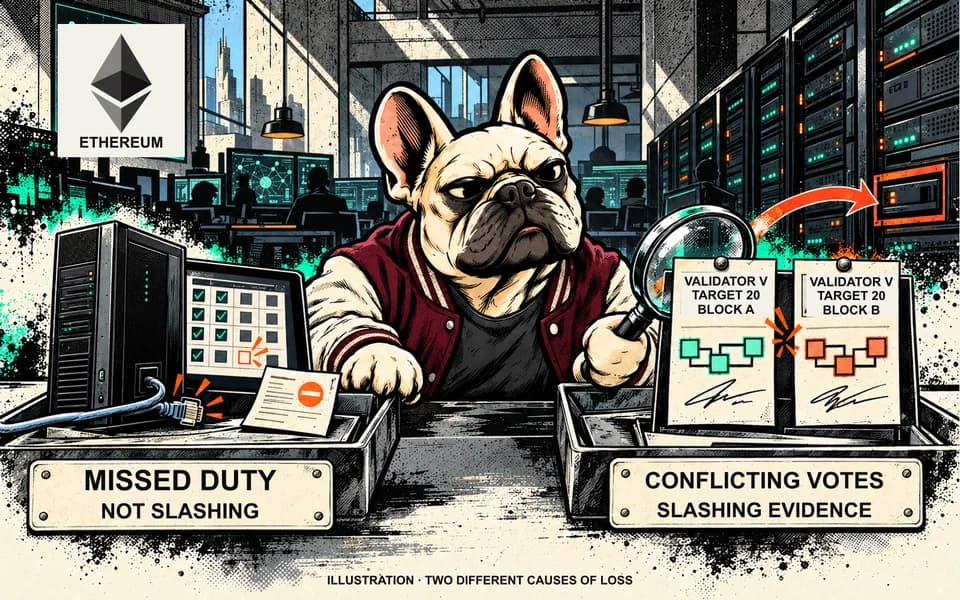
Ethereum consensus specifies particular conflicting-signature offences. An additional service can define different commitments and a different slashing process. The AllocationManager enforces authorization, allocation and other eligibility checks; it does not independently adjudicate every offchain service failure.
Read the service's actual slashing conditions, the authorized slasher and relevant governance controls. Do not assume the only possible trigger is an Ethereum double vote, or that every allegation requires the same onchain proof as a consensus slashing. A reputable operator's name does not substitute for those terms.
Contracts add dependencies too: permissions, upgrades and pause controls can affect the position. A proxy's upgrade authority is a separate question from how often a service completes its tasks.
Queued does not mean paid or protected
In the pinned DelegationManager documentation, queueing a withdrawal records a claim that must later be completed. The queued shares can still be affected by applicable slashing during the withdrawal period. Completion can return tokens or accounting shares, depending on the route; receiving shares is not the same as receiving spendable ETH.
For native ETH, the pod must also have sufficient withdrawable execution-layer ETH to honor a token withdrawal. Beacon-chain exit and withdrawal processing, proofs, protocol delays and pause status are distinct dependencies. There is no single withdrawal date supplied by this explainer.
Another clock appears in the v1.13.0 release notes: a 50,400-block slash-resolution delay before newly recorded burnable or redistributable slashed shares can be cleared. At an assumed 12 seconds per block, that is 50,400 × 12 = 604,800 seconds, or approximately 7 days. The release also describes a dedicated pause control and an exception for pre-upgrade slashes.
That is a slashing-settlement delay, not a universal withdrawal wait, refund promise or guaranteed appeal period. Block counts and illustrative wall-clock estimates do not establish when a particular holder will receive assets.
A read-first restaking checklist
Before interpreting a restaking screen as "the same stake earning twice," identify:
- The network, asset and exact route: native validator ETH, an LST strategy or another wrapper/vault.
- The operator, service and Operator Set, with the strategy and active or pending allocation.
- The commitment being enforced, the authorized slasher and any additional governance assumptions.
- Whether the displayed amount is deposited, delegated, slashable, queued or actually withdrawable, with its observation time.
- What the exit delivers: shares, an LST or native ETH, and which further steps remain.
Check the token's actual identity and network rather than inferring the route from its symbol. A separate liquid restaking token or vault can add an issuer, redemption queue and market-price risk beyond this core EigenLayer example. This article does not assess one such product or estimate an APR.
Brokzi's Take
Restaking can make collateral support additional services. It also makes the operator's choices, service terms and exit accounting relevant to the holder. Read those commitments before comparing the advertised rewards. An extra line of yield is not evidence that the collateral has become two independently recoverable assets.
Sources
Primary documentation checked October 25, 2026. EigenLayer sources are the protocol publisher's documentation, not an independent audit. Contract references are pinned to v1.13.0; release notes distinguish new behavior from older entries. The deployment table is attributed, not independently confirmed by an RPC or bytecode comparison. No wallet connection, deposit, delegation, proof submission or withdrawal was performed. The capacity example, timing conversion and cover are illustrative, not a measured position or completion forecast. Education, not financial advice.
- Ethereum.org: Staking: base consensus participation versus additional middleware and restaking exposure.
- EigenLayer v1.13.0: Overview and deployment registry: named protocol roles, environment boundaries and published deployment versions.
- EigenLayer v1.13.0: DelegationManager: delegation, share scaling, queued withdrawals, completion and loss exposure.
- EigenLayer v1.13.0: AllocationManager: Operator Sets, allocation magnitude limits, eligibility and slashing.
- EigenLayer v1.13.0: EigenPod: native-validator withdrawal credentials, balances, proofs and accounting.
- EigenLayer v1.13.0: StrategyManager: liquid-token strategy deposits, shares and withdrawal processing.
- EigenLayer v1.13.0 release notes: slash-resolution delay, pause control and pre-upgrade exception; not an exit-time guarantee.
See something wrong? Brokzi logs material changes. Prepare a correction note.