
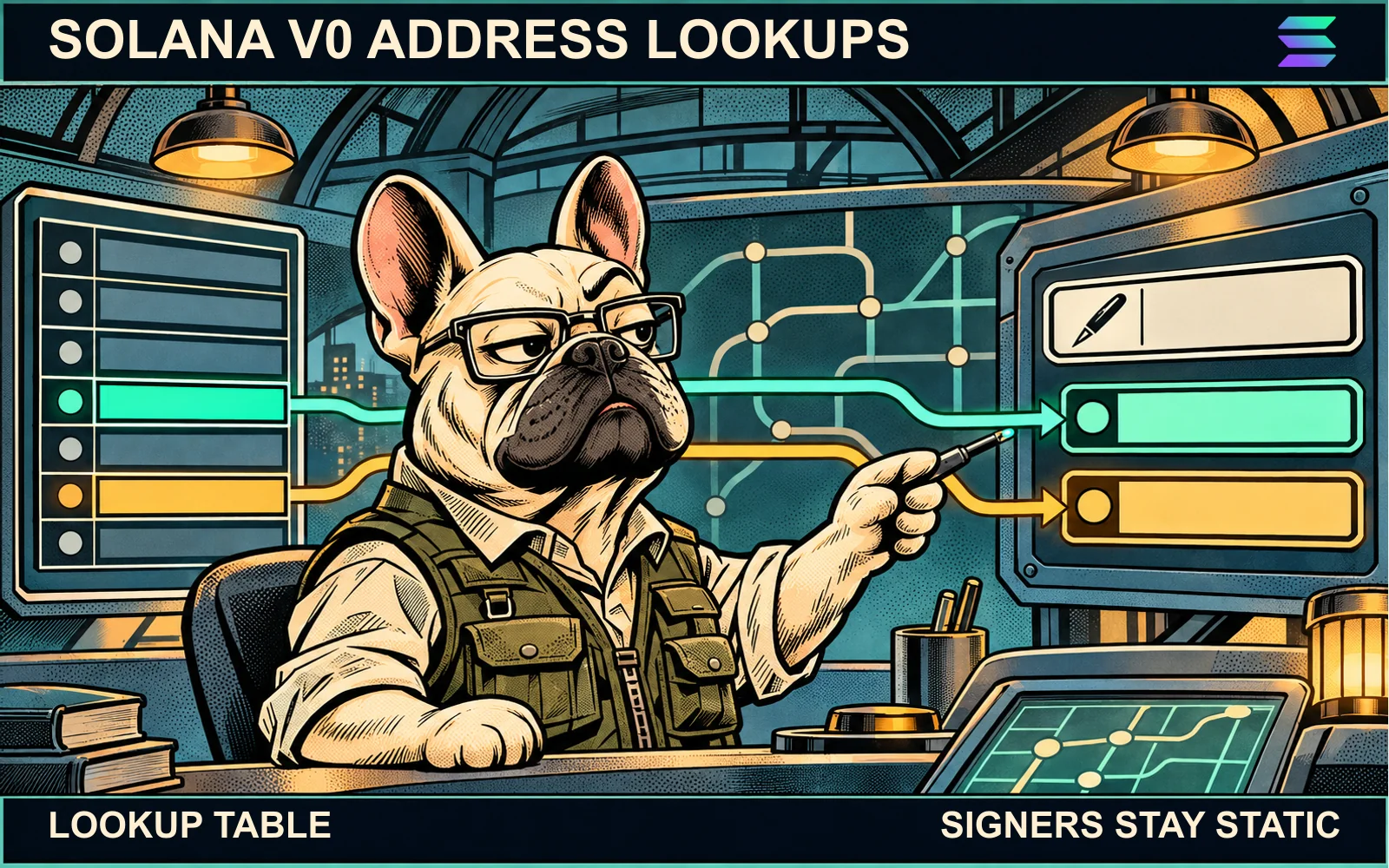
A Solana explorer can show an account that never appears as a full public key in the raw v0 message. The message points to a table entry, and Solana resolves that entry to an address before the transaction executes.
What does the v0 message actually store?
The message has static account keys and can also contain address table lookups. A lookup identifies an on-chain table and gives separate lists of indexes for writable and read-only accounts. Those indexes refer to positions in that table. A one-byte index takes less space in the message than a full 32-byte public key. Solana's versioned transaction documentation describes this layout for v0. The newer v1 format stores its account addresses inline.
How do the indexes turn into account keys?
Imagine a record with the static list DEMO-PAYER, DEMO-PROGRAM. The header says one signature is required. The message references DEMO-TABLE, with writable index 4 and read-only index 1. All names in this example are placeholders.
| Where the key comes from | Resolved key | Role in this example |
|---|---|---|
| Static key 0 | DEMO-PAYER | Writable signer and fee payer |
| Static key 1 | DEMO-PROGRAM | Read-only non-signer |
| Table entry 4 | DEMO-BALANCE | Writable non-signer |
| Table entry 1 | DEMO-SETTINGS | Read-only non-signer |
The resolved list follows the order in the table above. The static keys come first, followed by the writable keys loaded from lookup tables, then the loaded read-only keys. An instruction index into that full list uses a different numbering system. In this example, table entry 4 becomes key 2 in the combined list. If an instruction refers to key 2, it points to DEMO-BALANCE.
Where do you check the signers?
In a raw record, read numRequiredSignatures in the message header. The first that many static keys correspond to the transaction’s signatures, in order. Here the signer is DEMO-PAYER. A writable account loaded from a table remains a non-signer. Writable means an instruction can potentially change the account, subject to the runtime and program’s rules. It does not show that a change occurred. Solana's transaction structure documentation explains the header and key ordering.
When raw RPC status metadata includes loadedAddresses, its writable and read-only arrays show the resolved keys. In a parsed record, the account list can instead label where each key came from and whether it was a signer. Check the record’s version before interpreting either view. Solana's RPC JSON reference documents both forms. For the difference between an account address and what the account stores, see Solana token accounts.
Sources
See something wrong? Brokzi logs material changes. Prepare a correction note.